








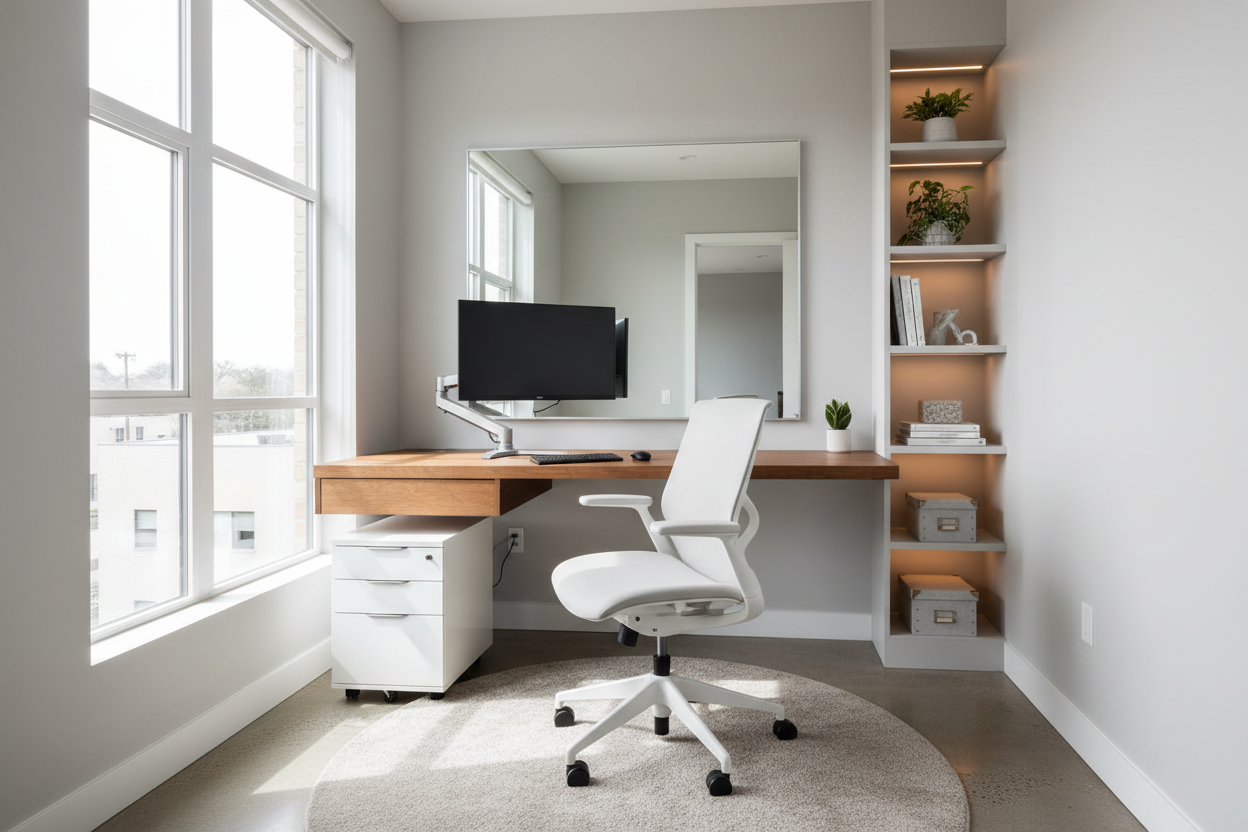
One of the most frequent grievances I hear from clients isn't about the color of their walls or the style of their rug—it is about the collision of furniture. You purchase a desk that technically fits the wall, only to realize you cannot push your chair back without hitting a bookshelf. Understanding the correct dimensions of a small home office is less about fitting pieces into a puzzle and more about orchestrating the negative space known as 'circulation paths.'
When square footage is at a premium, every inch counts. However, simply cramming furniture into a room results in a claustrophobic environment that kills creativity. In this guide, we will move beyond basic measurements and discuss how to balance ergonomic standards with visual weight to create a workspace that feels intentional, not accidental.
Quick Decision Guide: Critical Measurements
If you are currently holding a tape measure and need immediate numbers, here are the non-negotiable standards for a functional workspace.
- Minimum Home Office Size (Room): Ideally 50–70 sq. ft. for a dedicated enclosed space; 30 sq. ft. for a functional nook.
- Standard Desk Depth: 24 to 30 inches. Anything less than 24 inches compromises monitor viewing distance.
- Chair Clearance: Minimum 42 inches from the desk edge to the wall or obstacle behind you to allow for slide-back and rotation.
- Traffic Lane Width: 30 to 36 inches for a comfortable walkway past the desk.
- Monitor Height: The top of the screen should be at or slightly below eye level (approx. 20–30 inches from eyes).
Defining the Envelope: Minimum Home Office Size
When we discuss the minimum size for home office layouts, we must distinguish between a 'dedicated room' and a 'functional zone.' For a fully enclosed room, building codes and comfort generally dictate a home office room size of at least 70 square feet (roughly 7x10 feet). This allows for a standard desk, a chair, and perhaps a small filing cabinet without creating a 'box' effect.
However, in urban apartments or compact floor plans, we often work with 'cloffices' (closet offices) or alcoves. Here, the minimum home office size can shrink to a footprint of about 5 feet by 5 feet. The key in these micro-spaces is verticality. If you cannot expand outward, you must expand upward with joinery and shelving to remove floor clutter, keeping the usable footprint clear for your chair's movement.
Ergonomics and Standard Home Office Dimensions
A beautiful desk is useless if it destroys your posture. The standard home office dimensions for a desk height are universally 29 to 30 inches. However, in a small space, the visual bulk of a standard desk can overwhelm the room.
Choosing the Right Material to Reduce Visual Mass
In smaller dimensions, the material you choose dictates how large the furniture feels. A solid oak desk with a modesty panel blocks light and sightlines, shrinking the room. Conversely, a desk with a glass top or slender metal legs (a 'leggy' silhouette) exposes the flooring underneath. This optical trick makes the home office dimensions standard feel more generous because the eye can travel through the furniture to the wall beyond.
The Depth Dilemma
While standard home office dimensions suggest a 30-inch depth for executive desks, in a small home office, a 24-inch depth is often the sweet spot. It is deep enough to accommodate a laptop and a notepad, but shallow enough to maximize the circulation zone behind you. Be wary of 'console desks' that are only 18-20 inches deep; while they save space, they often force you to sit too close to the wall, leaving no room for your legs to stretch or for proper monitor focal depth.
My Personal Take on Dimensions of a Small Home Office
I learned the hard way that measurements on paper do not always translate to comfort in reality. Years ago, I designed a custom built-in for my own apartment nook. I obsessed over the minimum size for home office requirements and built a desk exactly 20 inches deep to save floor space.
It looked sleek, but it was a functional disaster. I hadn't accounted for the monitor stand footprint. Once the monitor was placed, the keyboard was pushed right to the edge of the desk. My wrists had absolutely no support, hanging off the edge while I typed. The finish—a matte black laminate—also showed every single oily smudge from my palms resting on the edge. I ended up having to mount the monitor on the wall just to reclaim three inches of desk depth. The lesson? Never sacrifice desk depth below 24 inches, no matter how much space you think you are saving.
Conclusion
Planning the layout of a compact workspace requires a balance of rigid math and fluid design. By adhering to the minimum size for home office clearance while manipulating materials to reduce visual weight, you can build a space that performs like a corner office. Measure twice, consider your vertical volume, and always prioritize the space you need to move over the size of the desk itself.
Frequently Asked Questions
What is the absolute minimum size for a home office?
For a standalone room, 70 square feet is the standard minimum to meet most building codes for a habitable room. However, for a functional workspace niche or 'cloffice,' a footprint of 5ft x 5ft (25 sq. ft.) is sufficient to house a desk and chair comfortably.
How much space do I need for an office chair?
You should allocate a minimum of 42 inches (3.5 feet) of depth behind your desk. This allows you to push the chair back to stand up without hitting the wall. If you need to walk behind the chair while someone is seated, you need at least 60 inches of total clearance.
Are standard home office dimensions different for standing desks?
The footprint remains similar, but you must account for stability. Standing desks often require a wider base to remain stable at full height. Ensure your layout accounts for the desk's movement and that no shelving or artwork obstructs the desk's vertical path.


Leave a comment
This site is protected by hCaptcha and the hCaptcha Privacy Policy and Terms of Service apply.