










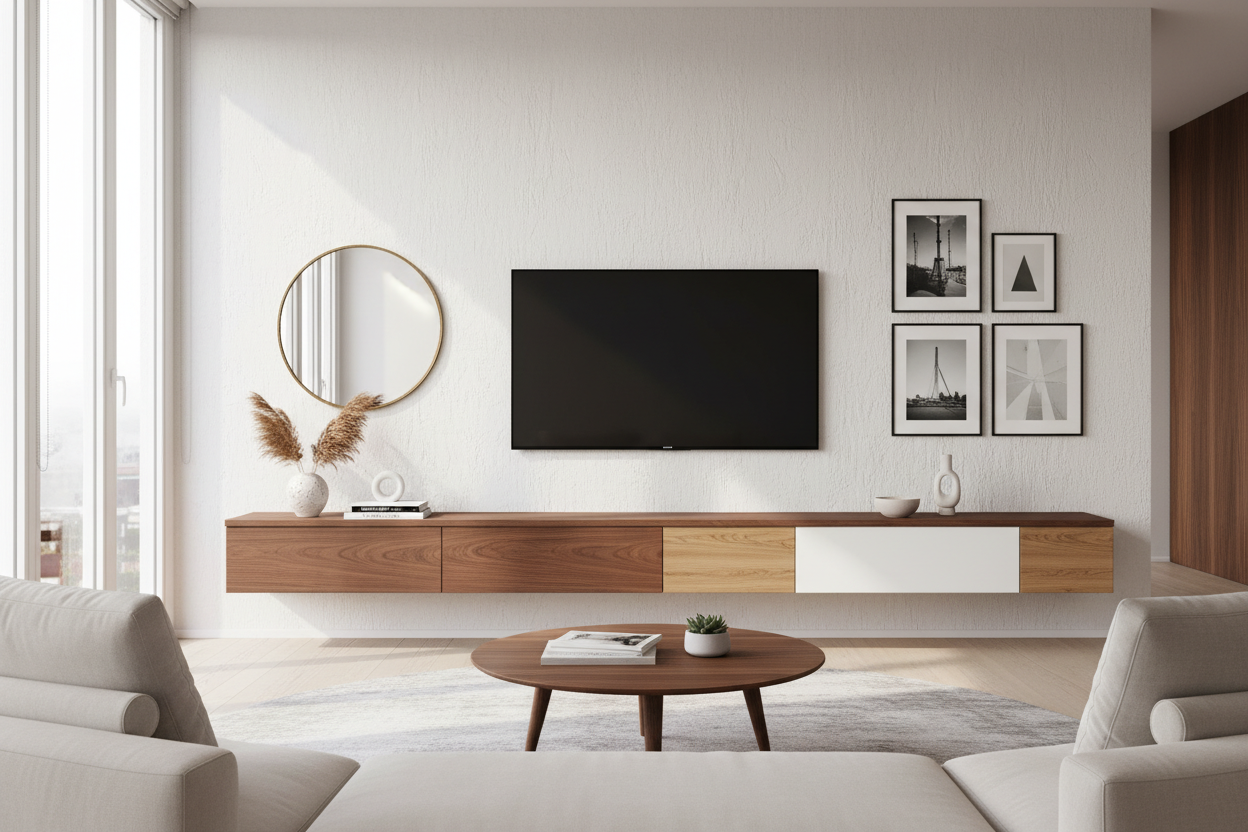
I spent three months staring at my living room wall, convinced I just needed more 'minimalism.' Instead, I ended up with a space that felt like a high-end dentist's waiting room. Everything was white, the light was cold, and my TV looked like a black hole sucking the life out of the drywall. That changed the second I bolted a walnut floating tv shelf to the studs.
It wasn't just about the storage. It was about the warmth. Real walnut has those deep, chocolatey swirls that make a room feel like someone actually lives there, rather than just staging it for a real estate listing. It's the kind of piece that makes you want to put down your phone and actually look at your furniture.
- Floating units save about 8 inches of visual floor depth, making small rooms feel massive.
- Natural walnut grain hides dust and fingerprints far better than high-gloss white.
- Stud finders are non-negotiable; don't trust drywall anchors with a $1,000 OLED.
- Cable management is the secret sauce to the 'hover' look.
The 'White Box' Syndrome (And Why My Room Felt Dead)
I fell for the Pinterest trap of the 'all-white everything' aesthetic. I started with a basic white wood floating tv stand, thinking it would blend into my eggshell walls and create this seamless, airy vibe. Instead, it looked like a hospital corridor. There was no soul, no friction, and zero personality.
The problem with a white-on-white setup is that it offers no visual 'break' for your eyes. My 55-inch TV just sat there looking like a giant plastic rectangle. I realized that 'clean' doesn't have to mean 'clinical.' I needed something with weight and texture to stop the room from feeling like it was floating away into a void of boredom.
Why I Chose Walnut Over Just Buying More Wall Art
Most people try to fix a boring room by slapping more prints on the wall. I almost did the same, but realized the issue was the furniture itself. A walnut floating tv shelf is basically functional art. It brings in an organic element that breaks up the hard lines of the TV and the speakers.
The switch to natural wood tones changed everything. I stopped worrying about matching every piece of furniture and started mixing walnut and white finishes to create some depth. The walnut grounds the wall, giving the TV a 'home' rather than just a place to hang. It’s the difference between a house that feels 'decorated' and one that feels 'designed.'
The Magic of the 'Hover' Effect in a Small Room
If you live in a place where you can touch both walls at once, you know floor space is gold. When I had one of those traditional floor-bound TV stands, it ate up three feet of floor and made the rug feel cramped. It created a dead zone where dust bunnies went to die.
Lifting the console off the floor is a total visual trick. Because you can see the floor extending all the way to the baseboard, your brain perceives the room as larger. It’s about 65 inches of solid wood that looks like it’s defying gravity. It gives the room a sense of 'breath' that bulky, legged furniture just can't provide.
Not Ready for Dark Wood? The Two-Tone Compromise
I get it—committing to a dark wood grain can feel like a big jump if you’ve been living in a Scandi-white bubble. If you're nervous, a white and wood floating tv stand is the perfect middle ground. You get the crispness of the white frame with the warmth of a walnut face or top.
This is what designers actually think about mixing materials: it’s all about the 'high-low' of textures. The smooth white surface keeps things modern, while the wood grain provides the organic touch. It’s a gateway drug to more adventurous furniture choices down the line.
Installation Reality Check (Yes, You Need Heavy-Duty Anchors)
Let’s talk about the part everyone skips: the installation. I tried to 'eyeball' it the first time. Don't be me. You need a level, a real stud finder (not the $5 one that beeps at everything), and a second pair of hands. If you miss the studs, that beautiful walnut shelf will eventually start the 'slow lean' of death.
Also, plan your cables before you drill. I spent two hours mounting mine only to realize I had a 'tail' of black HDMI cords hanging down like spaghetti. I ended up using a simple plastic cord channel painted the same color as my wall. It’s not perfect, but it keeps the focus on the wood, not the wires.
How high should I mount my floating shelf?
The center of your TV should be at eye level when you're sitting on your sofa. For most people, that means the shelf itself sits about 20 to 24 inches off the floor. Don't mount it too high or you'll end up with 'Couch Neck.'
Can a floating shelf hold a 65-inch TV?
If you're mounting the TV to the wall separately, the shelf only needs to hold your soundbar and remote. If the TV is sitting on the shelf, you absolutely must bolt it into at least two studs. Most quality walnut units can handle 50-75 lbs if installed correctly.
Does walnut scratch easily?
Walnut is a hardwood, so it's pretty durable, but it's not invincible. I use a little bit of Howard Feed-N-Wax every few months to keep the grain popping and hide any tiny surface scratches from my keys or the remote.


Leave a comment
This site is protected by hCaptcha and the hCaptcha Privacy Policy and Terms of Service apply.