










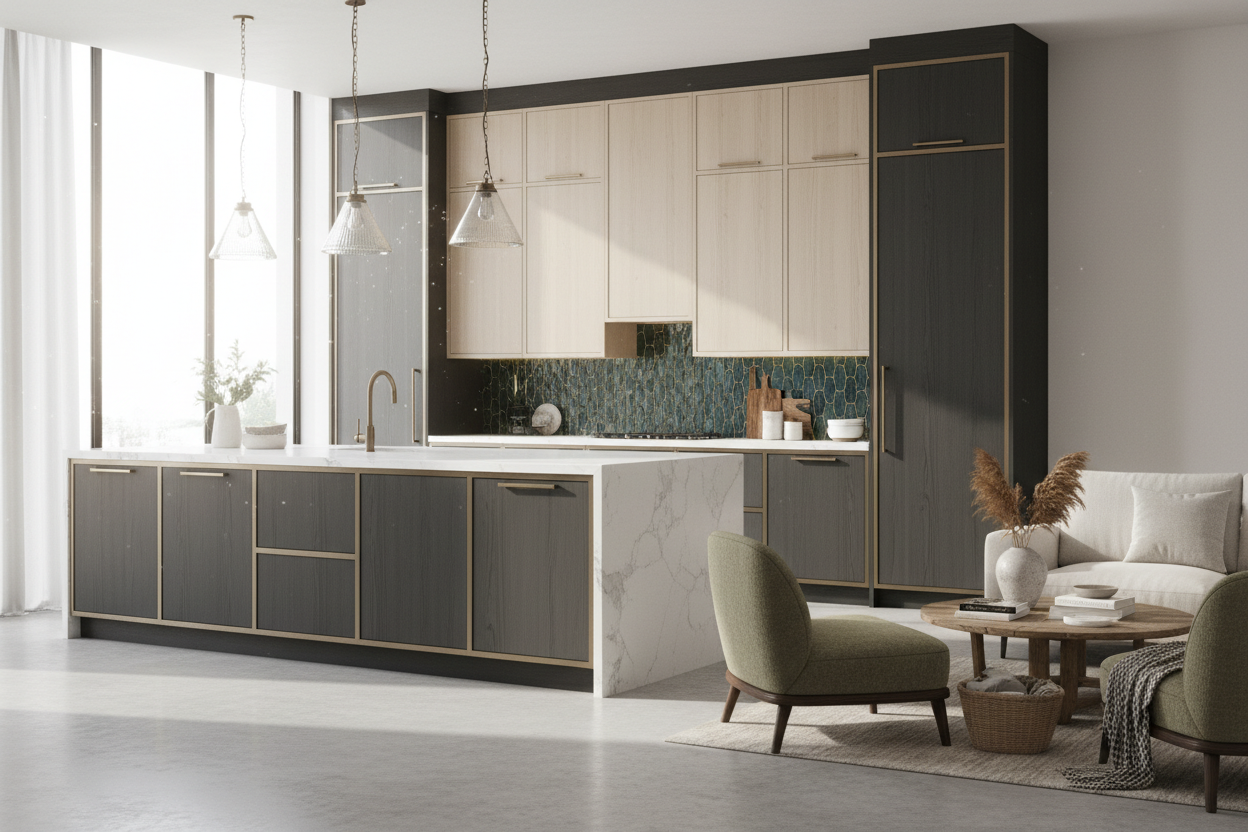
I remember my first client who insisted on importing kitchen cabinets directly from China. They'd seen the prices online—about 40% less than domestic quotes—and were ready to pull the trigger. The photos looked stunning: sleek, modern cabinets with dovetail drawers and soft-close hinges. But when the shipment arrived six weeks later, the reality was different. The cabinet boxes were made from particle board that swelled at the edges, the drawer glides felt cheap, and the finish was uneven. We made it work, but it cost us extra in modifications and labor. That experience taught me what really matters when considering Chinese kitchen cabinets.
Quick Takeaways
- Not all Chinese manufacturers are equal—quality ranges from budget particle board to premium plywood construction
- Expect longer lead times (8-12 weeks) plus 2-3 weeks for shipping and customs clearance
- Standard Chinese cabinet depths are often 560mm (22 inches) instead of North America's 24 inches
- Always request physical samples before placing a wholesale order
- Factor in 15-20% extra budget for potential modifications during installation
The Real Appeal: Why North American Designers Consider Chinese Kitchen Cabinets
Let's be honest—the primary draw is cost. For a standard 10x12 kitchen, I've seen quotes for Chinese-made cabinets come in at $8,000-$12,000 versus $15,000-$25,000 for comparable domestic options. That's significant savings, especially for investment properties or budget-conscious renovations. But it's not just about price. Chinese manufacturers offer scale and material variety that's hard to match. Need 50 linear feet of rift-cut white oak cabinets with a custom stain? They can produce it in quantities that would strain most North American shops.
The manufacturing infrastructure in regions like Guangdong and Zhejiang is impressive. These facilities often have dedicated lines for different materials—one for MDF, another for plywood, separate stations for hardware installation. This specialization allows for consistency in large orders. I've worked with suppliers who produce 500+ cabinet sets monthly with remarkably uniform finishes.
However, the logistics are real. That same scale means you're dealing with container shipments (minimum 20-foot container for most wholesale orders), customs documentation, and the reality that once those cabinets are on the water, there's no easy returns process. I always advise clients to think of it as buying a car sight-unseen—you need to do your homework first.
Quality Decoded: How to Assess Chinese Kitchen Cabinet Construction
When designers ask 'are Chinese cabinets good quality?' my answer is always: 'It depends which factory you choose.' The difference between premium and budget options comes down to four key elements. First, material selection. Budget lines use particle board or MDF for cabinet boxes, while better manufacturers use 15mm or 18mm plywood with moisture-resistant glue. For doors, solid wood frames with MDF panels are common, but check the wood moisture content—it should be 8-10% to prevent warping in different climates.
Second, examine the joinery. Dovetail drawers are standard in better lines, but check the spacing—tight, uniform joints indicate precision manufacturing. For cabinet boxes, look for dado or rabbet joints rather than simple butt joints with staples. Third, hardware matters. I specify Blum or Hettich hinges and slides even when importing—the extra cost ($2-3 per hinge) is worth it for durability. Many Chinese manufacturers can install these upon request.
Finally, finishes. A quality polyurethane finish should be 3-5 coats with proper sanding between layers. I always request finish samples on the actual material, not just color swatches. For wood options, many Chinese suppliers offer excellent cherry wood cabinets at competitive prices—just verify they're using genuine cherry veneer or solid wood, not printed finishes.
The Supplier Selection Process: Finding Reliable Chinese Kitchen Cabinet Manufacturers
Start with verification. Any legitimate manufacturer should provide business licenses, factory photos, and production capacity details. I look for suppliers with ISO 9001 certification—it's not a guarantee of quality, but it shows they have documented processes. Next, check their experience with North American exports. Ask specifically about CARB Phase 2 compliance for formaldehyde emissions—this is non-negotiable for US and Canadian imports.
References are crucial. Request contact information for 2-3 North American clients who've imported in the past year. When you speak with them, ask about communication (Was there an English-speaking project manager?), problem resolution (How were defects handled?), and whether the cabinets matched the samples provided.
Minimum order quantities vary. Some factories require 20-foot container minimums (roughly 10-15 kitchen sets), while others offer mixed container options. I recently worked with a supplier who allowed mixing cabinet orders with other furniture—we filled a container with kitchen cabinets plus a dining set and bedroom furniture for a whole-house project.
Always, always visit if possible. On my last factory tour in Foshan, I saw three production lines: one using automated CNC machines for precision cutting, another with skilled craftsmen doing hand-finishing on high-end pieces, and a third that was clearly cutting corners with inferior materials. The difference was visible in person in ways photos never show.
Logistics and Installation: What Importing Chinese Kitchen Cabinets Really Involves
Let's talk timelines. From order placement to installation, budget 12-16 weeks. Production typically takes 6-8 weeks, ocean freight 4-5 weeks, plus customs clearance and inland transportation. I build in a 2-week buffer for delays—weather, port congestion, or documentation issues can add time.
Shipping terms matter. I prefer FOB (Free on Board), meaning the supplier gets cabinets to the port and loaded on the ship, then I arrange and pay for ocean freight and insurance. This gives me control over the shipping line and allows me to insure at full replacement value. For a 20-foot container from Shanghai to Los Angeles, current rates are $3,000-$4,000 plus insurance at 1.5% of declared value.
Installation requires adaptation. Chinese cabinets often use metric measurements and different mounting systems. The standard 560mm depth (22 inches) versus our 24 inches means you might have a 2-inch gap at the back—we usually build out the wall or add filler panels. Also, many imported sets come flat-packed like the corner kitchen pantry cabinet set I recently installed, requiring assembly on site. This adds labor time but reduces shipping damage risk.
Design Integration: Making Chinese Kitchen Cabinets Work in North American Homes
The key is planning for differences. Standard upper cabinet height in China is often 720mm (28.3 inches) versus our typical 30 or 42 inches. I design with filler panels at top or bottom to adjust. For frameless cabinets (common in Chinese modern styles), you'll need to specify full-overlay doors to achieve the seamless look North American clients expect.
Color matching requires attention. Even with RAL color codes, finishes can vary between production runs. I order all cabinets for a project in one production batch and request they be packed together. For open shelving or display cabinet styling, I often source these locally to ensure perfect color continuity with the imported base cabinets.
Consider mixing sources. For a recent project, we imported the main cabinet run from China but sourced the kitchen island locally. This gave us the cost savings on the majority of cabinets while ensuring the island—the visual centerpiece—had perfect proportions and easier customization for electrical and plumbing.
The Verdict: When Chinese Kitchen Cabinets Make Sense (And When They Don't)
Importing makes most sense for: 1) Large projects where the volume justifies container shipping, 2) Designs requiring specific materials or finishes at scale, 3) Investment properties where budget is primary, and 4) Clients comfortable with longer timelines. I recently completed a 12-unit condo renovation where Chinese cabinets saved approximately $140,000 compared to domestic quotes—well worth the extra coordination.
Stick with domestic sourcing when: 1) You need cabinets in under 8 weeks, 2) The project requires frequent modifications or custom sizes, 3) You're doing a high-end kitchen where every millimeter matters, or 4) The client wants hands-on involvement with the fabricator. For smaller accent pieces like a buffet cabinet with storage, domestic sourcing often makes more sense due to shipping costs.
My recommendation? For designers new to importing, start with a secondary kitchen or laundry room. The stakes are lower, and you'll learn the process. Always work with a supplier who provides detailed drawings for approval before production begins. And remember—the cheapest quote is rarely the best value when you factor in quality issues and modification costs.
Frequently Asked Questions
How much can I really save importing kitchen cabinets from China?
Typically 30-50% compared to similar quality domestic cabinets. But factor in shipping ($3,000-$5,000 per container), customs duties (3.2% for wood furniture to the US), and potential modification costs during installation.
What's the biggest quality risk with Chinese cabinets?
Inconsistent finishes and material substitutions. I've seen samples in beautiful quarter-sawn oak that arrived with rotary-cut veneer of lower quality. Always specify exact materials in your contract and request production photos.
Can I get cabinets that match North American standard sizes?
Yes, but you must specify precisely. Provide detailed drawings in millimeters. Most manufacturers can produce to your specifications, but there may be minimum quantity requirements for custom sizes.
What happens if cabinets arrive damaged or defective?
This is why insurance matters. Document everything with photos before unpacking. Reputable suppliers will typically credit 5-10% for minor defects or replace severely damaged items on your next order. But replacement takes time—another reason to order with buffer.

Leave a comment
This site is protected by hCaptcha and the hCaptcha Privacy Policy and Terms of Service apply.