










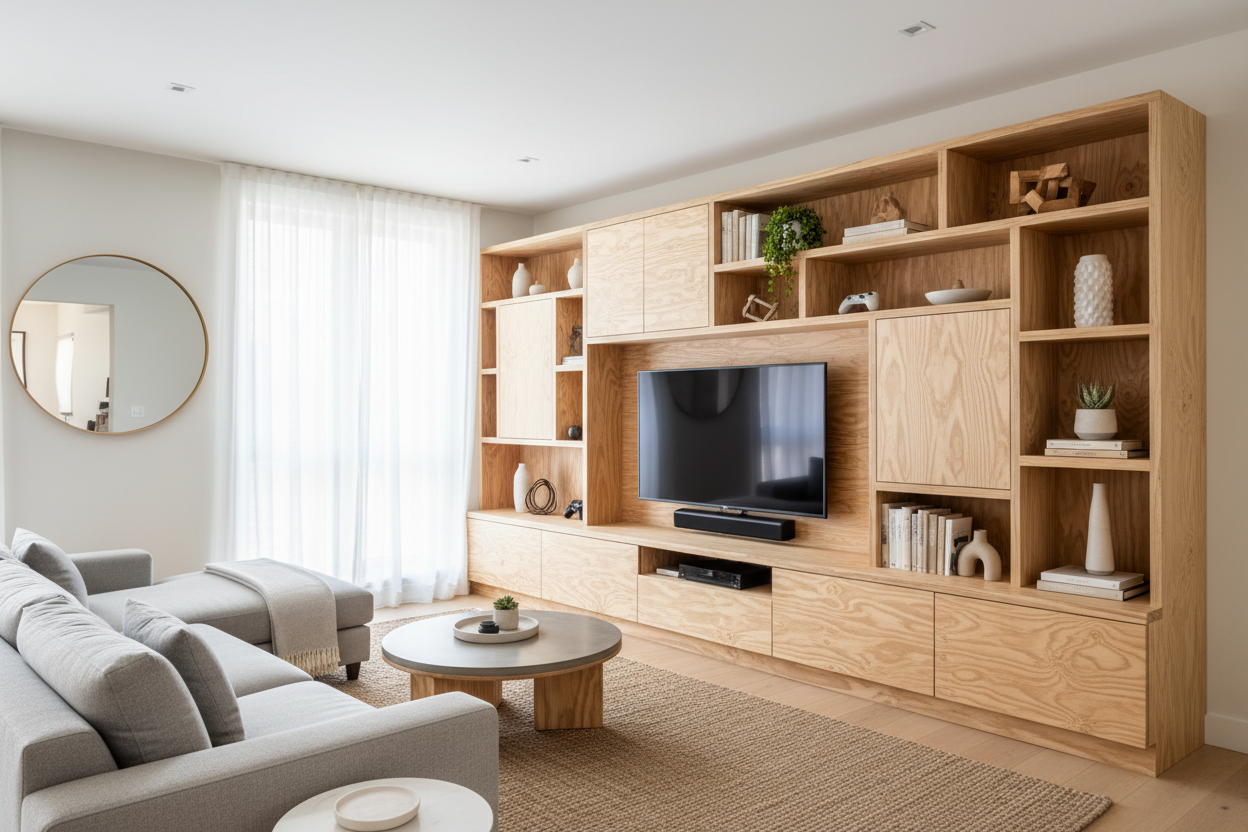
I remember walking into a client's living room last year. They'd just moved into a new apartment and had ordered a beautiful solid oak entertainment center online. When it arrived, it looked stunning—for about two months. Then the humidity changes in their building started working on it. A hairline crack appeared along one panel, and the doors began sticking. They called me, frustrated, asking if this was normal. It's not, but it's common with solid wood in modern homes with inconsistent climates. That's when I started recommending plywood for entertainment center projects instead.
Here's what I've learned after furnishing over 200 homes:
- Plywood offers better dimensional stability than solid wood, resisting warping and cracking
- You can achieve high-end looks for 30-40% less cost than comparable solid wood pieces
- The layered construction allows for cleaner, more consistent edges and surfaces
- It's easier to work with for custom designs, whether you're DIY-ing or working with a professional
Why Plywood Beats Solid Wood for Modern Entertainment Centers
Let's talk structure first. Solid wood expands and contracts across its grain with humidity changes. A 48-inch wide solid walnut panel can swell or shrink up to 1/4 inch seasonally. Plywood's cross-laminated layers counteract each other's movement, keeping your entertainment center stable. I've installed plywood TV stands in beach houses with 80% humidity and desert homes with 10% humidity—they hold up beautifully where solid wood would warp.
Cost matters too. A custom solid walnut entertainment center might run $3,000-5,000. The same design in walnut-veneered plywood? $1,800-2,500. You're getting the same beautiful wood grain on the surface, but the engineered core keeps costs down. For many clients, this difference means they can invest in better electronics or other furniture pieces.
Design flexibility is where plywood really shines. Need a 96-inch long media console with no center support? Plywood's strength-to-weight ratio handles it. Want floating shelves that appear to defy gravity? Plywood's consistent density makes it ideal. I recently designed a TV stand and entertainment center with integrated LED lighting—the plywood's smooth surface made routing channels for wires simple and clean.
Choosing the Right Plywood Grade and Finish for Your TV Stand
Not all plywood is created equal. For entertainment centers, I recommend starting with cabinet-grade plywood. The face veneers are selected for appearance, with fewer patches and defects. Birch plywood is my go-to for painted finishes—it takes paint beautifully and costs about $75-100 per 4x8 sheet. Maple plywood runs $90-120 per sheet and works well for natural finishes with a light stain.
Thickness matters. For most TV stands, I use 3/4-inch plywood for the main structure. It provides enough strength for shelves holding media components (typically 20-40 pounds each) and TVs up to 75 inches. For floating designs or cantilevered sections, I might increase to 1-inch thickness in stress areas.
Finish selection depends on your lifestyle. For families with kids or pets, I recommend polyurethane over oil-based finishes. It provides better protection against spills and scratches. If you're going for a natural look, water-based polyurethane maintains the wood's color better than oil-based versions, which tend to amber over time.
Design Considerations for Plywood Entertainment Centers
Cable management should be your first consideration. I always design in at least two 2-inch diameter access holes in the back panel—one near the top for TV cables, one near the bottom for power strips. For wall-mounted units, leave a 1-inch gap between the back of the entertainment center and the wall to run cables neatly.
Weight distribution is critical. A typical 65-inch TV weighs 50-70 pounds. Add a soundbar (10-15 pounds), gaming console (5-10 pounds), and other components, and your center shelf needs to support 80-100 pounds. I reinforce these areas with additional vertical supports or thicker plywood.
Storage integration depends on your needs. For minimalists, open shelving with 12-inch deep compartments works well. For families, I recommend at least two enclosed cabinets with adjustable shelves. Consider a floating TV stand wall mounted media console if you're short on floor space—it creates visual lightness in smaller rooms.
DIY vs. Custom-Built: Which Plywood Route Is Right for You?
DIY makes sense if you have basic woodworking skills and tools. You'll need a circular saw or table saw, a drill, clamps, and sanding equipment. Budget 15-20 hours for a basic entertainment center. The biggest challenge I see DIYers face is edge banding—applying veneer tape to cover the plywood edges. Take your time here; rushed edge banding looks amateurish.
Custom-built through a professional saves time and ensures precision. A good carpenter can build what you design, handling complex joinery and finishing. Expect to pay $800-1,500 for labor on a medium-sized entertainment center, plus materials. If DIY feels overwhelming, browse our TV stands collection for ready-made options that offer similar benefits.
My personal experience? I've built both. For my own home, I went custom because I wanted specific cable routing and integrated lighting that would have taken me weekends to execute properly. For a guest room, I DIY-ed a simple plywood TV stand in about 12 hours total.
Maintaining and Styling Your Plywood Entertainment Center
Cleaning is straightforward. Dust weekly with a microfiber cloth. For spills, wipe immediately with a damp cloth, then dry. Avoid harsh chemicals—they can damage the finish. Every 6-12 months, apply a furniture wax or polish specifically made for your finish type.
Protection matters most in high-traffic areas. If your entertainment center gets a lot of use, consider adding felt pads to the bottom of decorative objects. For frequently opened doors or drawers, install soft-close hardware—it prevents slamming that can loosen joints over time.
Styling should balance form and function. Leave 2-3 inches of empty space around your TV for visual breathing room. Use baskets or boxes on open shelves to contain clutter while adding texture. Remember that an entertainment center doesn't have to be traditional—sometimes a sideboard for TV stand offers better proportions for your space.
Frequently Asked Questions
Can plywood entertainment centers support heavy TVs? Absolutely. Properly constructed with 3/4-inch plywood and adequate support, they can handle TVs up to 85 inches. I always recommend checking your TV's weight and comparing it to the manufacturer's specifications for mounting hardware.
How do I hide the plywood edges? Several options: iron-on veneer tape (easiest for DIY), solid wood edge banding (more durable), or painting the edges a contrasting color (design-forward). For painted pieces, I use wood filler on the edges before painting for a seamless look.
Is plywood furniture less durable than solid wood? In some ways, it's more durable. The cross-laminated construction resists splitting and warping better than solid wood. The surface veneer can be scratched, but so can solid wood. Both benefit from protective finishes.
Can I modify a plywood entertainment center later? Yes, and this is a major advantage. Adding shelves, modifying compartments, or even extending the length is easier with plywood than solid wood. Just be sure to support any modifications properly.


Leave a comment
This site is protected by hCaptcha and the hCaptcha Privacy Policy and Terms of Service apply.