










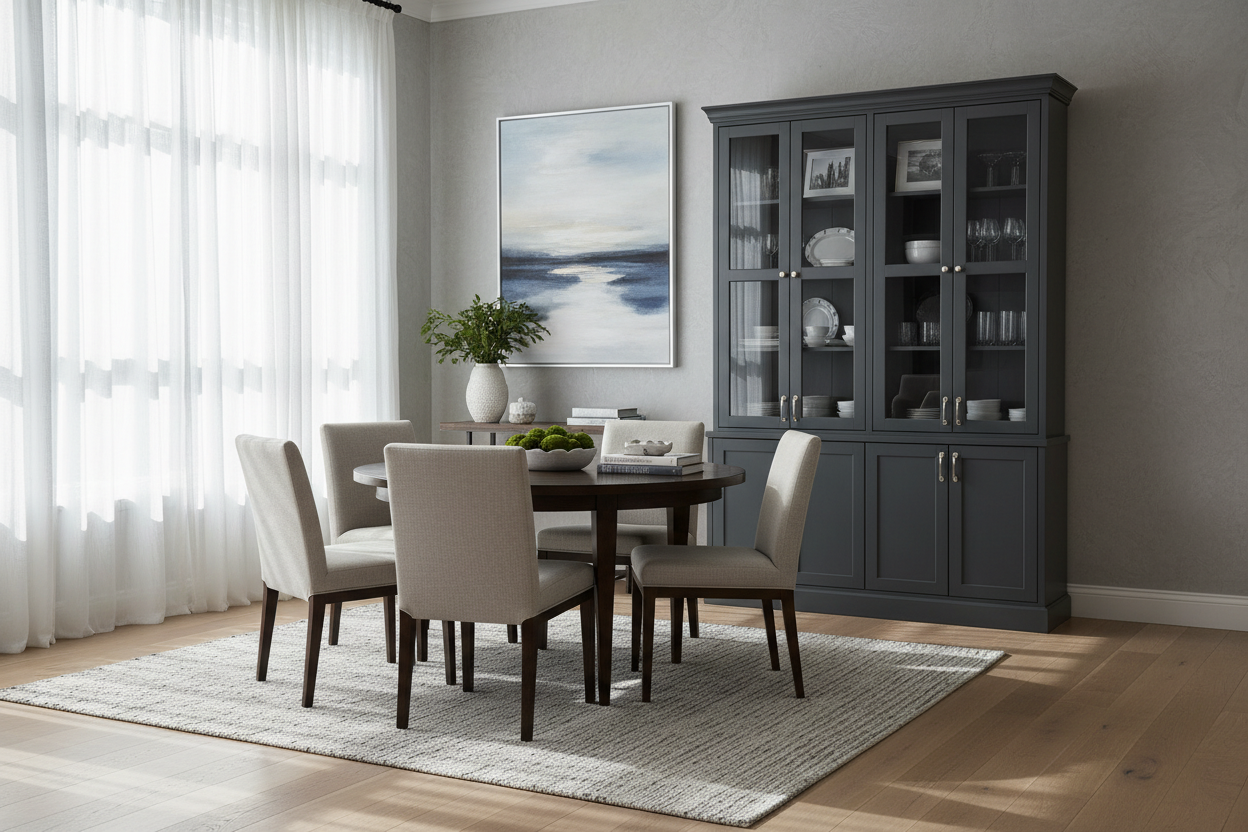
I remember walking into a client's dining room last year—they'd just moved into a 1920s colonial and were staring at an empty corner. 'We need something for Grandma's china,' they said, 'but everything brown feels too heavy, and white shows every fingerprint.' That's when I suggested a gray china cabinet. It wasn't just about storage; it was about finding a piece that could anchor the room without dominating it, work with their existing oak table, and handle their two young kids' sticky hands. After furnishing over 200 homes, I've seen how the right cabinet solves three big problems: where to put your special dishes, how to add personality without clutter, and how to make a room feel finished.
Quick Takeaways
- Gray acts as a true neutral—warmer than black, softer than brown—and pairs with almost any wall color or wood tone.
- Measure your space first: a standard china cabinet is about 18-22 inches deep and 70-84 inches tall; leave at least 36 inches of walkway in front.
- Light grays open up small rooms; dark grays add drama in spaces with plenty of natural light.
- Style isn't just about the cabinet—it's about what you put inside. Mix heights and textures for visual interest.
Why Gray is the New Neutral for China Cabinets
For decades, china cabinets came in dark mahogany or glossy black. They were formal, sometimes imposing. Gray changed that. It's become the go-to neutral because it doesn't fight with other colors. In a farmhouse kitchen with white shaker cabinets, a grey china cabinet adds depth without the stark contrast of black. In a modern condo with concrete floors, it softens the industrial edge. I used one in a mid-century ranch last fall—the clients had teak furniture and worried a brown cabinet would blend too much. A charcoal gray unit with clean lines became the focal point, letting their Danish modern table shine. The finish matters too: a matte gray absorbs light gently, while a semi-gloss reflects it, making a piece feel more contemporary.
Choosing Your Perfect Gray: From Light to Dark
Gray isn't one color. It's a spectrum. Light grays, like fog or silver, work wonders in north-facing rooms or smaller dining nooks. They recede visually, making a 10x12 foot room feel more spacious. I typically recommend light tones for apartments or homes with lower ceilings (under 8 feet). Medium grays—think slate or pewter—are the most versatile. They have enough body to stand out against white walls but won't overwhelm a room. Dark grays, like charcoal or graphite, bring drama. They're excellent in dining rooms with high ceilings or abundant natural light. One caution: in a room with only one small window, a dark cabinet can feel heavy. Always consider your lighting. If you're worried about shadows inside the cabinet, look for models with integrated lighting, like the 63H China Cabinet With Glass Door And Light. The warm LED strips can make your dishes glow and counteract any gloominess from a dark finish.
Style Integration: Making Gray Work in Your Space
The beauty of gray is its adaptability. In a traditional dining room with wainscoting, a gray cabinet with raised panel doors and antique brass hardware feels classic yet fresh. In a minimalist space, opt for a flat-panel gray hutch cabinet with simple bar pulls. The key is coordination. If your flooring is warm (like oak or walnut), choose a gray with brown or taupe undertones to avoid a cold clash. For cool-toned floors (maple, gray laminate), a blue-based gray will harmonize. Don't forget scale. A massive 84-inch tall grey hutch cabinet can anchor a large open-concept area, but in a cozy breakfast nook, a slimmer 60-inch version might be better. If you're struggling to fit a standard cabinet, consider a built-in solution. I've helped clients convert awkward alcoves into custom displays—you can read more about that process in our article on Built-In China Cabinet — How to Make It Work.
Corner Solutions: When Space is Limited
Not every dining area has a long, empty wall. That's where a gray corner china cabinet saves the day. These triangular or curved units tuck neatly into a 90-degree corner, utilizing often-wasted space. I specify them frequently for galley kitchens or small dining rooms where every inch counts. A typical corner cabinet is about 36 inches wide on each side and 72 inches tall. Look for features like lazy Susans or adjustable shelves to maximize storage for odd-shaped platters. For a sleek option that doesn't sacrifice style, the Elegant Corner China Cabinet with frosted glass doors offers display space while softening the contents inside—perfect if your dish collection is more 'well-loved' than 'museum-quality.'
Display Strategies for Gray Cabinets
A cabinet is just a frame; your items are the art. Start by editing. You don't need to fill every shelf. Group items in odd numbers (three, five) for a natural look. Vary heights: place a tall cake stand behind a set of low bowls. Since gray is neutral, you can play with color inside. White dishes pop against a dark gray back panel. For a light gray cabinet, try earthy tones like terracotta or sage green. Lighting is crucial. If your cabinet doesn't have built-in lights, add battery-operated puck lights to the top shelf. They're easy to install and cast a warm glow. For more detailed techniques on arranging everything from heirloom china to modern ceramics, our guide on Elegant Display Ideas is a great resource.
Hutch vs. Cabinet: Understanding Your Options
Clients often ask me the difference. A china cabinet is typically a single unit with glass doors above and solid doors below. A grey china cabinet with hutch usually refers to a two-piece set: a base cabinet (often a sideboard or buffet) with a separate, smaller display unit on top. Hutches offer more flexibility—you can use the base alone if you move to a room with lower ceilings. Standalone cabinets are more unified and often feel more substantial. For a busy family kitchen where you need quick access to everyday dishes, a hutch with a mix of open and closed storage might be best. For a formal dining room where you're displaying a curated collection, a single, elegant dark gray china cabinet with full glass doors makes a stronger statement. Consider your ceiling height too: a tall, one-piece cabinet needs about 6 inches of clearance from the ceiling to feel balanced.
Personal Experience: The Honest Downside
Gray is versatile, but it's not magic. Early in my career, I ordered a beautiful light gray cabinet for a client's beach house. The finish was a very pale, cool gray. When it arrived, against their warm, peach-toned wood floors, it looked stark and slightly blue—it clashed. We had to return it and go with a warmer, greige tone. The lesson? Always get a physical sample. Paint a large swatch on your wall or tape a finish sample next to your flooring. Also, gray shows dust. A matte finish is more forgiving than a high-gloss one, which will show every fingerprint. If you have a busy household, factor in a quick weekly wipe-down.
Frequently Asked Questions
Can a gray china cabinet work in a room with brown furniture?
Absolutely. Gray and brown are a sophisticated combination. Choose a gray with warm undertones (like greige or taupe) to bridge the gap. The contrast is less jarring than black-and-brown and feels intentionally curated.
What's the best way to clean a gray china cabinet?
For painted wood or laminate, use a microfiber cloth dampened with water and a drop of mild dish soap. Dry immediately. Avoid abrasive cleaners or anything with ammonia, which can damage the finish over time.
How much should I expect to spend?
It varies widely. Ready-to-assemble options in engineered wood start around $300. Solid wood, custom-built cabinets can be $2,000+. A good mid-range, assembled cabinet in kiln-dried hardwood with glass doors typically falls between $800-$1,500.
Is gray going out of style?
As a designer, I see gray evolving, not disappearing. While the all-gray 'greige' rooms of the 2010s are softening, gray as a furniture neutral has staying power because it's so functional. It's becoming a classic, like white or natural wood.


Leave a comment
This site is protected by hCaptcha and the hCaptcha Privacy Policy and Terms of Service apply.