










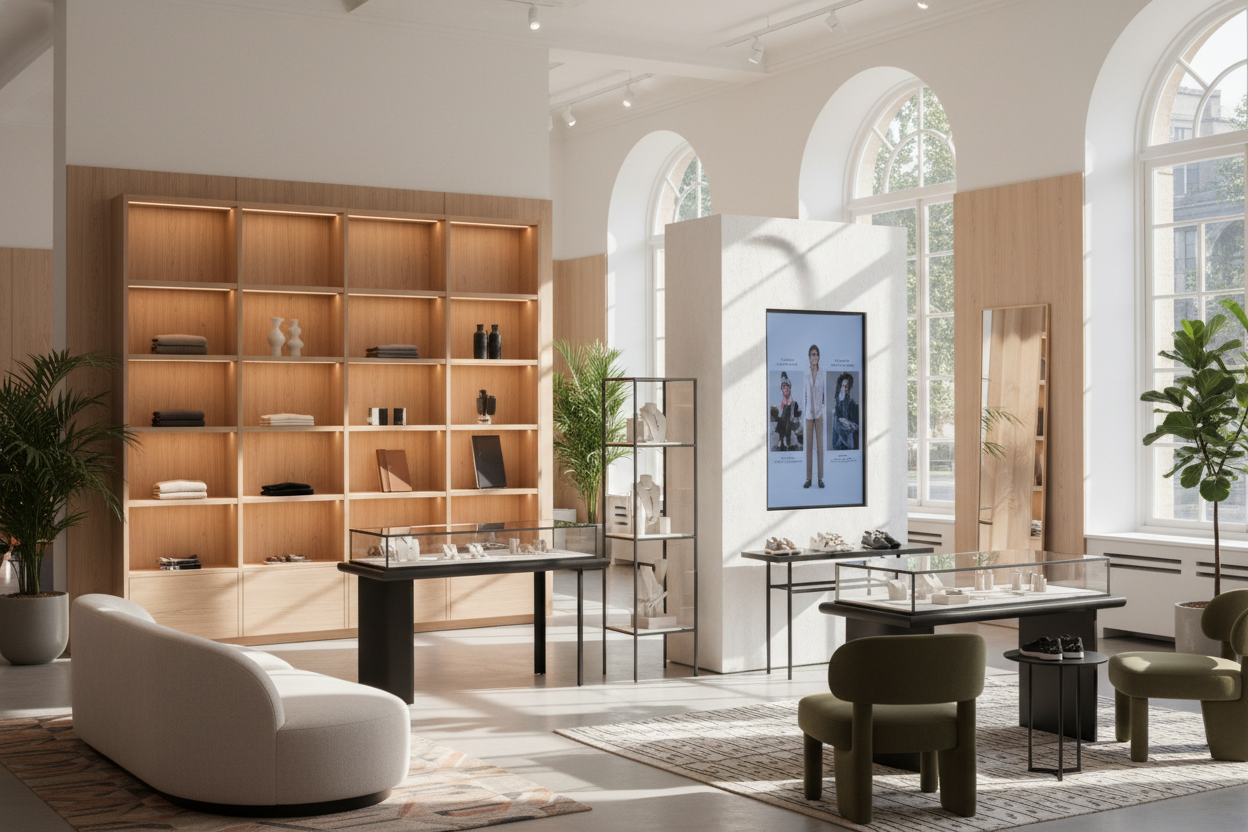
I remember walking into a client's new boutique last year. They'd spent a fortune on custom walnut fixtures that looked stunning in the renderings. In person? The 84-inch main display case blocked the natural flow from the door, creating a 24-inch bottleneck that felt claustrophobic. The beautiful wood was already scuffed from merchandise being clumsily loaded. That's the gap between theory and reality in retail design. After furnishing over 200 stores, I've learned that store solutions aren't about what looks best in a catalog—they're about what works on the sales floor, day after day, season after season.
Quick Takeaways
- Your fixtures are tools, not just decor. They need to withstand daily customer traffic and staff handling.
- Material choice is critical. A powder-coated steel frame often outlasts cheaper MDF composites in high-touch areas.
- Always maintain a minimum 36-inch clearance in main walkways for comfortable customer flow and ADA compliance.
- Lighting isn't an afterthought. Integrated LED strips can increase product visibility by 40% compared to overhead alone.
- Think modular. Systems that can be reconfigured save thousands when you need to refresh your layout.
Why Your Store Fixtures Are Your Silent Sales Team
Think about the last time you walked into a store and felt immediately drawn to a product. Chances are, it wasn't just the item itself—it was how it was presented. Your retail displays and fixtures do more than hold merchandise; they guide customers, tell your brand story, and protect your inventory investment. I've seen stores increase sales by 30% simply by rethinking their fixture layout to create better sightlines and touchpoints.
Consider customer flow. In a standard 1,200-square-foot boutique, I always map out a primary path that's at least 48 inches wide, with secondary paths at 36 inches. Fixtures should be placed to create natural pauses—what we call 'merchandise moments'—without creating dead ends. A common mistake is using fixtures that are too deep. A 24-inch deep clothing rack might hold more, but it pushes customers too far from the wall, shrinking the perceived space. I prefer 18-inch deep units for most apparel, which keeps the walkway feeling open while still displaying product effectively.
The 5 Non-Negotiables for Retail Display Success
When selecting store fixtures, I evaluate every option against five essential criteria. First, durability. Will it survive being bumped by strollers, leaned on by customers, and rearranged by staff? Second, flexibility. Can it adapt to different merchandise or seasonal changes? Third, safety. Are there sharp edges? Is it stable when loaded? I once saw a 72-inch display tower tip because the base was only 18 inches square—now I insist on a base at least 24 inches square for anything over 60 inches tall.
Fourth, aesthetics. Does it complement your brand without overwhelming the product? And fifth, ROI. This includes not just purchase price but installation cost, maintenance, and lifespan. Sometimes what seems cheaper upfront costs more long-term. As I've learned from experience with what retail reps won't tell you about display cabinets, the hidden costs of specialty finishes or custom hardware can add 25% to your budget.
Material Matters: What Holds Up in Real Retail Environments
Let's get specific about materials. For high-traffic areas like entry displays or checkout counters, I specify powder-coated steel frames with laminate surfaces. They resist scratches better than painted wood and clean easily. For boutique environments where warmth matters, I use kiln-dried hardwood with a commercial-grade polyurethane finish—at least three coats. Avoid MDF (medium-density fiberboard) in areas that might get wet; it swells and warps.
Acrylic is great for jewelry or cosmetics displays because it's crystal clear and lightweight, but it scratches easily. For these applications, I use 1/4-inch thick acrylic instead of 1/8-inch. Composite materials have improved dramatically; some bamboo composites now rival hardwood for durability while being more sustainable. Always ask for the weight capacity per shelf—a good retail-grade unit should hold at least 50 pounds per linear foot.
Flexible vs. Fixed: When to Choose Each Display Approach
Modular systems make sense when you anticipate frequent changes or aren't sure about your long-term merchandise mix. I recently designed a pop-up shop using a grid system of 36-inch square modules that could be configured as tables, walls, or towers. The client spent 40% less than on custom fixtures and reused 80% of the system for their next location.
Fixed, custom-built fixtures work best when you have a permanent location with specific needs that off-the-shelf solutions can't meet. A wine shop needed display racks that could hold bottles at a precise 15-degree angle for label visibility while being earthquake-secure. Custom was the only option. Sometimes, as with why DIY display cabinet plans often work better for unique spaces, a hybrid approach works—buying standard bases and customizing the tops or fronts.
Boutique vs. Big Box: Tailoring Your Store Solutions
The needs couldn't be more different. In a 500-square-foot boutique, every fixture must multitask. A display table might need to hold merchandise, provide storage below, and serve as a wrapping station. I look for pieces with clean lines that don't visually clutter the limited space. Many of my boutique clients love versatile display cabinet options that can transition from holding handbags to books to ceramics as their inventory evolves.
In big box environments (think 10,000+ square feet), the priorities shift to durability, scalability, and efficiency. Here I specify systems that can be assembled quickly, withstand forklift bumps (yes, it happens), and create clear sightlines across vast spaces. Gondola systems—those classic retail shelves—typically come in 48-inch, 60-inch, and 72-inch widths. I use the narrower ones for high-margin impulse items near checkout, wider ones for bulk goods in the main aisles. The lighting approach differs too: boutiques use accent lighting to create mood, while big boxes need uniform, bright illumination for safety and price tag readability.
The Lighting Factor: Making Your Merchandise Shine
Lighting is where many stores miss opportunities. Overhead fluorescent panels create even light but flatten textures and colors. I always layer three types: ambient (overall illumination), accent (focused on displays), and task (at checkout or fitting rooms). For display cases, LED strip lighting mounted inside the top front edge eliminates shadows on merchandise. The color temperature matters—I use 3000K (warm white) for clothing and home goods, 4000K (neutral) for electronics, and 5000K (cool white) for jewelry to make diamonds sparkle.
Remember that lighting generates heat. I once designed a chocolate shop where the display case lighting melted the product! Now I always check the heat output specifications and ensure proper ventilation. For adjustable shelving, I specify fixtures with integrated power channels so lighting can move with the shelves—this costs 15-20% more upfront but saves on electrician fees later.
Future-Proofing Your Store: Smart Fixture Investments
The most expensive fixture is the one you replace in two years because it no longer serves your needs. I advise clients to think in 5-year cycles. What might change? Your product mix? Your technology needs? Your store layout? Modular systems with standardized connections let you reconfigure without starting from scratch. I'm seeing more interest in multi-functional display storage solutions that work equally well for retail and back-of-house needs.
Consider vertical flexibility. Can your wall displays accommodate different product heights? Adjustable shelving with 1-inch increment changes gives you this adaptability. For seasonal changes, I design with 'anchor' fixtures that stay year-round (like your main checkout counter) and 'variable' elements that change. A great example is tiered display shelving systems where you can adjust shelf heights for holiday merchandise versus everyday items.
Personal Experience: When Beautiful Fixtures Failed
Early in my career, I specified gorgeous custom glass display cases for a high-end watch retailer. They looked incredible in the installation photos. Within six months, the client called—fingerprints covered the glass constantly, requiring hourly cleaning. The glass shelves, while elegant, made subtle ticking sounds that annoyed staff. We replaced them with anti-reflective coated glass (more expensive initially) and switched to acrylic shelves for the quieter models. The lesson? Test materials in context before committing. Now I always get samples and live with them in my studio for a week, touching them with oily hands, bumping them, seeing how they clean.
Frequently Asked Questions
How much should I budget for store fixtures?
For a complete new store, budget 15-25% of your total build-out cost for fixtures and displays. For a refresh of an existing space, 5-10% is typical. This varies by retail type—jewelry stores spend more per square foot than bookstores due to security requirements.
What's the biggest mistake you see stores make with displays?
Overcrowding. When every inch of every shelf is packed, customers don't know where to look. I follow the '40-30-30' rule: 40% of display space for featured merchandise, 30% for complementary items, and 30% empty space for visual breathing room.
How often should I update my store's displays?
Major refreshes every 18-24 months, with seasonal adjustments quarterly. But you should be tweaking weekly—moving bestsellers to eye level (54-66 inches from floor), cleaning fixtures, and replacing any damaged elements immediately.
Are used fixtures a good option?
Sometimes, especially for startups. Check for stability, repair any damage properly, and refinish if needed. Avoid used electrical fixtures unless they've been professionally inspected. I've found great deals on used mannequins and basic shelving, but I always buy new for anything that touches food or requires precise calibration.

Leave a comment
This site is protected by hCaptcha and the hCaptcha Privacy Policy and Terms of Service apply.