










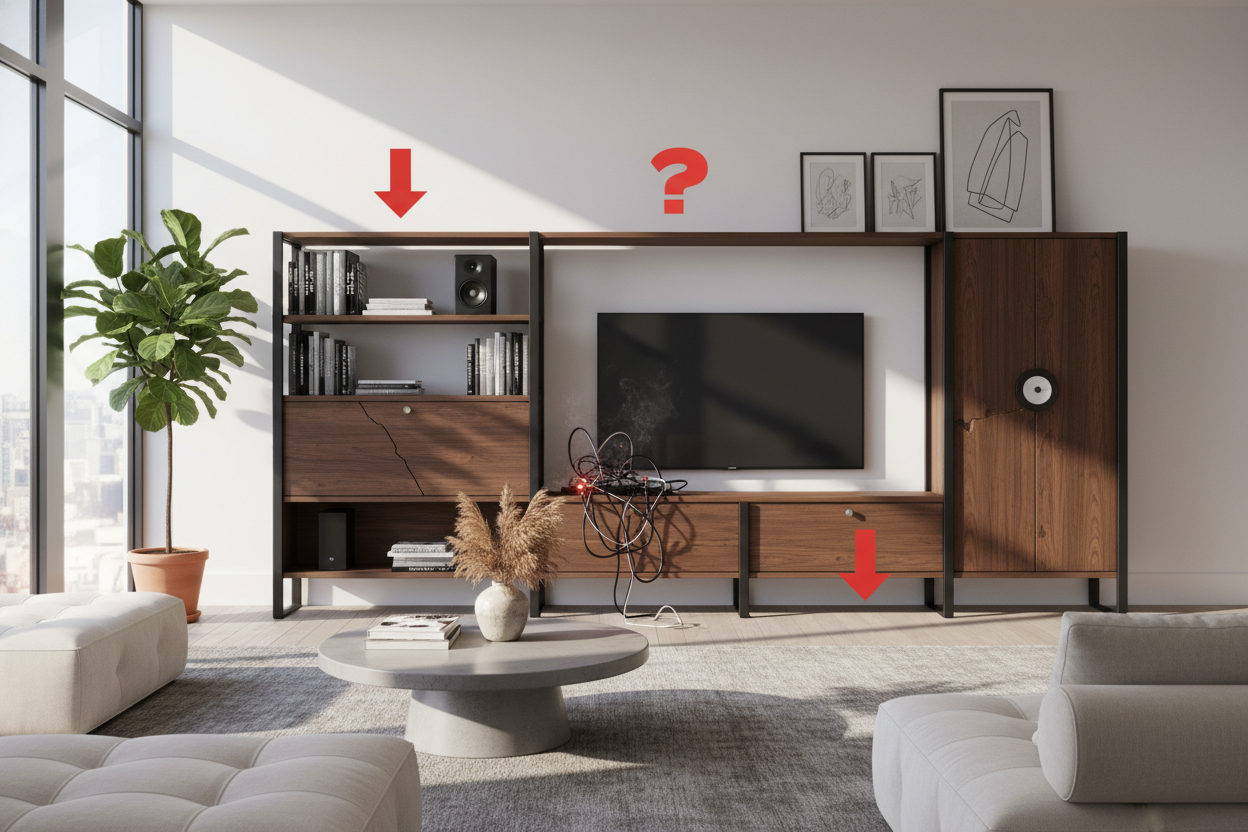
I remember my first real apartment. I spent three weeks' worth of grocery money on a media console that looked like a mid-century masterpiece in the catalog. When it arrived, it was so flimsy that my 55-inch TV made the top shelf bow like a wet noodle within forty-eight hours. It was my first expensive lesson in why entertainment furniture units aren't all created equal.
Quick Takeaways
- Avoid 'hollow-core' construction; it's basically cardboard disguised as wood.
- Always measure your TV's actual footprint, not just the diagonal screen size.
- Check for ventilation if you plan on hiding a gaming console or router inside.
- Don't let a '60% off' tag distract you from a poor return policy.
Why the Big Discount Tag Clouds Our Design Judgment
We've all been there. You're scrolling through entertainment units for sale and see a price that feels like a steal. Suddenly, you're convincing yourself that a 40-inch stand is 'perfectly fine' for your 65-inch TV, or that a bright orange oak finish 'adds character' to your moody, industrial living room. It doesn't. It just looks like a mistake you're stuck with.
The problem is that a massive discount creates a sense of urgency that overrides our logic. We stop thinking about the technical needs—like whether the shelves are deep enough for an AV receiver—and start thinking about the savings. I've seen people buy units that were so poorly scaled for their rooms that they ended up spending more money on 'filler' decor just to make the wall look balanced. A sale is only a deal if the piece actually works for your life.
Red Flag 1: The Dreaded Hollow-Core Trap
If you pick up a box and it feels surprisingly light for a 70-inch console, put it back. Budget manufacturers love hollow-core construction. It’s essentially two thin pieces of veneer or laminate sandwiched over a honeycomb of cardboard. It looks thick and expensive in photos, but it has zero structural integrity. Put a heavy TV on it, and you're asking for a disaster.
I always tell friends to check the weight capacity and the material list. You want high-density fiberboard (HDF) at the very least, but kiln-dried hardwood or furniture-grade plywood is the gold standard. To get a better sense of the technical specs that matter, I usually recommend checking out what designers look for before you buy. Real furniture shouldn't feel like a prop from a movie set.
Red Flag 2: Showroom Proportions Are Lying to You
Walking through a furniture warehouse is like walking through a stadium. Everything looks smaller because the ceilings are 30 feet high. That 'compact' unit you saw in the entertainment units sale might actually be an 8-foot behemoth that will make your apartment feel like a crawlspace. Conversely, a unit that looks standard in a warehouse might look like dollhouse furniture against a large accent wall.
The fix? Tape it out. Use blue painter's tape on your wall and floor to see the physical footprint. If you have a weirdly shaped room or a wall that’s just a bit too short for standard sizes, look for something versatile. A wide adjustable TV stand for living room can be a lifesaver here because it lets you tweak the width to fit your specific wall without it looking cramped or lonely.
Red Flag 3: The Afterthought Cable Management
There is nothing that ruins a room's vibe faster than a 'waterfall' of black cables hanging out from under a sleek console. Cheap units treat cable management as an afterthought. They might give you one tiny, jagged hole in the center that can't fit more than two plugs, or worse, no holes at all, forcing you to leave the back panel off and compromising the unit's stability.
When I'm shopping, I look for dedicated channels and ventilated backing. Electronics get hot. If you're stuffing a PlayStation or a cable box into a sealed wooden cabinet, you're basically slow-cooking your tech. I prefer a modern design with ample storage space that includes pre-drilled grommets and enough depth to keep the wires tucked away. If you have to drill your own holes in a brand-new piece of furniture, you bought the wrong piece.
How to Actually Shop an Entertainment Units Sale Safely
Navigating a clearance event doesn't have to be a gamble. Before you hit 'checkout,' ask yourself: Can this hold 50% more weight than my current TV? Does the height align with my eye level while sitting on my actual sofa? And finally, if this wasn't on sale, would I still want it in my home? If the answer to any of those is 'no,' keep scrolling.
I once bought a console just because it was $150 off, despite it being three shades too dark for my floors. I hated looking at it every single day for two years. Now, I prioritize the build and the layout over the initial 'win' of a low price. If you're ready to find something that actually lasts, browse our entertainment center collection to see units that prioritize both style and structural honesty.
Personal Experience: My 'Cardboard' Console Disaster
A few years back, I fell for a 'wood-look' unit that was actually just paper-wrapped particle board. I didn't realize it until I tried to move it across the room and the cam-lock screws literally tore through the side panels. It wasn't fixable. I had to throw the whole thing away. Now, I always check the joints—if it’s all glue and thin staples, it’s not coming home with me.
FAQ
How wide should my TV stand be?
Ideally, your stand should be at least 6 to 10 inches wider than the TV on both sides. This prevents the 'top-heavy' look and keeps the proportions of the room balanced.
Is 'engineered wood' always bad?
No. High-quality MDF or plywood is actually more stable than solid wood in humid climates because it won't warp or crack as easily. Just avoid the cheap, low-density stuff that feels like compressed sawdust.
What is the best height for a media unit?
The center of your TV screen should be at eye level when you're seated. For most people, that means a console height of about 20 to 24 inches, depending on the height of your sofa cushions.

Leave a comment
This site is protected by hCaptcha and the hCaptcha Privacy Policy and Terms of Service apply.