










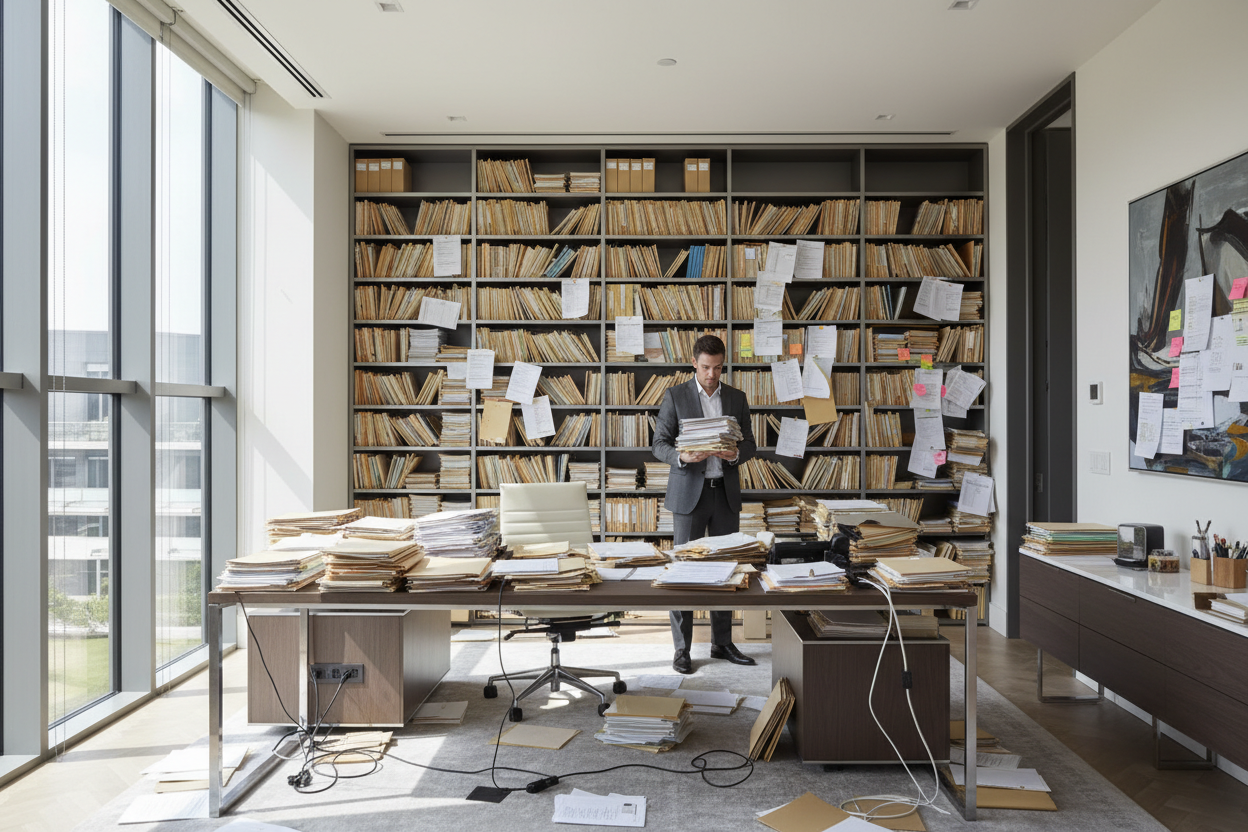
Paperwork has weight—both physical and psychological. When we approach a home office or a dedicated archive space, the instinct is often to hide the clutter in the darkest corner of the floor plan. However, a sophisticated file room design is not just about containment; it is about retrieval, workflow, and preserving the integrity of your documents. Poorly planned storage creates friction, turning a simple task into a frustrating excavation. Let’s treat this space with the same architectural respect we give a library or a wine cellar.
Key Features of Efficient Archives
- Load-Bearing Capacity: Ensure shelving materials (steel or reinforced joinery) can support 30-50 lbs per linear foot without bowing.
- Ergonomic Aisle Widths: Maintain a minimum of 36 inches between cabinets for drawer extension and comfortable movement.
- Lighting Temperature: Aim for 3500K-4000K LED lighting to reduce eye strain when reading small labels.
- Vertical Optimization: Utilize floor-to-ceiling height with rolling ladders or step stools to maximize footprint efficiency.
- Climate Considerations: Proper ventilation is crucial to prevent humidity damage to paper stock.
Structural Integrity and Material Selection
As a designer, I often see homeowners choose aesthetics over structural reality. Paper is incredibly dense. Standard particle board shelving will bow within months under the weight of full archival boxes. For a permanent solution, we look at high-gauge steel or solid hardwood with reinforced cleats.
Steel vs. Custom Millwork
While industrial steel shelving offers the highest weight rating, it lacks warmth. For a luxury residential setting, I recommend custom millwork with hidden metal reinforcements. This allows us to match the wood veneer to your existing office furniture—perhaps a walnut or white oak—while ensuring the shelves remain perfectly linear over time. If you are leaning towards metal, look for powder-coated finishes in matte black or brass to soften the industrial edge.
Optimizing the Floor Plan
Effective filing room design relies heavily on the 'triangle of retrieval.' You want your most frequently accessed files at eye level and close to the entry. The layout should encourage flow, not obstruction.
The High-Density Solution
If your square footage is limited, consider a track-mounted high-density mobile shelving system. While traditionally commercial, residential versions are becoming popular for collectors and heavy archivists. These systems eliminate fixed aisles, compacting your storage into half the space. However, be mindful of your floor joists; the concentrated weight load requires a structural engineer's sign-off if you aren't on a concrete slab.
Lighting and Atmospheric Control
Ambient lighting is insufficient for a file room. You need high-CRI (Color Rendering Index) task lighting. Shadows are the enemy of filing. We often install linear LED strips along the header of each shelving bay or directional track lighting that washes the face of the cabinets. Furthermore, paper is hygroscopic. It absorbs moisture. If your file room is in a basement or lacks airflow, incorporate a dehumidifier or passive ventilation into the cabinetry design to prevent that musty 'old paper' smell.
Lessons from My Own Projects
I learned a hard lesson early in my career regarding custom file drawers. I designed a stunning, floor-to-ceiling wall of lateral file drawers for a client’s home library. It looked impeccable in the renderings—seamless rift-sawn oak.
The mistake wasn't the look; it was the hardware. I specified standard heavy-duty slides, but I hadn't accounted for the sheer inertia of a fully loaded, 36-inch wide drawer filled with legal documents. When the client pulled the drawer, the 'racking' (side-to-side wobble) was substantial, and the tactile experience felt cheap and heavy. It didn't feel like luxury. We had to retrofit the entire unit with industrial-grade, synchronized rack-and-pinion slides. Now, I always test the 'pull force' required. If you have to fight your furniture to open it, the design has failed, no matter how beautiful the wood grain is.
Conclusion
Designing a dedicated space for your records is an investment in peace of mind. By prioritizing structural strength, proper lighting, and ergonomic layouts, you turn a storage closet into a functional asset. Build it right, and you will never dread filing paperwork again.
Frequently Asked Questions
What is the ideal depth for file room shelving?
For standard letter-size boxes or binders, a depth of 12 to 15 inches is standard. If you are storing legal-size documents or architectural plans, you will need to increase this to 18 or even 24 inches to prevent overhang.
How do I make a file room look less like an office?
Treat the cabinetry like a wardrobe. Use decorative hardware, incorporate glass-front upper cabinets for books or decor, and choose a warm paint color for the walls. A runner rug can also soften the acoustics and visuals.
Is open shelving better than lateral file cabinets?
Open shelving is superior for visibility and speed of access, especially for color-coded systems. However, lateral cabinets offer a cleaner visual aesthetic by hiding the clutter and protecting documents from dust and light exposure.

Leave a comment
This site is protected by hCaptcha and the hCaptcha Privacy Policy and Terms of Service apply.