










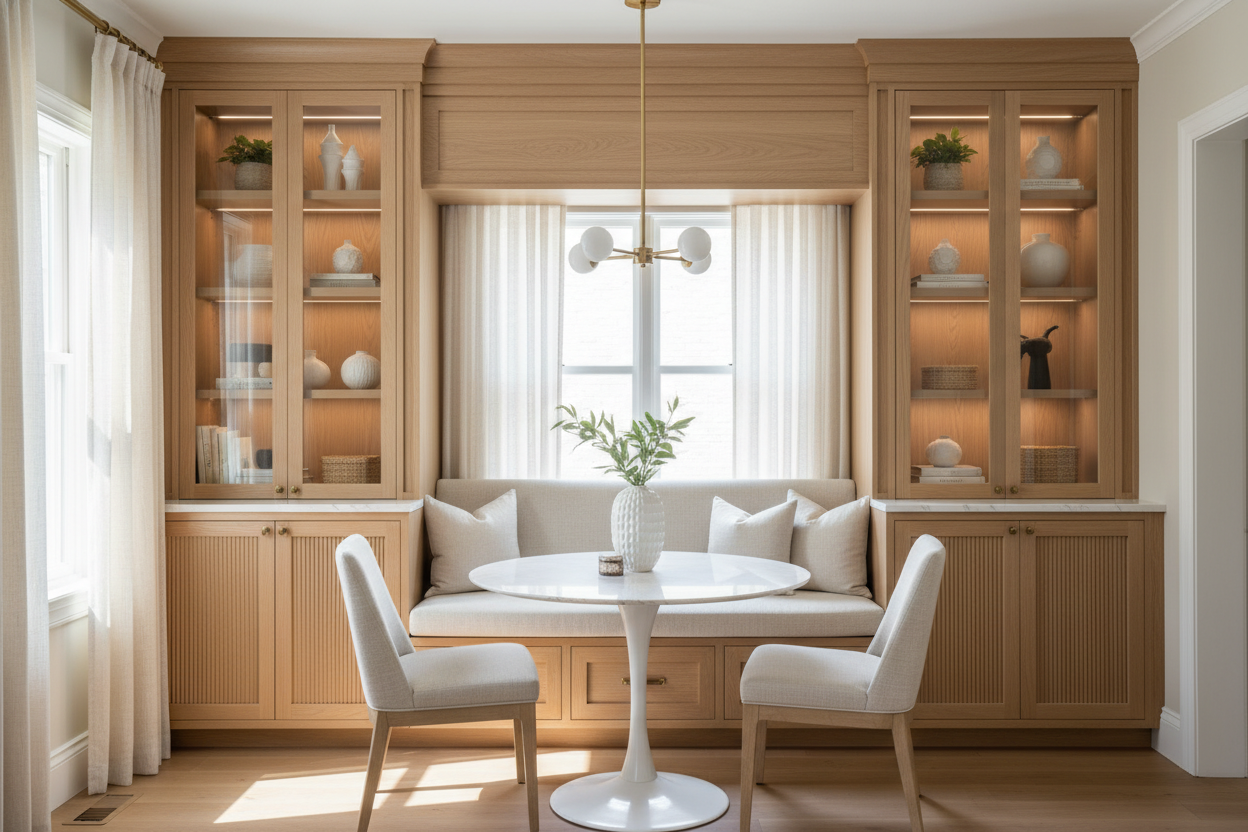
I spent three years doing a weird sideways shuffle every time I had more than four people over for dinner. My 10x10 dining room was dominated by a mid-century sideboard that looked stunning in photos but functioned like a roadblock in real life. If someone was sitting in the 'power seat' near the window, nobody could get to the kitchen without a 'scootch over' request.
I finally hit my breaking point during a holiday party when a guest nearly knocked over a $60 bottle of wine while trying to squeeze past the table. I realized that my freestanding furniture was actually the enemy of my floor plan. That is when I decided to go all-in on custom built-in dining room cabinets to reclaim my square footage and my sanity.
Quick Takeaways
- Stop buying deep buffets; they kill circulation in small rooms.
- Kitchen base cabinets offer better drawer storage than standard 'dining' furniture.
- Solid doors hide the chaos; glass doors are only for people who keep their stacks perfectly aligned.
- Matching cabinet paint to the wall color makes the massive unit 'disappear' into the architecture.
The 'Bulky Buffet' Problem We Could Not Ignore
Our old credenza was 22 inches deep. In a room that is only 120 inches wide, that is a massive chunk of real estate. Once you add a standard dining table and chairs, you are left with about 18 inches of walkway. It was a disaster. Beyond the physical footprint, the top of that buffet became a magnet for junk—mail, keys, a half-empty candle, and whatever else we did not want to carry to the office.
The storage inside was equally frustrating. It had those annoying swing doors that required you to practically lay on the floor to find a serving platter at the back. When I looked at our cramped dining room setup, I realized we were wasting the entire vertical half of the wall while the bottom half was choking the room. We needed to stop thinking about furniture and start thinking about millwork.
Stealing Tricks from the Kitchen
When we started quoting custom jobs, the prices were eye-watering. So, I went rogue. I realized that the most efficient way to get heavy-duty storage was to use kitchen cabinets in the dining room. Kitchen units are built to hold 50-pound stacks of plates and cast iron Le Creuset pots that would make a flimsy MDF sideboard bow in a week.
We opted for 15-inch deep 'upper' cabinets installed as bases. Why? Because a standard 24-inch kitchen base is too deep for a small dining area. By using shallow cabinets with high-quality drawer glides, we gained organized storage for every single napkin ring and tablecloth without protruding into the walking path. If you are doing this, skip the shelves and go for drawers. Trust me, your back will thank you when you are looking for that one specific gravy boat.
Going Vertical: Hiding the Ugly Stuff
The internet is obsessed with built in wall cabinets dining room designs that feature floor-to-ceiling glass. They look great in a magazine where a stylist has curated three white bowls and a single sprig of eucalyptus. In my house, I have mismatched Tupperware, a collection of souvenir mugs, and a blender I only use for margaritas. I do not want to look at that while I am eating steak.
We designed our upper units with solid shaker doors for 80% of the space. We left one small section of open shelving for the 'pretty' stuff—the vintage glassware and the good bourbon. This allowed us to use the entire height of the 9-foot ceilings. We now store holiday platters on the very top shelf, which freed up three entire shelves in our actual kitchen pantry. It is basically a secret annex for all the kitchen overflow.
A Nod to the Past, Without the Dusty Vibe
I wanted the look of a traditional home, but I did not want a 'grandma's house' aesthetic. The goal was a modern built-in china cabinet that felt like it was part of the house's skeleton rather than a piece of furniture we bought at a big-box store. We achieved this by using oversized, matte black linear pulls and skipping the ornate crown molding for a cleaner, square-edge trim.
The real secret, though, was the paint. We used a moody, dark charcoal in a satin finish. By painting the cabinets, the trim, and the walls the exact same color, the units don't jump out at you. They recede. It creates a backdrop rather than a focal point, which is exactly what you want when you are trying to make a small room feel sophisticated instead of cluttered.
The Final Verdict: Did It Shrink the Room?
The biggest fear everyone has with built-ins is that they will 'close in' the space. It is counterintuitive, but adding an 18-foot long, floor-to-ceiling wall of cabinetry actually made our 10x10 room feel significantly larger. Because the floor is now clear of 'legs' and 'gaps' from various pieces of furniture, the eye sees one continuous, long line. The room feels intentional and architectural.
I did make one mistake: I forgot to account for the electrical outlets. We had to cut holes in the back of the brand-new cabinets to move the plugs forward so we could still plug in the toaster and the lamp. It was a messy, stressful afternoon with a jigsaw. If you are doing this, map out your outlets before the cabinets are bolted to the studs. Aside from that? I would never go back to a freestanding buffet again.
How much depth do I really need for dining built-ins?
If you just want to store plates and glassware, 12 inches is plenty. If you want to store large serving platters or small appliances like a Crock-Pot, aim for 15 to 18 inches. Anything deeper than 18 inches starts to eat too much floor space in a standard room.
Is it cheaper to buy a buffet or build custom cabinets?
Buying a buffet is almost always cheaper upfront. Custom built-ins can run anywhere from $2,000 for a DIY IKEA-hack version to $10,000+ for professional millwork. However, the built-ins add actual appraised value to your home, whereas a buffet is just a piece of furniture you take with you.
Can I use stock cabinets from a home improvement store?
Yes, but the 'finish' is the giveaway. If you use off-the-shelf cabinets, spend the extra money on custom doors or a high-quality paint job. The difference between a 'cheap kitchen in the dining room' and 'custom millwork' is all in the trim, the hardware, and the paint finish.


Leave a comment
This site is protected by hCaptcha and the hCaptcha Privacy Policy and Terms of Service apply.