










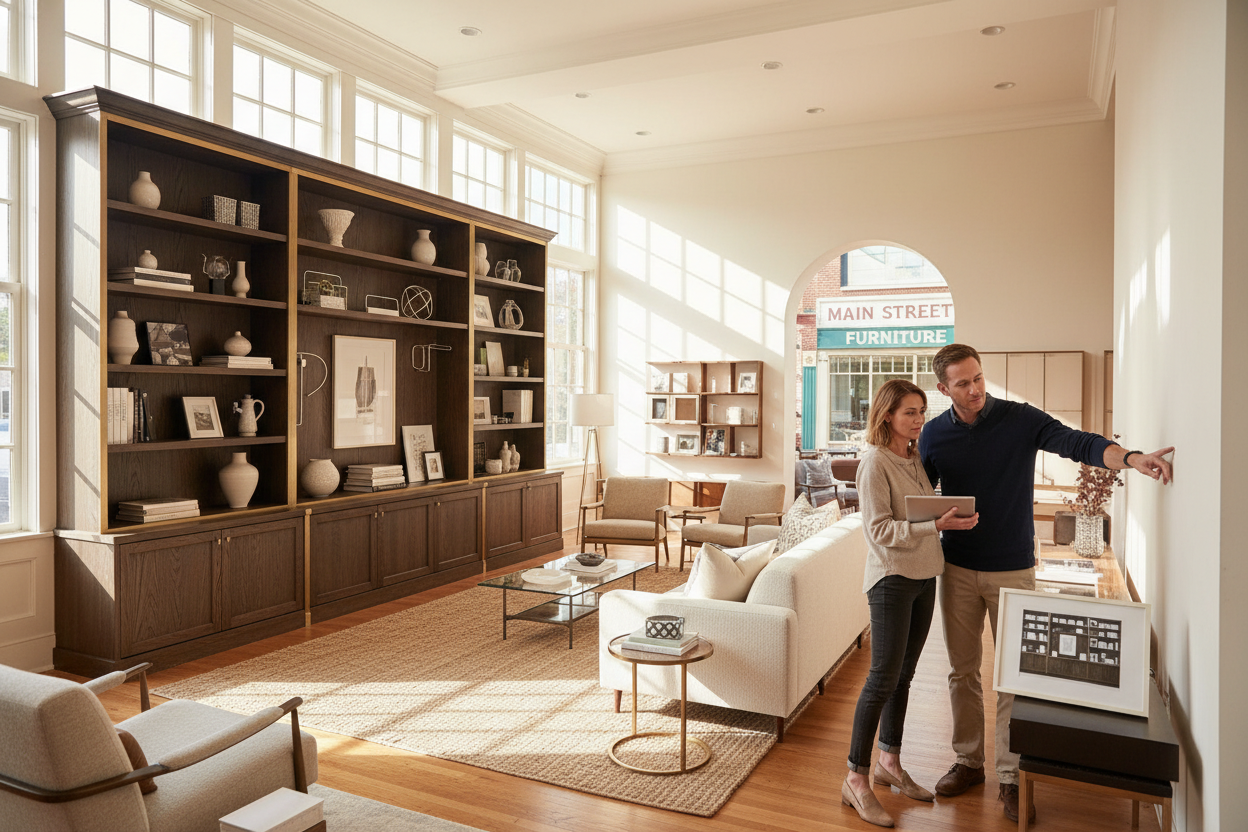
I remember staring at my screen at 2 AM, convinced that a $200 modular library system was the answer to my clutter. When it arrived, the 'wood' felt like hardened paper, and within three months, my hardcovers were creating a sad U-shape on every level. Buying wall furniture online is a high-stakes gamble I am no longer willing to take. There is a massive difference between a photo and the physical reality of a load-bearing shelf.
- Online flat-packs often use 0.5-inch particle board that sags under minimal weight.
- Physical stores allow you to test the 'wiggle factor' and structural joinery.
- Main Street shops often have better delivery and assembly options for bulky items.
- You can't judge wood grain or finish durability through a compressed JPEG.
The 'Flat-Pack Sag' Is Real (And It Will Break Your Heart)
The heartbreak of the 'flat-pack sag' is a rite of passage for many apartment dwellers, but it is one I’ve officially retired from. When you are dealing with floor-to-ceiling units or heavy-duty shelving, you aren't just buying a surface; you are buying a structural commitment. Most of the stuff shipped in flat boxes relies on cheap cam-locks and thin particle board that just cannot handle a real book collection. I have seen shelves buckle under 20 pounds, which is basically three art books and a candle.
When a piece of furniture is meant to dominate an entire wall, any imperfection is magnified. If the unit isn't perfectly square—which is common with cheap self-assembly kits—the doors won't align, and the drawers will stick. I once spent six hours building a wall unit only to realize the backing board was so thin it wouldn't even hold a nail. Never again.
Why I Started Hitting Every Furniture Store on Main Street
I eventually stopped scrolling and started hitting every furniture store on Main Street I could find. There is no substitute for running your hand over a finish to see if it is a real wood veneer or just a printed sticker. When you visit a main st furniture store, you can actually yank on the drawer glides. Does the drawer feel like it is grinding on sand? Is the 'solid wood' actually just a heavy frame with hollow panels? You won't know until you are standing in front of it at a main street furniture company.
Walking into a furniture store main street also gives you a true sense of scale. A unit that looks manageable online can easily swallow a 12-foot wall and make your ceiling feel three feet lower. I like to bring my own tape measure and actually map out the footprint on the showroom floor. It saves the headache of a return that requires a freight truck and a prayer.
The Mandatory 'Wiggle Test' for Wall to Wall Furniture
I call it the 'Wiggle Test.' If I walk into a furniture store in Walla Walla and a floor model of a wall to wall furniture unit sways when I give it a light shove, I walk out. Check the backing board. If it is that flimsy folded cardboard you nail in with tiny tacks, keep moving. Whether you are at a main street discount furniture spot or a high-end showroom like wall 2 wall furniture & mattress, look for screwed-in backs or thick plywood. That is what keeps the unit square over time.
Check the shelving pins, too. Are they plastic or metal? Metal pins in reinforced holes are the gold standard. If you are browsing Walla Walla furniture stores, look for units that offer adjustable leveling feet. Floors are rarely perfectly flat, and a wall 2 wall furniture walla walla setup will look crooked instantly if you can't compensate for a sloping floor.
Factoring Your Pets and WFH Life Into the Equation
My cat thinks every shelf is a personal jungle gym. If you have pets, you have to assume they will treat your library like cat furniture. A flimsy unit is a tipping hazard waiting to happen. When I'm at a furniture store on main street, I'm checking to see if the unit can be safely anchored to studs without splintering the frame.
Also, if you are trying to fit a desk in home office layouts within a wall system, you need to measure the legroom in person. Sometimes those 'integrated desks' have a horizontal support bar right where your knees should go. If you have a dog, consider if you need to tuck large dog crate furniture with divider beneath a floating shelf—you need to know exactly how much clearance you have before the drill hits the drywall. Seeing these pieces at a main street furniture co walla walla allows you to visualize these clearances better than any 3D room planner.
3 Questions You Must Ask the Sales Rep Before Buying
Before you hand over the credit card at a main street home furnishings shop, ask three things. First: 'What is the weight capacity per shelf?' Don't accept 'it is very sturdy' as an answer; look for a number in pounds. Second: 'Do you offer professional wall anchoring?' This is vital if you have kids or live in a high-traffic home. Third: 'Is this a floor model or a warehouse pull?' Sometimes the one on the floor is better built than the one in the box.
FAQ
Is solid wood always better for wall units?
Not necessarily. High-quality plywood with a thick hardwood veneer is often more stable and less likely to warp than solid wood in homes with fluctuating humidity. Just avoid the 'honeycomb' cardboard fills.
How do I know if a shelf will sag?
Look at the span. Any shelf longer than 30 inches without a center support is asking for trouble if you're loading it with books. Thicker shelves (1 inch or more) handle longer spans much better.
Should I pay for professional assembly?
For wall furniture, yes. If the unit is tall or heavy, pros will ensure it is level and safely anchored to your wall studs, which is the most important safety step you can take.


Leave a comment
This site is protected by hCaptcha and the hCaptcha Privacy Policy and Terms of Service apply.