










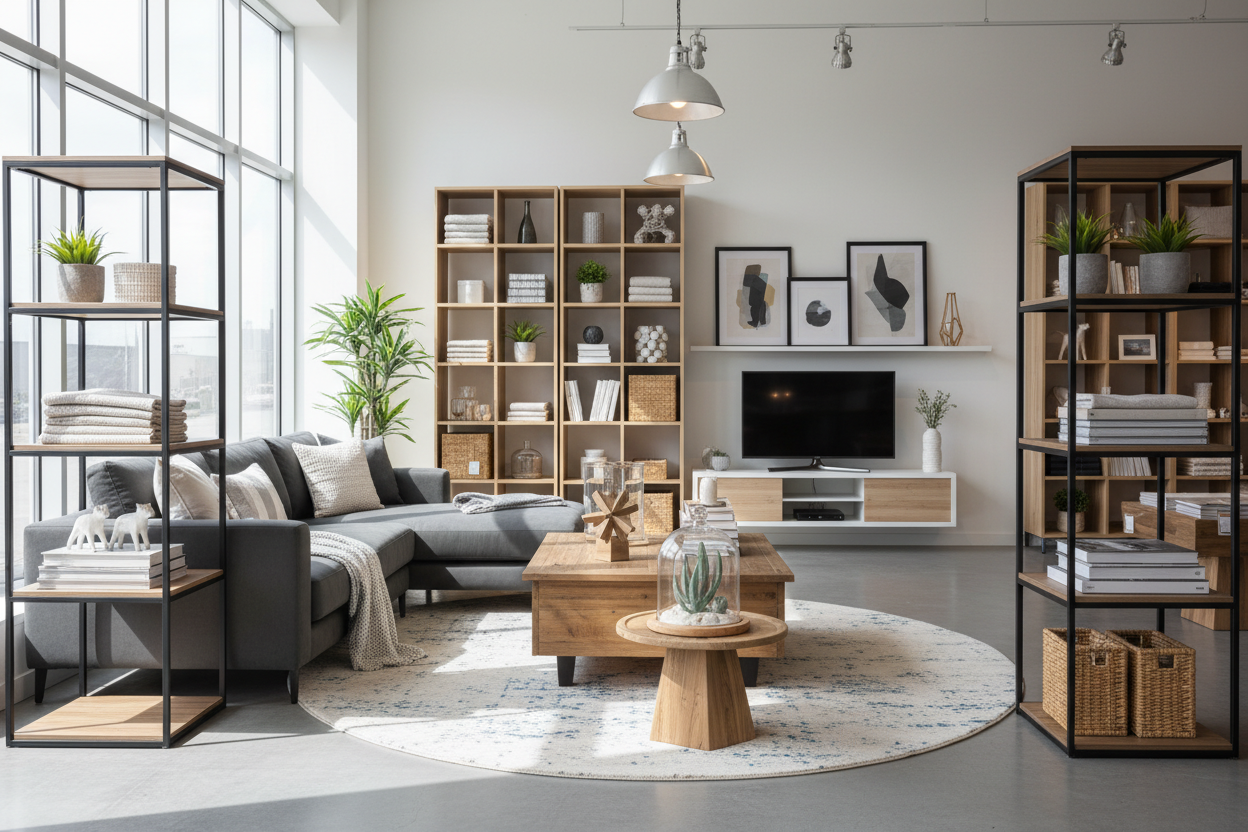
I spent three hours last Sunday rearranging my bookshelves, only to step back and realize my living room looked less like a curated sanctuary and more like a high-end garage sale. It is a common frustration. You buy the nice things, you have the 'good' taste, but somehow the actual floor display in your home feels cluttered rather than intentional. I used to spend my days as a retail merchandiser, and I finally realized I was ignoring every rule I used to follow at work.
Quick Takeaways
- Group items in odd numbers (the 'Rule of Three') to create immediate visual balance.
- Pull furniture away from the walls to create a more architectural, 'boutique' flow.
- Negative space is as important as the objects themselves; let your pieces breathe.
- Integrated lighting is the secret sauce that makes a cheap shelf look like a custom installation.
Your Living Room Needs a 'Visual Merchandising' Reality Check
In a store, every single item is placed with a purpose. A retail floor display isn't just about showing off inventory; it is about telling a story that makes you want to live the life that inventory represents. Most of us treat our homes like storage units—we find a flat surface and we put a thing on it. That is the quickest way to kill the 'vibe' of a room.
Instead, start thinking about a product floor display. If you were selling your favorite ceramic vase, how would you light it? Where would it sit so people could see it from three different angles? When you stop 'storing' your decor and start 'merchandising' it, the room suddenly feels expensive. I started treating my coffee table like a display floor, and the change in energy was instant.
The 'Rule of Three' Isn't Just for Storefronts
The human brain loves odd numbers, specifically three. It is stable but not boring. When I style floor retail displays, I always group items by height: one tall, one medium, one small. This creates a triangle that leads the eye around the collection. If you have a flat row of books, it looks like a library; if you stack three horizontally and top them with a small brass object, it looks like a design choice.
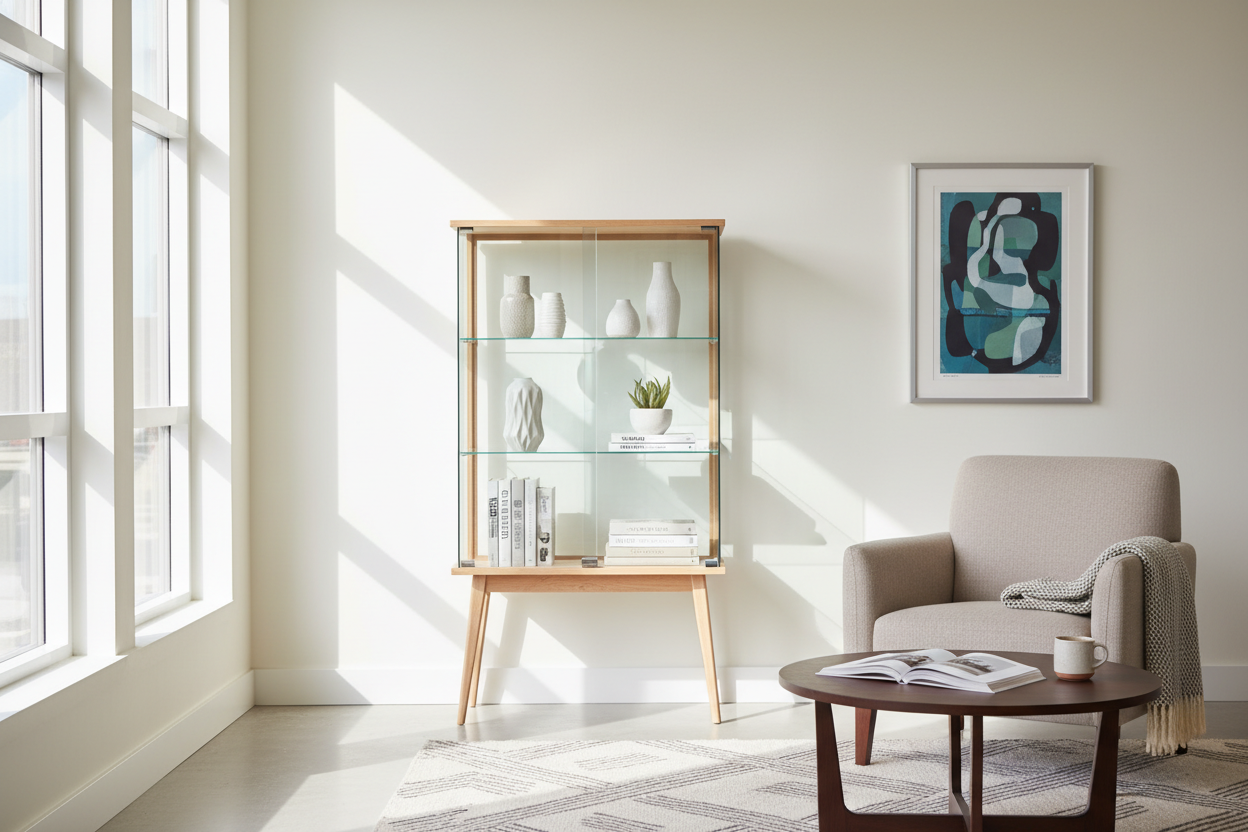
This rule is even more effective when you have a dedicated 'frame' for your items. I have found that the rule of three works best inside a floor standing display cabinet because the glass and shelving provide the boundaries that keep the grouping from looking like it is floating in space.
Stop Pushing Everything to the Walls
The biggest amateur mistake is the 'perimeter' layout—lining every piece of furniture against a wall as if the center of the room is lava. High-end shops use a freestanding retail display strategy to guide people through the space. By pulling a cabinet or a console six inches off the wall, or using it to divide the 'living' area from the 'dining' area, you create depth.
I love using freestanding display cabinets for this. When a piece is finished on all sides and sits proudly in the room, it acts as an architectural anchor. It makes the room feel larger because you are creating 'paths' to walk through, rather than just a big empty box in the middle of the floor. Just make sure the back of the unit isn't that cheap unfinished cardboard—nothing kills the boutique look faster than a view of raw staples.
Lighting Your Display Floor Like a High-End Shop
You can spend five figures on a custom floor display and it will still look like a basement if the lighting is bad. Retailers spend a fortune on lighting because they know it creates drama. Most homes rely on 'The Big Light' (the overhead fixture), which is the enemy of style. It flattens everything out and creates harsh shadows.
Take a page from professional floor display design and add accent lighting. I am a huge fan of $20 LED puck lights hidden under shelves. If you want to get fancy, run a thin LED strip along the back of a shelf. It creates a 'glow' that makes your objects pop. When the sun goes down, your living room should feel like a moody gallery, not a brightly lit pharmacy.
The Exact Cabinets That Fake the Boutique Look
You do not need to hire a carpenter for a custom floor display stand. You just need pieces that have clean lines and enough glass to feel airy. I have seen people try to use heavy, dark wood hutches that look like they belong in a 1990s dining room, and it just weighs the whole space down. You want something that acts as a stage, not the main character.
A tall white glass display case is a personal favorite for this. The white finish disappears against most walls, making the glass and the items inside the star of the show. It mimics that clean, minimalist retail aesthetic without costing three months' rent. I put one in my office for my vintage camera collection, and it is the only thing people comment on during Zoom calls.
Personal Experience: The 'MDF' Disaster
A few years ago, I bought what I thought was a 'heavy duty' display unit for my heavy art books. It looked great for exactly two months. Then, the shelves started to 'smile'—they bowed right in the middle because the material was cheap 1/2-inch particle board. My mistake was prioritizing the look over the weight capacity. Now, I never buy a display unit unless the shelves are at least 3/4-inch thick or reinforced with metal. If you are displaying heavy ceramics or books, do not cheap out on the substrate. Your 'curated' look will quickly turn into a sagging mess.
FAQ
How do I stop my display from looking cluttered?
The 60-40 rule. Sixty percent of the shelf should have items; forty percent should be empty space. If every inch is covered, your eye has nowhere to rest, and it just looks like a mess.
Do I need glass doors for a floor display?
If you hate dusting, yes. Glass doors keep your items clean and add a layer of reflection that makes the room feel more 'finished.' Just be prepared to Windex the fingerprints once a week.
Can I mix different styles in one cabinet?
Absolutely, but keep a common thread. Maybe all the items are the same color family, or they are all made of natural materials like wood and stone. A 'theme' prevents the display from looking random.

Leave a comment
This site is protected by hCaptcha and the hCaptcha Privacy Policy and Terms of Service apply.