










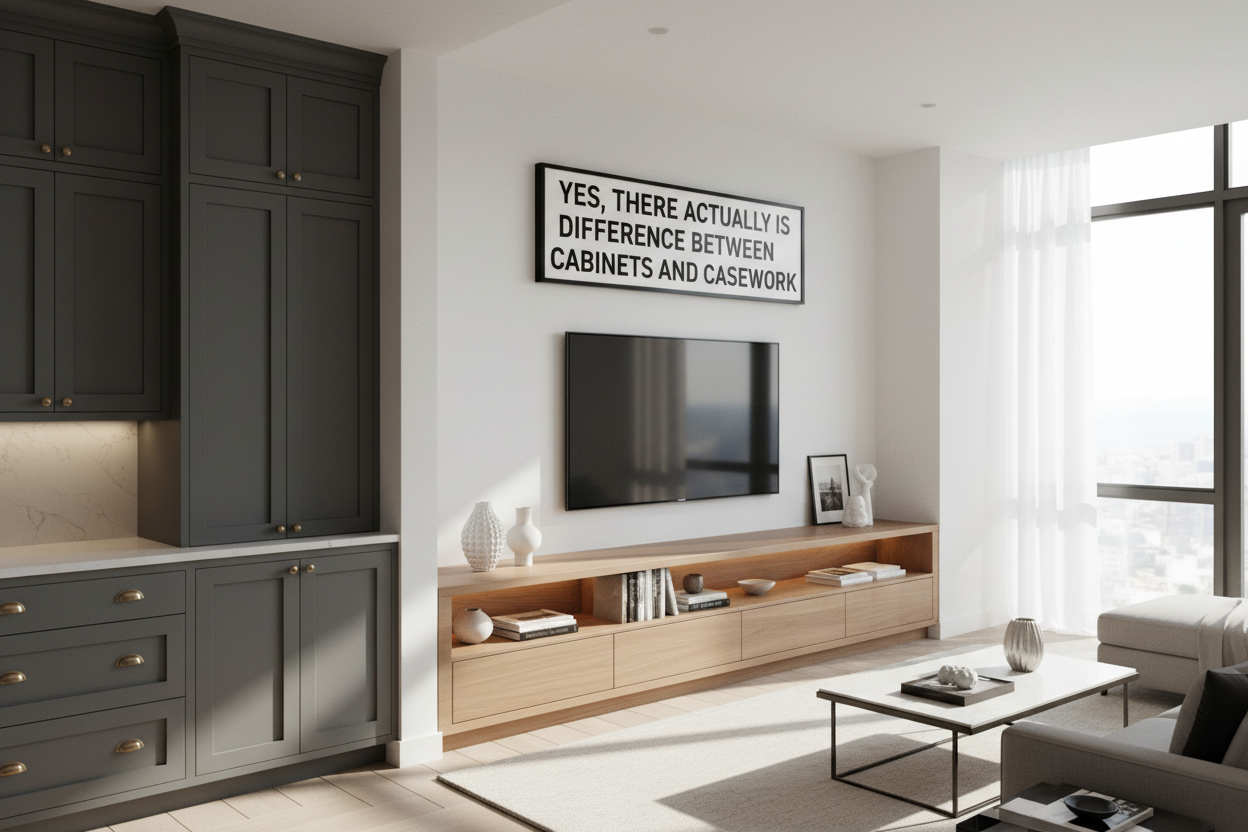
I remember sitting at my kitchen table three years ago, staring at a twenty-page renovation bid that felt like it was written in a dead language. I’d spent months pinning 10-foot-tall library walls and sleek, handle-less kitchens, but the quote in front of me didn't say 'kitchen storage.' It said cabinets and casework. I felt like I was being overcharged for syllables.
If you have ever stared at a contractor’s invoice and wondered why they are charging you for 'casework' instead of just saying 'the boxes that hold my plates,' you are not alone. It is one of those industry distinctions that sounds like pretentious jargon but actually dictates how your house is built, how long it lasts, and—most importantly—how much of your savings account disappears.
Quick Takeaways
- Casework is the umbrella term for box-like storage; cabinets are a specific, functional sub-type.
- Casework is often mass-produced or modular, whereas custom cabinets are usually built to fit a specific nook.
- Millwork refers to the decorative 'jewelry' (trim and molding), while casework is the 'skeleton' of the room.
- Modular casework furniture offers a middle ground for renters who want a built-in look they can actually take with them.
Wait, Aren't They Exactly the Same Thing?
In the simplest terms: all cabinets are casework, but not all casework is cabinets. Think of it like this—casework is the industry’s broad term for 'making boxes.' If a carpenter is building a series of 3/4-inch plywood shells for a hospital, a school, or your home office, they are doing casework. It is the architectural science of creating storage. It covers everything from those open bookshelves in a library to the storage cubbies in a mudroom.
Cabinets, on the other hand, are the specialized version of those boxes. They usually involve doors, drawers, and specific hardware like soft-close hinges or undermount slides. When a pro talks about casework cabinets, they are usually referring to the structural boxes themselves before the fancy finishes are applied. I’ve seen homeowners get frustrated when a 'casework' bid doesn't include the crown molding or the decorative end panels they saw on Pinterest. That is because, in the trade, the box and the beauty are often priced separately.
The distinction matters because casework is often about efficiency and standard dimensions. If you are buying 'stock casework,' you are getting boxes built to 3-inch increments (12, 15, 18 inches wide). If you deviate from those standards, you are moving into the realm of custom casework, where the price per linear foot starts to climb faster than your heart rate during a demo day.
Why Your Quote Separates Casework Cabinets From Trim
When you look at a professional bid, you might see 'Casework' listed at $8,000 and 'Millwork/Trim' listed at $4,000. It feels like double-dipping, but it isn’t. Casework is the functional shell—the 5/8-inch or 3/4-inch melamine or plywood boxes that hold your heavy Le Creuset pots. It’s the industrial part of the job. It’s built for load-bearing and organization, not necessarily for looking pretty on Instagram.
The 'trim' or 'millwork' is the decorative skin. This includes the baseboards, the crown molding, the light valances, and the scribe pieces that hide the gaps where your 100-year-old walls are inevitably crooked. I once worked with a client who tried to save money by DIY-ing the trim on professional casework cabinets. It was a disaster. The boxes were level, but the trim was wonky, making the whole $10,000 installation look like a middle-school woodshop project.
Understanding this separation helps you spot hidden overcharges. If a contractor is charging you 'custom millwork' prices for standard, pre-built boxes, they are padding their margins. You want to pay for the labor where it counts: the installation and the finishing. The boxes themselves? Unless you have a very weirdly shaped room, standard casework is usually more than enough.
Can Casework Furniture Actually Move With You?
This is the gray area I love to play in. Traditionally, casework is 'built-in'—it’s screwed into the wall studs and stays with the house when you sell it. But we are seeing a massive shift toward casework furniture. These are high-quality, modular pieces that look like they were built for the room but are technically freestanding. It’s the ultimate loophole for people who have commitment issues with their floor plan.
For example, instead of spending $5,000 on a permanent media built-in that you’ll have to leave behind, I often suggest buying a high-end freestanding TV stand with cabinets. If it’s built with the same 18mm thick panels and European hardware as architectural casework, it gives you that seamless, integrated look. The difference is that when you move to a bigger place, you just unplug it and go.
I’ve made the mistake of over-investing in permanent built-ins in a rental apartment before. I spent a weekend anchoring 'custom' shelving to a wall, only to have the landlord keep my security deposit for the wall damage, and I lost the shelving anyway. Now, I look for modular casework that uses a French cleat system or heavy-duty leveling feet. It’s the look of a library with the flexibility of a suitcase.
When to Splurge on Custom Casework (And When to Fake It)
Not every room deserves custom casework. If you are doing a kitchen, yes, go custom or semi-custom. The kitchen is a high-traffic zone where 1/16th of an inch can be the difference between a dishwasher fitting or your drawers hitting the oven handle. I always tell people to spend their money on the 'working' boxes—the ones with drawers that will be opened 20 times a day. You want those to be kiln-dried hardwood or high-grade Baltic birch plywood, not the 1.5 lb density particle board that swells the second a sponge touches it.
However, in areas like a mudroom or a laundry room, you can absolutely 'fake' the custom look. Instead of a $4,000 custom locker system, I’ve had great luck installing dedicated shoe cabinets and then adding a simple DIY bench and some chunky hooks. By using standalone units that share a similar color profile, you get 90% of the functionality for 20% of the price.
The secret to 'faking it' is the finish. If you buy standard casework furniture and add high-end, heavy brass hardware (the kind that actually has some weight to it), you trick the eye. People don't notice the box is stock if the handles feel like they belong in a five-star hotel. I once saved a client $6,000 in a master closet by using high-quality modular units and just spending an extra $400 on custom-cut mirrors for the doors. It looked bespoke, but it was basically adult Legos.
My Golden Rule for Mixing Standard and Bespoke Pieces
The biggest mistake I see people make is thinking their entire house has to be one or the other. They either go all-IKEA or all-custom-carpenter. The real magic happens in the mix. I like to use permanent casework for the 'heavy lifting' (pantries, wardrobes) and then break up the monotony with a statement piece of furniture.
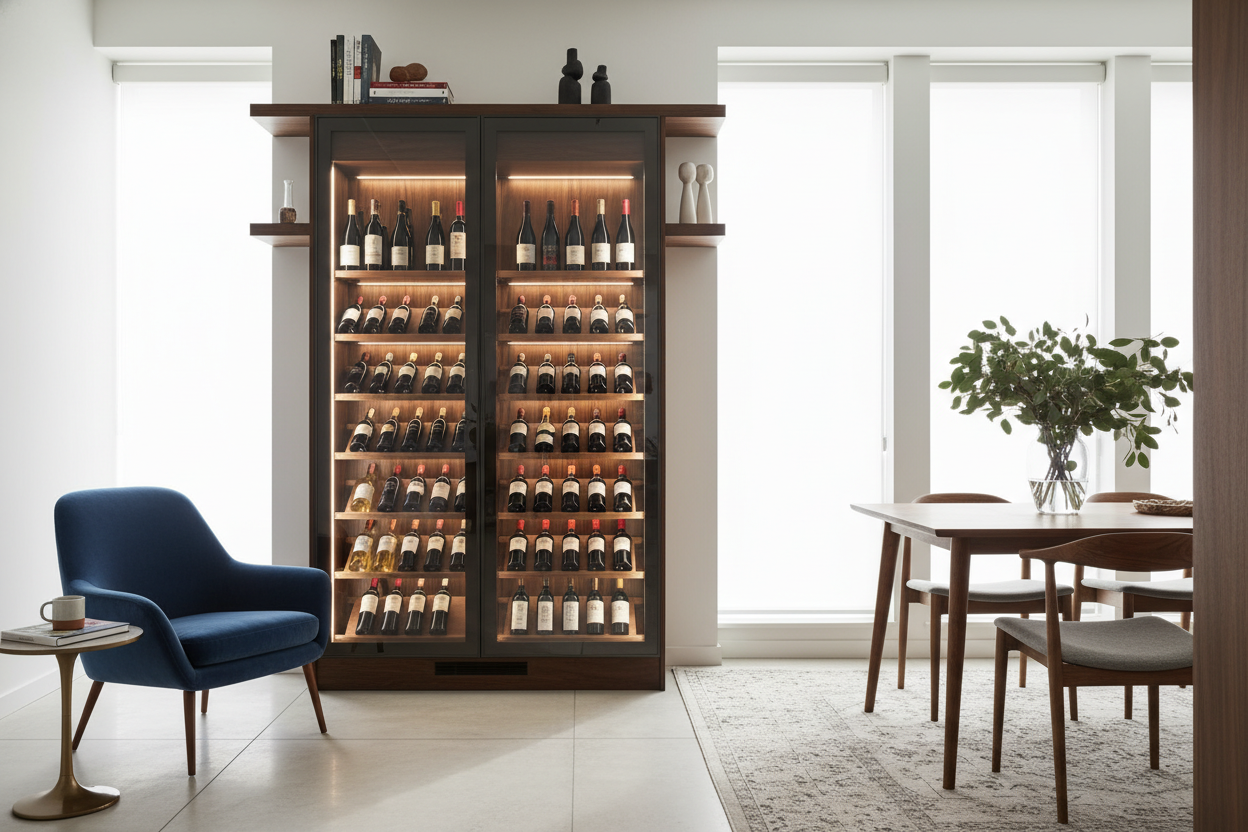
For instance, in a dining room, you might have standard built-in lower cabinets for your linens. But instead of continuing those cabinets to the ceiling, try choosing a classic display case or a vintage hutch to sit nearby. It breaks up the 'wall of boxes' feeling that can make a home feel like a corporate office.
My personal rule? If it’s something you’ll touch every day (like a kitchen drawer), buy the best casework you can afford. If it’s just for looking at (like a display shelf for your weird collection of ceramic owls), go for the standard stuff and spend the savings on a better sofa. I’ve lived with cheap cabinets that literally fell off their hinges after two years—trust me, the 'cheap' option is always more expensive in the long run when you have to buy it twice.
FAQ
Is casework cheaper than cabinetry?
Usually, yes. Because 'casework' often refers to mass-produced, modular boxes with standard dimensions, it costs less than custom cabinetry which is built to the exact inch of your specific space. However, high-end commercial casework can still be pricey because it's built to withstand heavy use.
What is the best material for casework cabinets?
If you want it to last, look for 3/4-inch plywood. Avoid thin MDF or low-density particle board in wet areas like kitchens or bathrooms. Plywood holds screws better and won't turn into oatmeal if your sink leaks for five minutes.
Can I install casework myself?
If you can use a level and find a stud, you can install basic casework furniture. But for a full kitchen of casework cabinets, I’d hire a pro. If the first box is even slightly tilted, the last box in the row will be inches off, and your countertops will never sit flat.


Leave a comment
This site is protected by hCaptcha and the hCaptcha Privacy Policy and Terms of Service apply.