










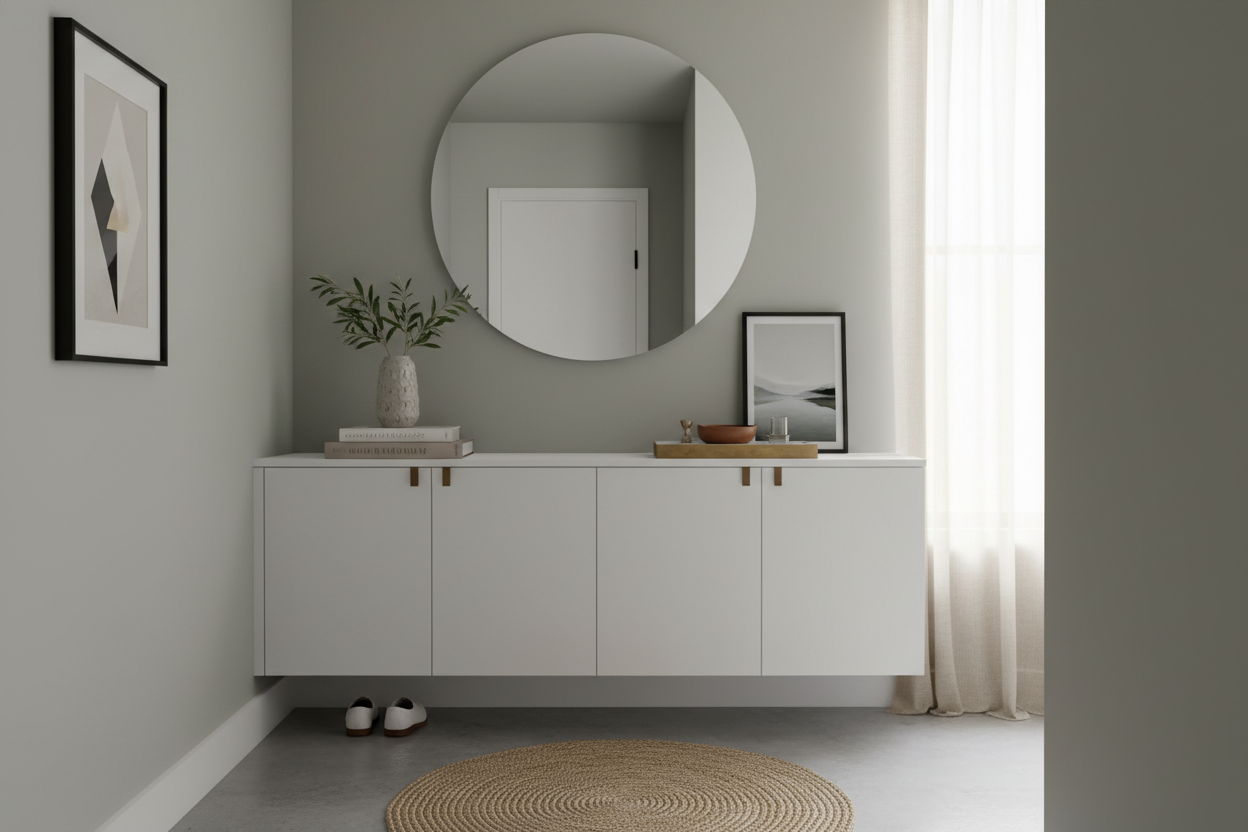
I used to live in a pre-war walk-up with a hallway so narrow I had to exhale just to pass the 'storage' bench I bought at a flea market. Every time I came home with groceries, my right hip would inevitably find the sharp corner of that 16-inch deep monster. It wasn't functional; it was a daily obstacle course that left me with a permanent bruise and a burning resentment for my own furniture choices.
The reality is that most entryway furniture is designed for suburban foyers, not actual city corridors. If you are tired of turning sideways just to reach your kitchen, it is time to admit that your current setup is too fat. A shallow cabinet for hallway storage is the only way to reclaim your floor plan without sacrificing a place to drop your keys.
- Standard consoles (15-18 inches) are too deep for hallways under 40 inches wide.
- A 10-inch depth is the 'sweet spot' for most narrow corridors.
- Wall anchoring is non-negotiable for skinny furniture to prevent tipping.
- Tilt-out drawers are the most efficient way to store shoes in tight spaces.
The Daily Hip-Check (Why Standard Consoles Fail)
We have all been there: you see a beautiful mid-century console online, and the listing says 'compact.' You get it home, assemble it, and suddenly your hallway feels like a submarine. Most 'standard' entryway tables are at least 15 inches deep. In a typical 36-inch wide hallway, that leaves you with 21 inches of clearance. For context, the average person needs about 30 to 36 inches to walk comfortably without feeling like they are in a crawlspace.
When you force a bulky piece into a narrow vein of your home, you aren't just losing floor space; you are losing light and 'visual air.' I have found that swapping a heavy, deep chest for a shallow depth display cabinet or a slim console instantly makes the ceiling feel higher and the walls feel further apart. It stops the hallway from being a 'clutter tunnel' and turns it back into a functional transition zone.
Enter the Shallow Hallway Cabinet: A Total Shift
The magic happens when you drop down to that 9-to-12-inch range. It sounds like a small difference—just five or six inches—but in a hallway, that is the difference between hitting the wall and walking with your arms at your sides. A shallow hall cabinet allows you to have a designated 'drop zone' for mail and masks without creating a bottleneck at the front door.
Before you buy, you have to be ruthless with your tape measure. I always suggest taping out the footprint of the potential cabinet on your floor with painter's tape. Leave it there for 24 hours. If you find yourself stepping on the tape or tripping over it, the piece is too deep. Finding the perfect shallow cabinet for narrow halls requires checking not just the depth of the unit, but how much space you have when the doors or drawers are fully extended.
But What Actually Fits in a 10-Inch Deep Box?
You might worry that a 10-inch cabinet is useless for storage. In my experience, it is actually a blessing in disguise. It forces you to stop using your entryway as a graveyard for things that belong in the garage or the trash. A shallow hallway cabinet is for the high-rotation essentials: your wallet, the dog's leash, sunglasses, and that one pile of mail you actually need to deal with.
I use a 10.5-inch deep unit in my current place, and it holds more than you'd think. The trick is verticality. Instead of one big, deep junk drawer, you get three or four shallow ones. It keeps things organized because you can't physically stack items deep enough to lose them at the back. It’s the ultimate cure for the 'where are my keys?' morning panic.
The Tilt-Out Shoe Trick
If you are trying to hide a shoe mountain, look for tilt-out drawers. These units store shoes vertically, toes down, which allows the cabinet to stay incredibly thin—sometimes as little as 7 or 8 inches. It is a brilliant bit of engineering that beats a traditional rack every time. While a larger shoe storage rack bench cabinet is great if you have a massive mudroom, it’s a death sentence for a narrow apartment hall. The tilt-out method keeps the profile slim while still hiding the visual clutter of your sneakers.
Styling a Shallow Hall Cabinet So It Doesn't Look Like a Sad Box
The biggest challenge with skinny furniture is that it can look a bit 'dorm room' if you aren't careful. Since you don't have the surface area for a massive lamp or a bowl of fruit, you have to think vertically. I like to lean a large mirror or a piece of framed art on the top surface rather than hanging it. It adds depth without taking up an extra inch of space.
For lighting, skip the table lamp—the cord will look messy and the base will take up half your surface. Go with a wall-mounted plug-in sconce instead. If you want to display a collection or some books without the unit looking cluttered, a taller display cabinet with glass doors at the very end of a hallway can provide a focal point that draws the eye down the corridor, making the whole space feel longer and more intentional.
My Golden Rules for Buying Skinny Furniture
First rule: You MUST anchor it to the wall. Shallow furniture has a high center of gravity and a narrow base. If you pull a drawer too hard, the whole thing is coming down. Most units come with cheap plastic anchors; toss those and go to the hardware store for some heavy-duty toggle bolts. Your drywall will thank you.
Second rule: Check your baseboards. Many shallow cabinets don't have a cutout at the back for baseboards, meaning the cabinet will sit an inch away from the wall, creating a gap where your mail will inevitably fall. Look for units with a 'baseboard notch' or be prepared to use a jigsaw to make your own. Finally, check the door swing. If you have a narrow hall, sliding doors or tilt-out bins are always superior to swinging doors that block the entire path when opened.
FAQ
Will my boots fit in a shallow shoe cabinet?
Usually, no. Tilt-out cabinets are great for sneakers, flats, and low-profile shoes. If you have chunky combat boots or heels over 4 inches, you’ll likely need to store those sideways or look for a unit with adjustable internal dividers.
Is MDF okay for a hallway cabinet?
For a shallow piece, MDF is actually fine because it’s lighter and less likely to warp in the humidity of an entryway. However, look for a 'high-grade' veneer or lacquer finish so it doesn't peel if you set a wet umbrella on it.
How do I stop the cabinet from wobbling?
Aside from wall anchors, check if the unit has leveling feet. Hallway floors, especially in older buildings, are notoriously uneven. A tiny adjustment to the front feet can make a cheap cabinet feel like a custom built-in.


Leave a comment
This site is protected by hCaptcha and the hCaptcha Privacy Policy and Terms of Service apply.