










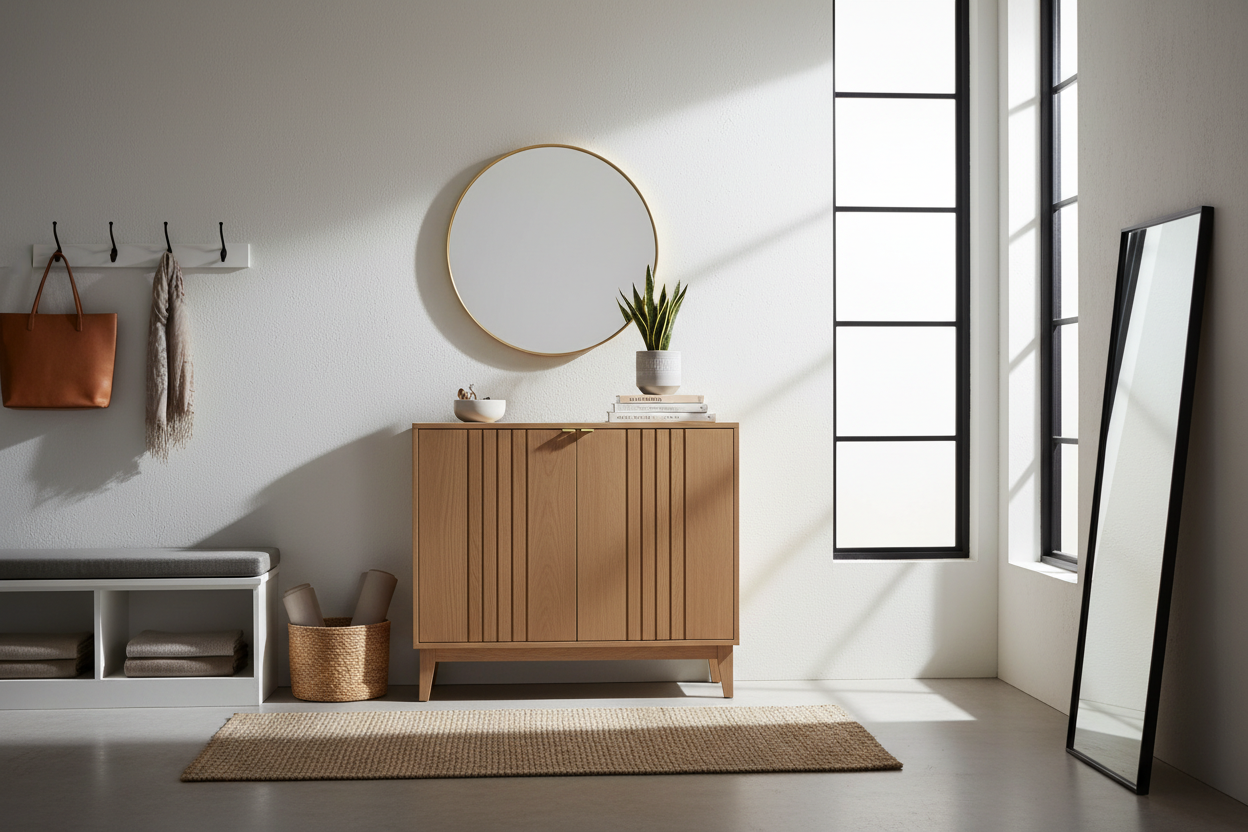
I spent three years staring at a spindly mid-century console table in my entryway, convinced it was the peak of 'minimalist' design. In reality, it was a high-priced dust bunny stadium. Every time I walked through the door, my keys, three weeks of junk mail, and a tangled dog leash ended up in a heap on that narrow top, visible to anyone who dared to knock on my door.
We have been sold a lie that entryways need to be 'airy.' Unless you live in a showroom, airy just means you can see all your mess from the sofa. Swapping that useless table for a medium storage cabinet was the single best decision I made for my sanity. It provides the same surface area for a lamp and a catch-all tray, but it actually hides the chaos of daily life behind solid doors.
Quick Takeaways
- Standard consoles are 'visual clutter' magnets; cabinets hide the mess.
- A medium height (30 to 45 inches) keeps the hallway from feeling like a narrow tunnel.
- Solid doors beat baskets every time for long-term organization.
- Glass doors add depth to small spaces without sacrificing storage.
- Scale matters: if your wall is over 60 inches wide, go for a sideboard instead.
The Problem With 'Aesthetic' Entry Consoles
Pinterest loves an open-leg console table. They look fantastic when styled with exactly one ceramic vase and a single architectural branch. But my life involves bulk packs of AA batteries, half-empty bottles of hand sanitizer, and those 'return to sender' envelopes I keep forgetting to drop off. On a console, that stuff is front and center.
The open space under a console is a trap. You think you'll put a cute basket there, but eventually, that basket overflows with mismatched shoes and umbrellas. You end up with a pile of stuff that’s technically 'stored' but still looks like a disaster. A solid piece of furniture creates a clean visual line that tells your brain the room is tidy, even if the inside of the cabinet looks like a junk drawer exploded.
Enter the Mid-Sized Cabinet (My Storage Goldilocks)
When I talk about a medium cabinet, I’m looking for that 30-to-45-inch height range. It’s high enough to act as a 'drop zone' for your wallet and mail without requiring you to bend over, but low enough that it doesn't swallow the light in a narrow hallway. You want something with a depth of 12 to 15 inches—anything deeper and you’ll be bumping your elbows every time you walk past.
The utility here is unmatched. It’s similar to how a 2 drawer base cabinet is the storage hero in a kitchen; it’s all about having a dedicated spot for the items you use every single day. In a hallway, that means one shelf for outgoing packages and another for the 'stuff I might need later' bin. It turns a transition space into a functional room.
Why Doors Are Always Better Than Baskets
I’ve tried the basket method. I bought the expensive seagrass ones that shed little flakes of dried grass every time you move them. Within a month, they were sagging and dusty. Doors are the superior technology. They protect your stuff from dust, they keep curious pets out of your gear, and most importantly, they provide 'visual peace.'
When you close a cabinet door, the mess ceases to exist. You don't have to perfectly align your shoes or stack your mail in a pleasing gradient. You just shut the door and move on with your life. If you’re worried about the space feeling too heavy, you can always opt for a piece with legs that sit 4-6 inches off the floor to keep some 'breathability' without sacrificing the cupboard space.
How to Keep It From Looking Like a Bulky Box
The biggest fear people have with putting a cabinet in a hallway is that it will feel like a giant wooden box is closing in on them. To avoid this, you need to play with light and reflection. I always suggest choosing a black cabinet with glass doors if you have a lighter wall color. The glass creates an 'eye-hole' that makes the cabinet feel less dense, while the black frame provides a sharp, sophisticated anchor.
Style the top with a tall, skinny lamp to draw the eye upward, and hang a large mirror or a piece of art directly above it. This breaks up the vertical mass of the furniture. If you’re still on the fence about the bulk, read up on why your foyer needs a glass cabinet to see how transparency can balance heavy storage needs without making your entrance feel like a closet.
When You Actually Do Need Something Bigger
There is one exception to my medium-cabinet rule: the 'Great Room' problem. If your entryway opens directly into a massive, open-concept living or dining area, a 36-inch cabinet is going to look like a toy. It will get lost against a long, expansive wall.
In these cases, you need to scale up to fill the visual field. I’d recommend a 59 w sideboard cabinet buffet storage cabinet. It offers the same hidden storage benefits but carries enough weight to ground a large room. It’s better to have one large, intentional piece than three small ones scattered along a wall like an afterthought.
The Time I Bought a 'Paper' Cabinet
I once fell for a very cheap 'medium storage cabinet' online that looked like solid oak in the photos. When it arrived, the 'oak' was actually a contact-paper-style wrap over low-density fiberboard. The first time I put a wet umbrella on top of it, the 'wood' bubbled up like a blister. I learned the hard way: if you're using a cabinet as a daily drop zone, buy something with a real wood veneer or a high-quality lacquer. It needs to handle keys being tossed on it and the occasional damp grocery bag without falling apart.
FAQ
Is a 15-inch deep cabinet too wide for a standard hallway?
Most hallways are 36 to 42 inches wide. A 15-inch cabinet leaves you with 21 to 27 inches of walking space. It’s tight but doable. If you’re worried, stick to 12 inches deep—it’s the sweet spot for most corridors.
Should I anchor a medium cabinet to the wall?
Yes, absolutely. Because these cabinets are often narrower and top-heavy once you put a lamp and decor on them, they can tip. Most come with an anti-tip kit—use it. Your floorboards (and pets) will thank you.
Can I use a kitchen cabinet as an entry storage piece?
You can, but kitchen base cabinets are usually 24 inches deep, which is way too bulky for a hallway. Look for 'accent cabinets' or 'hallway chests' specifically, as they are designed with a shallower footprint.


Leave a comment
This site is protected by hCaptcha and the hCaptcha Privacy Policy and Terms of Service apply.