










I’ve lived in five apartments in six years, which means I’ve spent more time than I care to admit staring at 47 browser tabs of media consoles at 2 AM. There is nothing more soul-crushing than finally unboxing a new television only to realize it looks like a flat-screen popsicle stuck on a toothpick. If your TV is the same width as your stand, your living room will always feel slightly off-kilter.
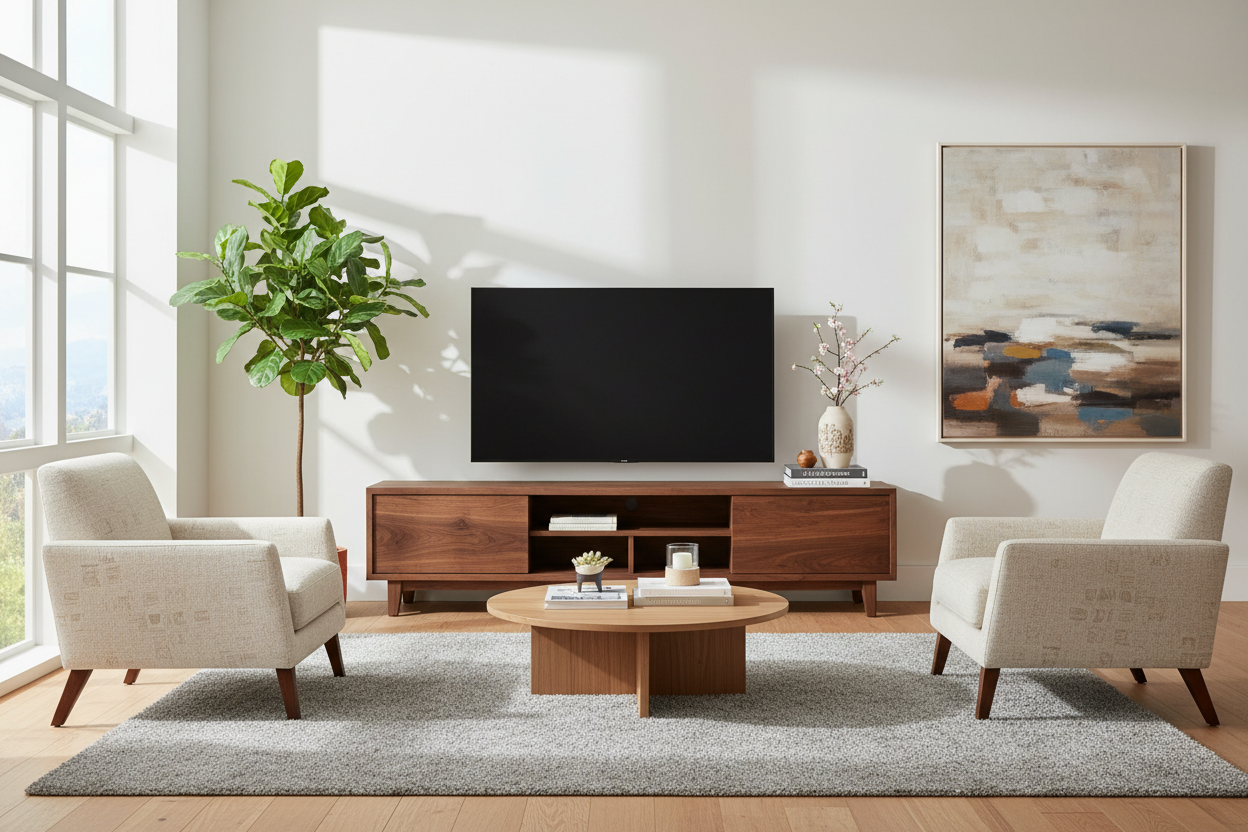
After three moves and two sagging shelves, I realized that a solid wood 60" tv stand is the secret weapon for anyone living in a normal-sized home. It’s the size that actually respects your floor plan while giving your tech the support it needs.
- TVs are measured diagonally, but stands are measured horizontally—don't mix them up.
- A 60-inch stand is the sweet spot for 55-inch and 65-inch screens.
- Real timber prevents the 'center-sag' that kills cheap particleboard units within a year.
- Leaving 3-5 inches of space on either side of the screen creates an intentional, high-end look.
The 'Overhang' Problem Is Ruining Your Living Room
We’ve all seen it: a massive 75-inch screen perched on a console that is exactly 60 inches wide. The screen hangs over the edges like a muffin top, creating a weird sense of physical instability. Even if the legs of the TV fit on the surface, the visual weight is top-heavy. It makes the room feel smaller and more cluttered than it actually is.
Designers call this visual anxiety. When you match your screen width exactly to your console width, you’re making a rookie mistake. You want your base to be the anchor. It needs to be wider than the object it’s holding to create a sense of balance. A 60-inch base gives you that literal and figurative ground to stand on.
Why the solid wood 60" tv stand is the Goldilocks Size
If you go with a 48-inch stand, you’re limited to tiny screens. If you go with an 80-inch behemoth, you’ve just committed an entire wall to a piece of furniture that might not fit in your next apartment. The 60-inch mark is the 'Goldilocks' move because it’s incredibly versatile. It’s large enough to look substantial in a suburban living room but compact enough to fit between the radiator and the window in a cramped city flat.
When you browse TV stands, you’ll notice that 60 inches is where the proportions finally start to make sense. It allows for a 55-inch screen to have about 6 inches of breathing room on either side. That’s just enough space to let the wood grain show through without the console looking like it’s being swallowed by the TV. It’s the ultimate balance of utility and aesthetics.
Wait, Will a 65-Inch Screen Actually Fit?
This is the question that keeps people up at night. Here is the math: a 65-inch TV is measured diagonally. The actual horizontal width of a standard 65-inch screen is roughly 57 inches. This means on a solid wood tv stand 60 inches wide, you have about an inch and a half of clearance on each side. It’s a tight fit, but it looks sleek and modern because the screen doesn't spill over the edge. It’s safe, sturdy, and looks like you actually measured before you clicked 'buy'.
Particleboard Bows Under Pressure (Trust Me)
I once bought a beautiful-looking 'oak finish' console from a big-box retailer. It was $150, came in a flat box, and weighed about as much as a stack of wet cardboard. Six months later, I noticed my TV was leaning. The MDF (medium-density fiberboard) had literally started to smile—bowing in the center under the 60-pound weight of my screen. It was a slow-motion disaster.
This is why I stopped messing around with veneers and started insisting on real timber. When you’re dealing with a 60-inch span, the physics of gravity are not on your side if you’re using glue and sawdust. You need kiln-dried hardwood or high-quality plywood cores to handle the load without warping. If you're wondering is a solid wood tv stand worth it, the answer is yes, if only for the peace of mind that your $1,000 OLED won't end up face-down on the rug.
How to Style the Extra Space Without Adding Clutter
The beauty of having those extra few inches on the sides of your TV is that you can finally add a bit of personality. But don't go overboard. The goal is to soften the 'black box' effect of the TV, not to create a shelf full of dust-collecting knick-knacks. I usually go for a short stack of three art books on one side and a small trailing plant, like a pothos, on the other.
If you’ve opted for a mid century modern tv stand, lean into that minimalist aesthetic. Keep the surface clear of remotes and cables. Use the drawers for the clutter and keep the top reserved for things that actually look good. A single ceramic vase or a vintage candle holder is all you need to make the setup look curated rather than just 'a place where the TV lives'.
FAQ
Can I put a 75-inch TV on a 60-inch stand?
Physically? Maybe, if the legs are close together. Visually? Absolutely not. The TV will be about 66 inches wide, meaning it will hang over the stand by 3 inches on each side. It looks unstable and messy.
Is solid wood too heavy for apartment floors?
Unless you're living in a literal treehouse, no. A 60-inch solid wood console weighs between 80 and 120 pounds. That’s less than a standard human. Your floors can handle it.
How do I hide cables on a solid wood stand?
Look for units with pre-drilled 'media holes' in the back panel. If it doesn't have them, use adhesive cable clips along the back legs of the stand to keep those black wires from dangling like vines.


Leave a comment
This site is protected by hCaptcha and the hCaptcha Privacy Policy and Terms of Service apply.