










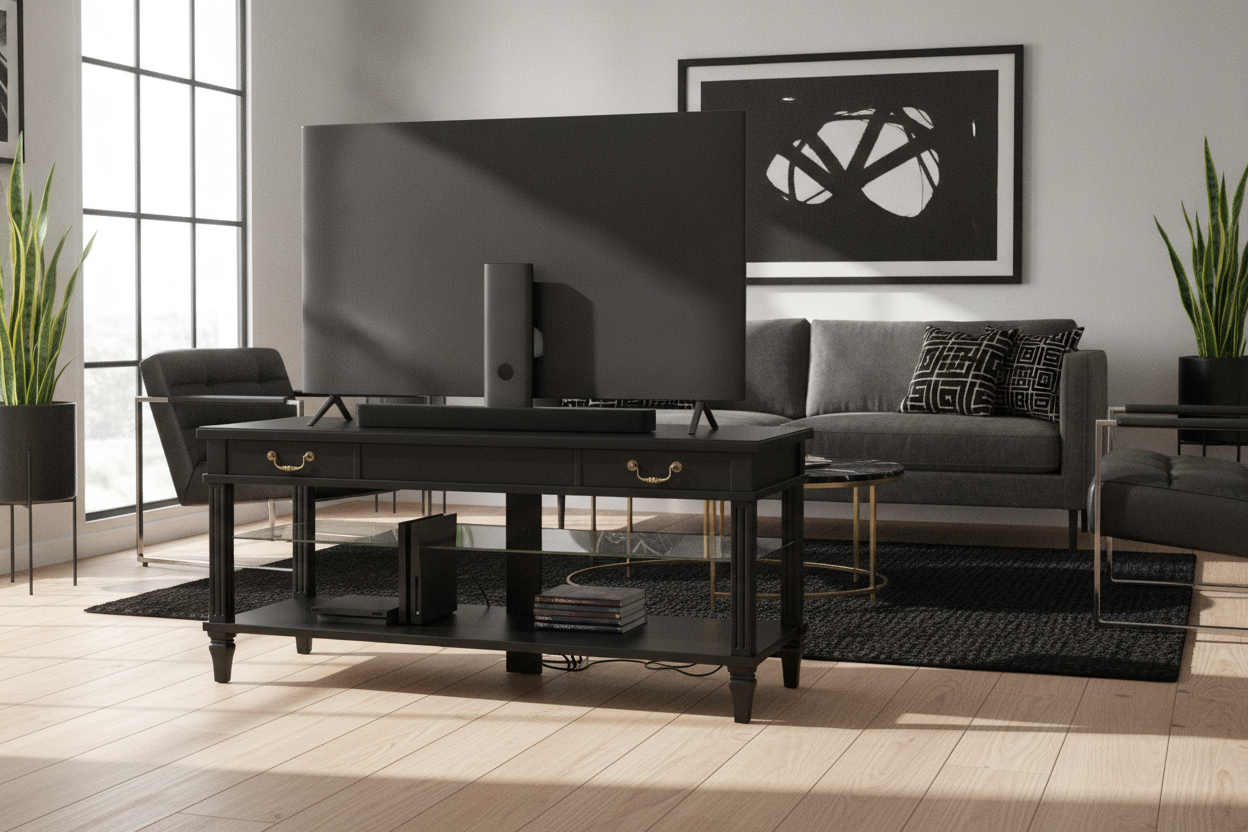
I spent three weeks haunting estate sales for the perfect black vintage tv stand, only to realize my 65-inch OLED looked like a billboard strapped to a postage stamp once I got it home. There is a specific kind of heartbreak that happens when you realize your dream 1960s credenza has zero holes for an HDMI cable. You are left staring at a tangled nest of black wires draped over a piece of hand-carved history, wondering if your aesthetic choices have finally outpaced your common sense.
- Authentic vintage pieces lack ventilation, which can literally bake your gaming consoles.
- Adding cord holes requires a hole saw and nerves of steel to avoid splintering old wood.
- Original ebonized finishes are rare; most 'black' vintage is actually a DIY paint job by a flipper.
- Scale is everything—modern TVs often overhang vintage cabinets by several inches, looking top-heavy.
The Brutal Reality of 1960s Cable Management
Mid-century designers were thinking about record players and maybe a single lamp cord. They were not prepping for a Sonos arc, a PS5, and a bulky mesh router. If you find a retro tv stand black in its original state, the back panel is likely a solid sheet of 1/4-inch plywood or, in higher-end pieces, solid hardwood. There is simply nowhere for the heat to go. I once tucked a cable box into a gorgeous closed-door vintage cabinet, and two hours of Netflix later, the box was hot enough to fry an egg. You have to be willing to modify the piece or leave the doors open whenever the TV is on.
The other issue is the sheer thickness of modern cables. HDMI 2.1 cables are stiff and unforgiving. Trying to snake three of them through a tiny gap between the back panel and the shelf is a recipe for a stripped wire or a broken port. Most vintage pieces have fixed shelves, too, meaning you can't just adjust the height to fit a tall vertical console like the Xbox Series X. You are essentially asking a piece of history to perform a high-tech job it was never meant to do, which often results in a 'cable waterfall' spilling out the sides.
Tools you'll actually need to drill through solid wood
If you are committed to the vintage life, do not just grab a standard drill bit and hope for the best. You need a 2-inch hole saw attachment. Before you touch the wood, put a thick layer of blue painter's tape over the spot you are drilling. This prevents the old, brittle veneer from splintering into a million pieces. Drill slowly from the inside out so any messy exit holes are hidden against the wall. It feels like sacrilege the first time you do it, but it is the only way to keep the setup from looking like a disaster zone.
Why a retro tv stand black finish is so hard to authenticate
Here is the truth: very few pieces from the 50s or 60s were actually painted matte black. You might find some 'ebonized' mahogany or walnut from high-end makers, but usually, if you see a pitch-black piece on Facebook Marketplace, it was spray-painted in a garage last Tuesday. Real ebonized wood still shows the grain texture; it feels like wood, not plastic. If the finish feels thick, sticky in humidity, or perfectly smooth like a car bumper, it is a paint job. This is not always a dealbreaker, but you should not pay 'collector' prices for a piece that was originally orange oak and got a quick coat of Krylon.
I always check the inside of the drawers and the underside of the top surface. If the 'black' stops abruptly and you see raw pine or cheap laminate, you are looking at a flipper project. A genuine vintage piece will have a consistent, aged patina, even in the dark tones. Also, do the smell test. Old furniture has a distinct scent of cedar, lemon oil, or just 'old house.' A fresh flip smells like chemical off-gassing and disappointment. Trust your nose before you hand over three hundred bucks for a 'rare' find.
Modern vs. Vintage: When to just fake the look
There comes a point where the DIY effort exceeds the reward. If you have a massive home theater setup with four different consoles and a dedicated receiver, a vintage cabinet is going to be a functional nightmare. You will end up hacking so many holes in the back that you will ruin the structural integrity of the piece. I have seen beautiful sideboards literally sag in the middle because someone removed too much of the back support for ventilation. It is a painful sight.
If you want the aesthetic without the carpentry, you are better off with a stylish black TV stand entertainment center. These are designed with the weight of modern 75-inch screens and the heat of electronics in mind. They give you the cord management you actually need while keeping that dark, moody silhouette. If you are still on the fence, go ahead and browse modern TV stands that use tapered legs and slat doors to give you that vintage vibe without the 1964 cable limitations. Sometimes 'new-old' is better than 'old-old' when it comes to expensive tech.
How to style it without looking like a haunted Victorian mansion
A heavy black piece of furniture can suck the life out of a room if you aren't careful. To avoid the 'gothic basement' look, you need to balance the visual weight. I always pair my dark furniture with a light-colored rug—think cream or a very pale grey—to create contrast. When styling a black wood TV stand, use brass or gold accents to break up the darkness. A few ceramic vases in organic shapes or a stack of bright coffee table books can make the piece feel intentional rather than heavy.
I am a big fan of keeping a black modern TV stand from looking heavy by using 'leggy' furniture. If the stand sits directly on the floor with a solid plinth base, it looks like a tombstone in your living room. If it is raised on 6-inch tapered legs, it breathes. Add a floor lamp with a warm-toned bulb nearby to cast light across the wood grain. This prevents the stand from becoming a 'black hole' that disappears into the shadows of your room at night.
The Verdict: Is the aesthetic worth the headache?
If you are a purist who loves the hunt and doesn't mind a Saturday afternoon spent with a power drill, a vintage piece is unmatched for character. There is a soul in old wood that MDF just can't replicate. However, for most people, the convenience of pre-drilled holes and heat management wins. I kept my vintage stand for my record player, but my gaming setup lives on a modern piece. It is the only way I could stop worrying about my equipment melting while I was halfway through a movie.
FAQ
Will a vintage stand hold a 75-inch TV?
Probably not safely. Most vintage pieces are narrower than modern screens, and the weight distribution can cause the top of an old cabinet to bow or the legs to splay over time. Stick to 55 inches or smaller for vintage units.
How do I fix a scratch on a black vintage finish?
Use a black wax stick or a furniture touch-up marker. If it is a true ebonized finish, a bit of Howard Restor-A-Finish in Ebony works wonders without needing a full sand-down and refinish.
Is it okay to paint a vintage piece black?
If it is a mass-produced, beat-up piece from a defunct brand, go for it. If it is a signed designer piece like a Wegner or Pearsall, please put the spray paint down. You are destroying thousands of dollars in resale value for a temporary trend.

Dejar un comentario
Este sitio está protegido por hCaptcha y se aplican la Política de privacidad de hCaptcha y los Términos del servicio.