










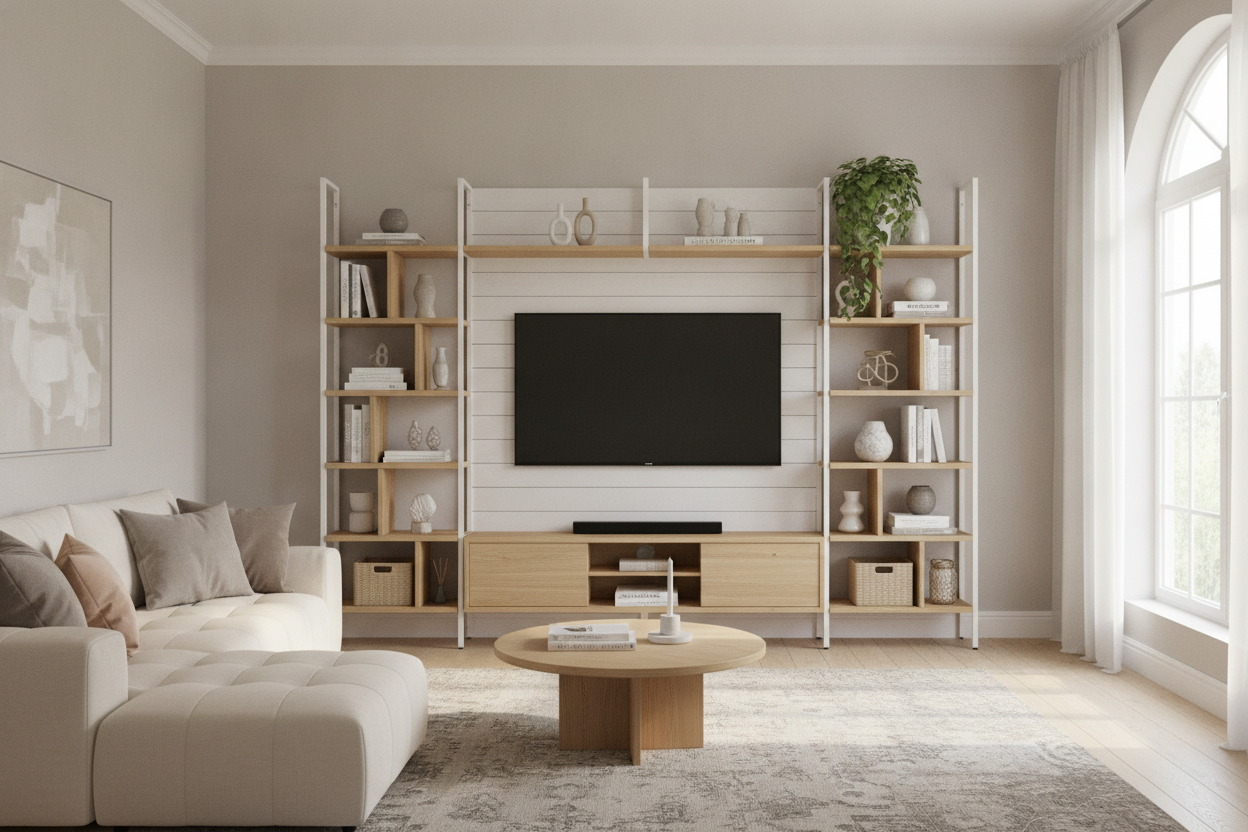
I spent three months staring at a 65-inch black rectangle that seemed to swallow my entire living room wall. It was mounted, sure, but it looked like a lonely piece of tech lost in a sea of beige drywall. I looked into hiring a local carpenter for custom built-ins, but the $6,500 quote nearly gave me a heart attack. Instead, I decided to hack the look using a massive tv wall shelf unit that actually fits my budget and my aesthetic.
- Built-ins cost thousands; a high-end modular system costs a fraction of that.
- Always measure your TV's actual width, not the diagonal screen size, before buying.
- Wall anchors are the difference between a stylish library and a living room disaster.
- Mix textures like ceramic and wood to keep the tech from feeling cold.
The 'Floating Rectangle' Syndrome
There is a specific kind of design sadness that happens when you mount a large flatscreen and realize it just looks... unfinished. I tried a skinny console underneath, but the scale was all wrong. The TV was too big for the furniture, making the whole room feel top-heavy and accidental. I debated just adding a single on wall TV shelf to hold the soundbar, but it didn't solve the problem of the massive blank space surrounding the screen.
To ground a room, you need verticality. A low-profile stand is great for a minimalist loft, but in a standard suburban living room, you need something that draws the eye upward. I realized I didn't just need a place for the remote; I needed a framework that made the TV look like a deliberate part of the architecture.
Why I Chose a Full TV Wall Shelf Unit Over Custom Carpentry
Custom cabinetry is beautiful because it’s seamless, but it’s also permanent. If I decide to move the living room layout in three years, that $6k investment stays with the house. By sourcing a modular system, I got the floor-to-ceiling look without the permanent commitment. The key is finding adjustable shelf storage so you can tweak the heights to fit your tallest art books and your shortest cable boxes.
I went with a dark oak finish that matched my floorboards. When you use a unit that spans at least 70% of the wall width, your brain stops seeing it as 'furniture' and starts seeing it as 'the wall.' That is the secret to the built-in look. It’s about occupying enough visual real estate to command the room.
Finding the Right Wall Shelf Unit for TV Placement
Measurement errors are the most common way this project fails. Most people buy a unit based on the screen's diagonal size, but you need to measure the outer frame. I left exactly three inches of 'breathing room' on either side of my screen. Any tighter and it looks cramped; any wider and the TV looks like it’s rattling around in a box. Using a tall multi tier storage shelf on either side of the central TV cavity creates that symmetrical, high-end library feel that usually requires a contractor.
The Assembly Reality Check
Let’s be real: assembling a twelve-foot-wide shelving system is a weekend-long test of your patience and your marriage. I spent six hours on a Saturday wrestling with cam locks and dowels. My biggest mistake? Thinking I could skip the wall anchors because the unit felt 'heavy enough.' It wasn't. The second I loaded the top shelves with books, I saw a terrifying 1/4-inch lean.
If you are building wall shelves for tv unit layouts, you must find the studs. Toggle bolts are fine for light decor, but for a massive modular system, you want long screws biting directly into the timber. I ended up anchoring the unit in six different places. Now, I could probably climb it (though I won't).
Styling the Shelves So It Doesn't Look Like an Electronics Store
The goal is to camouflage the technology. If you only put gadgets on your shelves, you're living in a Best Buy. I used a 60/40 rule: 60% books and art, 40% functional tech and 'white space.' I also followed the shelf under TV on wall spacing logic, keeping the main media ledge just far enough below the screen to allow for a center-channel speaker without blocking the bottom of the picture.
Trailing plants are your best friend here. A Pothos or Philodendron draped over the edge of a high shelf softens the hard lines of the wall shelf unit for tv and hides those inevitable stray wires that always seem to peek through. It took me three tries to get the shelf styling right, but now the TV is the last thing people notice when they walk in.
FAQ
Is a modular unit sturdy enough for a 75-inch TV?
Absolutely, provided the central bridge or base is rated for the weight. Most modern LED TVs are surprisingly light, but always check the weight capacity of the specific shelf the TV sits on or the wall mount it attaches to.
How do I hide the messy cords?
I used adhesive cable raceways painted the same color as my wall. Many modular units also have 'knockouts' in the back panels. If yours doesn't, a 2-inch hole saw bit and some plastic grommets will make it look professional.
Can I do this in a rental?
Yes, as long as you're willing to patch the anchor holes when you move. Since the unit is freestanding but anchored, it’s much more 'renter-friendly' than actual built-in carpentry that requires tearing into baseboards.


Dejar un comentario
Este sitio está protegido por hCaptcha y se aplican la Política de privacidad de hCaptcha y los Términos del servicio.