










I spent three hours last Tuesday staring at my living room, feeling like I was trapped inside a giant spreadsheet. The sofa is a rectangle. The rug is a rectangle. Even my 'artistic' coffee table is just a slab of wood with 90-degree corners. It felt stiff and clinical, like a waiting room for a very expensive dentist. I realized I didn't need more furniture; I needed a different shape.
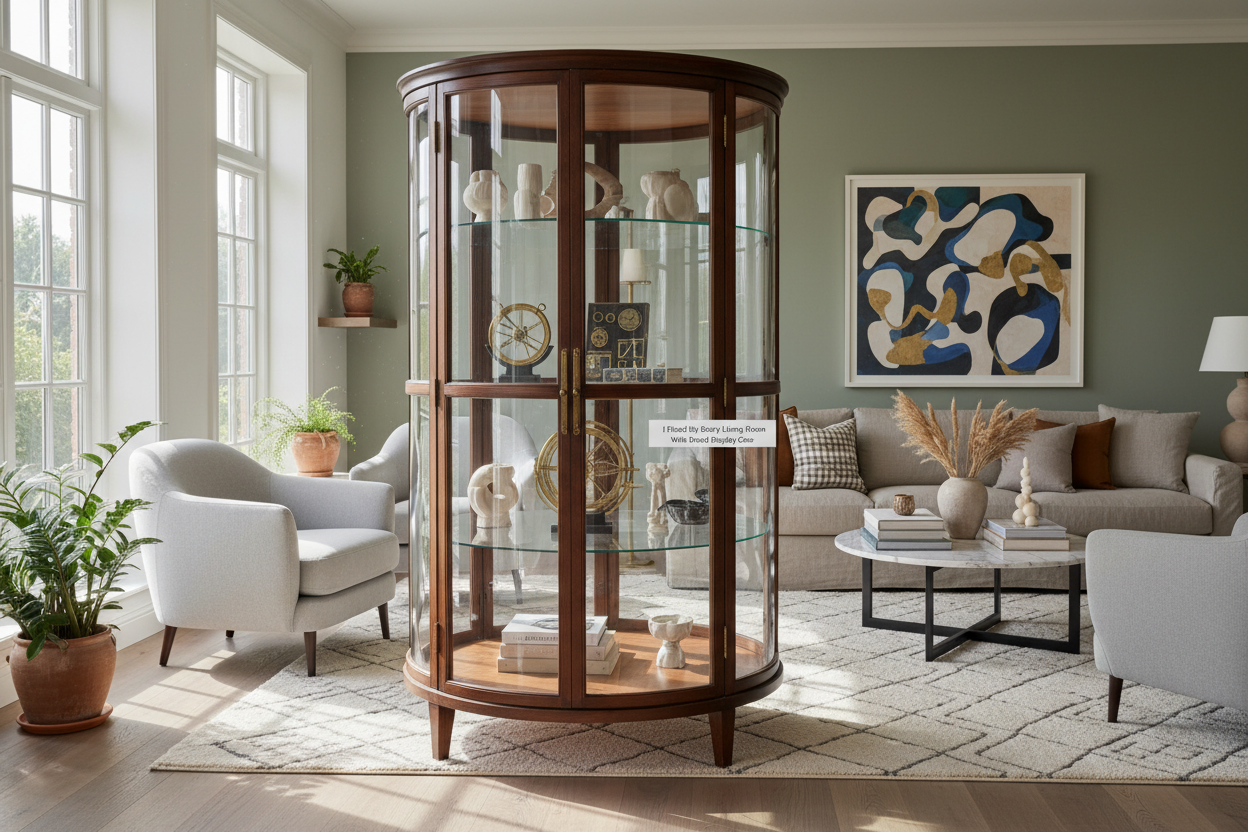
That is when I swapped my heavy, wall-hugging bookshelf for a round display case. It was an immediate relief. Suddenly, the room had a flow that it was missing for three years. The sharp edges of the room were softened by that one simple curve, and for the first time, my favorite ceramics didn't look like they were being stored—they looked like they were being showcased.
- Softens Visual Lines: Breaking up the 'grid' of a standard room makes the space feel bigger and less rigid.
- True 360-Degree Visibility: You can see your items from every angle, which is essential for sculptural pieces.
- Placement Flexibility: Unlike rectangular cabinets, cylinders can float in the middle of a room or sit comfortably in awkward transitions.
- Modern Aesthetic: Glass and acrylic curves feel architectural and high-end compared to standard wood boxes.
The Problem With Too Many Right Angles
Most of us fall into the 'boxy room syndrome' without realizing it. We buy furniture that fits neatly against the walls because it feels efficient. But when every piece of furniture—the TV stand, the sideboard, the shelving—follows the exact same 90-degree logic as the walls, the room starts to feel like a series of containers rather than a living space. It’s visually exhausting.
Introducing a circle display case acts as a visual 'circuit breaker.' It forces the eye to move in a different way. When you walk into a room and see a curved glass silhouette, your brain registers it as a focal point because it’s the only thing not fighting for space against the baseboards. I noticed that my 12x14 living room actually felt more spacious once I added a cylindrical unit because it didn't 'clutter' the wall line the way a traditional cabinet does.
If you feel like your room is too 'linear,' don't buy another rectangular end table. You need something that rounds off the energy. A round glass display case doesn't just hold your stuff; it changes the architecture of the air around it.
Why the 360-Degree View Actually Matters
Traditional shelving is basically a one-way street. You put something on a shelf, and the back of it is dead to the world. That’s fine for books, but it’s a tragedy for handmade pottery, vintage cameras, or that intricate Lego Titanic you spent forty hours building. A round glass display cabinet allows you to appreciate the depth of your objects.
I used to have my grandmother’s tea set in a standard hutch. You could see the front of the cups, and that was it. When I moved them into a 360-degree glass enclosure, I could see the hand-painted details on the back and the way the light hit the glaze from the side. It turned 'storage' into an 'installation.' It’s a completely different experience than what you’ll find in a standard guide to choosing and styling china cabinets, which usually focuses on front-facing organization.
For collectors, this is a massive win. If you’re displaying something with texture or a complex silhouette, you need that wrap-around glass. It makes the object feel like it’s floating in space rather than being pressed against a backboard.
Styling Curves Without Looking Like a Bakery
There is one major risk with a round glass display cabinet: the 'department store' effect. If you aren't careful, a tall glass cylinder can look like a display case for expensive handbags or a rotating rack of muffins at a local cafe. To avoid this, you have to be intentional with your textures and materials.
I recommend mixing organic materials with the glass. If you have a round acrylic display case, don't just fill it with more plastic or shiny metals. Add a piece of driftwood, a stack of linen-bound books, or a matte ceramic vase. The goal is to ground the piece so it feels residential. I personally love the look of a black cabinet with glass doors when it has those curved lines; the dark frame provides a 'weight' that keeps the glass from feeling too airy or clinical.
Also, watch your spacing. In a rectangular shelf, you can line things up like soldiers. In a round case, you need to think in clusters. Group items in the center and leave breathing room near the glass edges. This maintains that 360-degree transparency and prevents the 'cake stand' look.
Where on Earth Do You Put a Cylinder?
The biggest mistake people make with a round glass cabinet is treating it like a square one. They try to shove it flush against a flat wall, which creates these weird, dusty triangular gaps behind the cabinet. It looks like an afterthought. A cylinder needs room to breathe.
The best place for a round display is in a 'transition zone.' Think of that awkward spot between your dining area and the living room, or a wide hallway that feels too empty. Because it doesn't have corners, people can walk around it without bumping into sharp edges. It’s the ultimate piece for an open-concept floor plan because it looks finished from every single side.
Floating It vs. The Dreaded Corner Trap
If you absolutely must put it near a wall, pull it out about six inches. Let the light pass behind it. Shoving a round glass display case into a 90-degree corner is a waste of its potential—you’re basically hiding 40% of the glass you paid for. If you truly have a corner that needs filling, you’re better off asking yourself if a corner cabinet display case worth it for your specific needs, rather than forcing a round peg into a square hole.
I found that 'floating' my round case next to a floor lamp created a beautiful little vignette that didn't feel like it was crowding the room. It feels intentional, like a piece of sculpture itself, rather than just another piece of storage furniture shoved against the drywall.
The Honest Truth About Cleaning Curved Glass
Let’s be real: curved glass is a fingerprint magnet, and it’s a bit more annoying to clean than a flat pane. You can’t just use a massive squeegee and call it a day. The curve requires a bit more 'hand-work.' If you have kids or a dog with a wet nose, you are going to be cleaning this thing once a week.
My secret? Skip the paper towels. They leave lint and streaks that are magnified by the curved surface. Use a high-quality microfiber cloth and a dedicated glass cleaner (or a 50/50 mix of water and white vinegar). Wipe in small, circular motions following the bend of the glass. It takes me about five minutes to do my entire round display cabinet, and the payoff—when the sun hits that glass and it looks invisible—is worth every second of buffing.
FAQ
Is acrylic better than glass for a round case?
Acrylic is lighter and less likely to shatter, which is great if you move often. However, it scratches easily. Glass feels more 'premium' and stays clear longer, but it’s heavy and requires more care during assembly.
Can I put heavy items on the shelves?
Check the weight rating! Many round cases use tempered glass shelves supported by small brackets. I wouldn't put a 30-pound Dutch oven on one, but they are perfectly sturdy for vases, trophies, and most collectibles.
Does a round case take up more room?
Technically, no. Because it lacks corners, it often has a smaller footprint than a rectangular cabinet with the same internal volume. It also 'feels' smaller because you can see through and around it.

Dejar un comentario
Este sitio está protegido por hCaptcha y se aplican la Política de privacidad de hCaptcha y los Términos del servicio.