










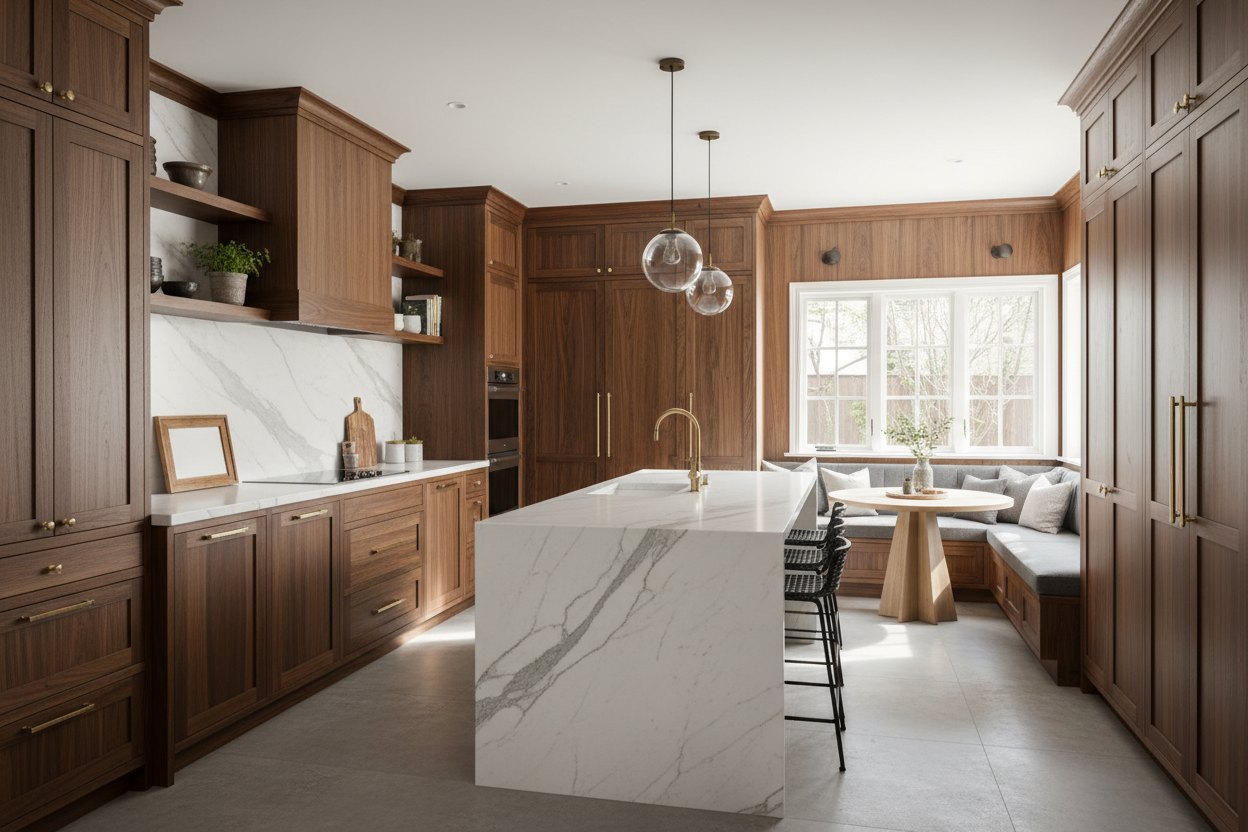
I was standing in my half-finished kitchen, eating cold cereal over a cardboard box, while my expensive farmhouse sink sat in the garage gathering dust. I thought I was being the smartest person in the room by acting as my own general contractor. I had spent weeks comparing quotes, convinced that by sourcing my custom cabinetry and countertops from two different specialist shops, I’d save enough to upgrade my range. I was wrong.
What I actually bought was a three-week delay, two 'trip fees' that wiped out my savings, and a permanent twitch in my left eye. If you are currently staring at two different bids trying to save a few thousand bucks, let me tell you why you should put the spreadsheet down and hire a unified team instead.
Quick Takeaways
- Sourcing separately creates a 'liability gap' where neither vendor takes responsibility for leveling or fit.
- You will likely lose your kitchen for 2-3 weeks because stone fabricators won't template until cabinets are 100% installed.
- A single mistake in a 1/16th-inch measurement can cost you thousands in wasted stone.
- Save the DIY project management for low-stakes areas like mudrooms or home offices.
The 'Save Money' Delusion That Started It All
It started with a $4,200 price difference. One high-end design-build firm quoted me a package for custom cabinets and countertops, and I scoffed. I found a local guy who built incredible 3/4-inch maple plywood boxes for a steal, and a stone yard that had the exact slab of Calacatta marble I wanted for a 'wholesale' price. I figured I could bridge the gap with a few phone calls.
I felt like a pro for about ten minutes. I didn't account for the fact that the design-build firm’s price included project management, templating insurance, and a seamless handoff. By splitting the bids, I became the person responsible for every measurement. If the cabinet guy was off by a hair, the stone wouldn't fit, and it would be my fault—and my bill.
The Finger-Pointing Game (When Things Inevitably Go Wrong)
The nightmare began the day the stone fabricator arrived to template. He pulled out a laser level, looked at the peninsula, and sighed. 'The back-left box is an eighth of an inch lower than the front right,' he said. 'I can’t template this. If the stone cracks because the cabinets aren't level, it’s on you.'
I called the cabinet guy. He insisted his boxes were perfect and that my 1920s subfloor was the culprit. He couldn't come back for four days. The stone guy charged me a $250 'dry run' fee and pushed my installation back two weeks. I was stuck in the middle of two professionals who refused to talk to each other, playing a high-stakes game of telephone while my kitchen remained a construction zone.
Why Templates Are the Enemy of a Sourced-Separately Kitchen
Here is the logistical reality: a stone fabricator will not—and should not—touch your house until the cabinets are permanently bolted to the walls and leveled. This creates a massive bottleneck. If you use one company, they often have a 'pre-template' process or a way to expedite the handoff. They own the timeline.
When you source separately, you are at the mercy of two different calendars. My cabinet guy finished on a Tuesday. The stone guy couldn't template until the following Monday. Then, the stone took 10 business days to cut. That was nearly three weeks of having zero functional counter space, no sink, and no dishwasher. If I had used a unified vendor, that gap is usually narrowed to 3-5 days because they coordinate the handoff internally.
Where You Can Actually Get Away With Splitting Vendors
I’m not saying you can never buy a cabinet without a countertop. There are plenty of 'low-stakes' zones where the tolerances aren't as punishing as a kitchen. If you are setting up a custom built in desk and cabinets in a home office, you can often use a wood top or a pre-cut butcher block that you install yourself. Since there's no plumbing or heavy stone to crack, the risk is minimal.
The same goes for entryways. If you're just looking for a place to hide the kids' sneakers, sticking with pre-made shoe cabinets and adding a simple shelf on top is a weekend project that doesn't require a master stone mason. These areas don't have the same 'perfectly level' requirements as a 600-pound slab of granite.
The Standalone Storage Exception
If you really want to source your own millwork without the headache, look for pieces that don't require a stone top at all. Choosing standalone pantry cabinets or floor-to-ceiling storage units allows you to get that custom look without the templating nightmare. These units are self-contained, meaning you aren't trying to marry two different materials from two different shops in a single horizontal plane.
The 3 Rules I Now Follow for Kitchen Vendors
After my 'frugal' kitchen nearly ended in a divorce and several grey hairs, I’ve developed a strict set of rules for any major renovation. First, the person who installs the cabinets must be the one who signs off on the stone template. This ensures they can't blame each other if the level is off.
Second, insist on a single point of contact. If the stone yard says they don't work with your cabinet maker, find a different stone yard. You want a team that has worked together before. Finally, pay the premium for a 'turnkey' solution. That extra 10% you pay for a managed project is actually insurance against the $500 trip fees and the $2,000 mistakes that happen when you try to be the boss of things you don't fully understand.
FAQ
Can I save money by buying my own stone slab?
Rarely. While the slab price might look cheaper at a wholesaler, most fabricators will charge you more for labor if you don't buy the stone through them. Plus, if the slab breaks during cutting, you are out the cost of the material.
What is the biggest risk of separate vendors?
The 'Levelness' Trap. If your cabinets aren't perfectly level, your stone can crack under its own weight. If the vendors are separate, they will spend weeks arguing over whose fault it is while you have no kitchen.
How long does it usually take between cabinet installation and countertop installation?
With a unified team, it’s usually 5 to 7 days. When you source separately, it’s common for that gap to stretch to 14 or 21 days due to scheduling conflicts between the two companies.



Dejar un comentario
Este sitio está protegido por hCaptcha y se aplican la Política de privacidad de hCaptcha y los Términos del servicio.