










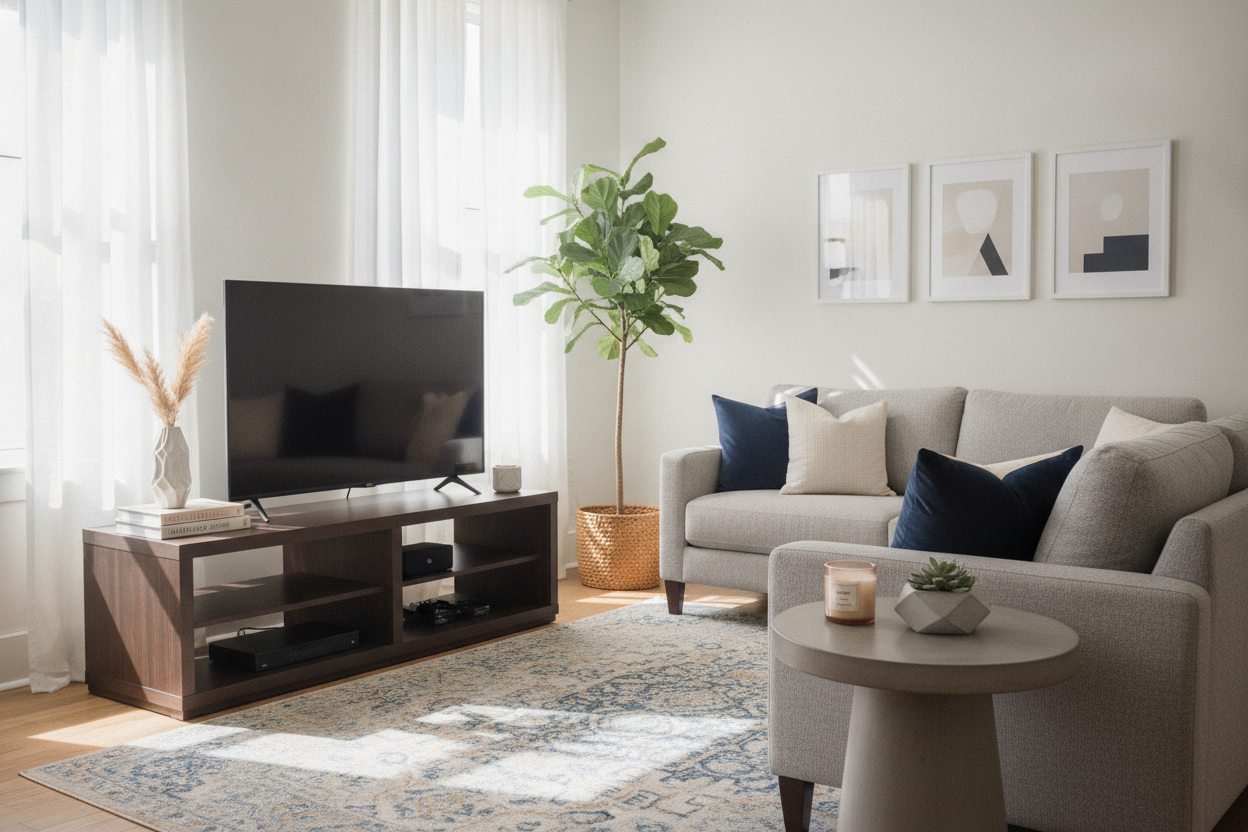
I remember staring at my first 'adult' apartment—a 450-square-foot studio with a 50-inch TV sitting on a $40 particle board unit that barely cleared my shins. It looked ridiculous. The TV was so much wider than the base that the whole setup looked like a giant head on a tiny, fragile body. If you are currently hunting for a small tv stand at walmart, you are likely trying to reclaim some floor space, but most people end up making their living room look like a cluttered waiting room because they choose the wrong proportions.
Quick Takeaways
- Avoid 'The Overhang': Your stand should be at least 2-4 inches wider than your TV frame.
- Aim for Height: In small rooms, a 24-30 inch height prevents the room from feeling 'squat.'
- Watch the Depth: Look for 15 inches or less to keep walkways clear.
- Check the Back: Enclosed backs hide the cord 'spaghetti' that ruins small-space aesthetics.
Why 'Tiny Furniture' Makes Your Room Look Worse
There is a common trap apartment renters fall into: buying miniature versions of everything. We think that if the room is small, the furniture must be shrunken. The reality is that one medium-sized, well-proportioned piece looks significantly cleaner than four tiny pieces shoved into corners. When you buy a stand that is too narrow for your screen, it creates a 'top-heavy' visual that actually makes the walls feel like they are closing in.
I actually traded my giant TV stand for small entertainment units a few years back, and I learned that scale is everything. If the stand is smaller than the TV, your eye focuses on the imbalance rather than the decor. You want a unit that 'grounds' the screen. Even if you only have four feet of wall space, choose a unit that fills that space edge-to-edge rather than a tiny 30-inch pedestal that leaves awkward gaps on the sides.
The Depth Dimension Nobody Talks About
Width and height get all the glory, but depth is what actually kills your floor plan. Most standard media consoles are 18 to 20 inches deep. In a narrow living room, that extra 5 inches is the difference between a clear walking path and bumping your knees every time you go to the kitchen. When browsing for a small entertainment center walmart carries, I specifically filter for 'slim' or 'narrow' profiles.
I found a console last year that was only 13 inches deep. It felt like a revelation. It held the TV, the gaming console, and a few books without protruding into the room like a bulky chest of drawers. If you can find a unit that sits flush against the wall—especially if it has a cut-out for baseboards—you gain back precious square footage that makes the room feel airy instead of cramped.
Height is Your Best Friend in Tight Spaces
The ultra-low, 15-inch-high modern consoles look great in a 2,000-square-foot loft with 12-foot ceilings. In a normal apartment? They make you feel like you are sitting in a beanbag chair at a frat house. When you are working with a small footprint, you need to use the vertical space. A taller unit—think 27 to 32 inches—does a few things for you.
First, it brings the TV to a natural eye level so you aren't craning your neck down from the sofa. Second, it allows for more 'hidden' storage underneath. Instead of just one shelf for a dusty DVD player, a taller unit gives you room for baskets or cabinets to hide the clutter of extra blankets, controllers, and tech junk. It draws the eye upward, which is the oldest trick in the book for making a ceiling feel higher than it actually is.
Where Exactly Do the Cords Go?
The biggest downside of a budget walmart tv stand small design is often the lack of cable management. Many of the cheaper, open-shelf models look great in the staged photos because there are no wires. In real life, you have a black power strip, three HDMI cables, and a bulky router sitting there like an eyesore. If you choose a unit with open shelving, you are committing to a life of Velcro ties and cable sleeves.
I highly recommend looking for units with a solid back panel or at least a 'cord port' (that pre-drilled circle in the back). If you've already bought an open unit, my pro tip is to use a decorative box with a hole cut in the back to house your power strip. It hides the 'spaghetti' and keeps the focus on your TV, not your electrical grid. A small space with visible cords feels 10 times more cluttered than one with clean lines.
My Pre-Shopping Checklist for Big-Box Consoles
Before you drive to the store or hit 'buy' on that small tv stand at walmart, you need to do a literal walk-through of your wall. I once bought a beautiful mid-century unit only to realize it blocked the only heat vent in the room. I had to return it the next day, which is a nightmare when you've already spent two hours sweating over an Allen wrench. Measure the height of your electrical outlets—you want the stand to either hide them completely or sit just below them.
Also, check your baseboards. If you have thick, old-school baseboards, a stand with four straight legs won't sit flush against the wall, leaving a 1-inch gap for pens and dust to fall behind. Look for 'tapered' legs or units with a recessed base. Before committing, my rules for finding a small TV stand Walmart sells that lasts include checking the weight capacity of the top surface. Many cheap units are only rated for 50 lbs, which a modern 55-inch TV can easily push if it has a heavy central stand.
FAQ
Should a TV stand be wider than the TV?
Yes, always. A TV that overhangs the edges of the stand is a major safety hazard and looks visually unstable. Aim for at least 2-3 inches of 'breathing room' on each side of the screen.
Can I use a dresser as a small TV stand?
Absolutely. Dressers are often taller and narrower than media consoles, making them perfect for bedrooms. Just make sure the depth doesn't swallow your floor space and that there is a way to route cables out the back.
What material is best for a budget TV stand?
At Walmart prices, you'll mostly see MDF or particle board. If you want durability, look for 'engineered wood' with a high-pressure laminate finish—it resists scratches and water rings much better than paper-thin veneers.

Dejar un comentario
Este sitio está protegido por hCaptcha y se aplican la Política de privacidad de hCaptcha y los Términos del servicio.