










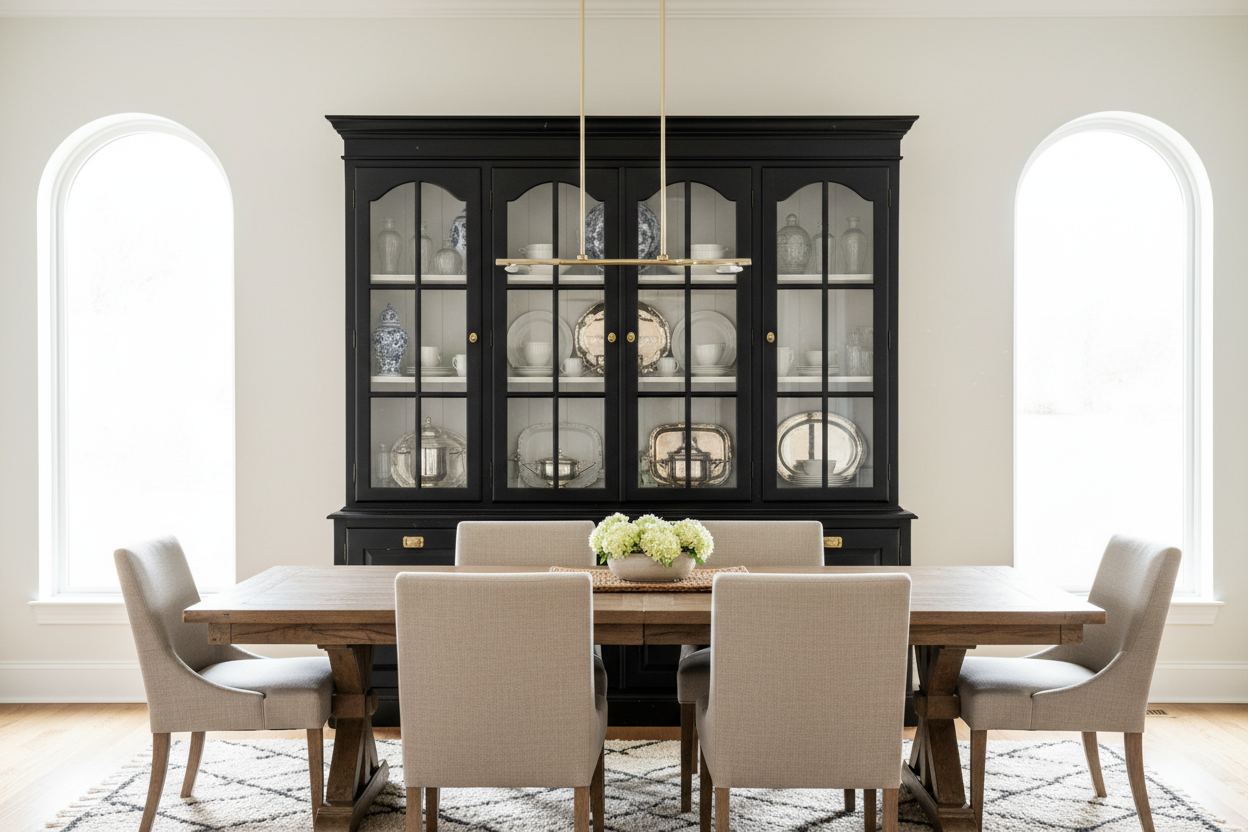
I remember walking into a client's dining room last year. They had just moved into a 1920s colonial and were struggling with a massive, empty wall opposite their farmhouse table. 'We need storage for my grandmother's china,' they said, 'but everything we try either disappears or feels too heavy.' I suggested a black china cabinet. The look on their face was pure skepticism—until we placed a 72-inch black wood china cabinet with glass doors against that wall. Suddenly, the room had a focal point. The black didn't shrink the space; it grounded it, making their white dishes and colorful glassware pop. That's the power of this piece.
Quick Takeaways
- A black china cabinet acts as a visual anchor, adding depth without overwhelming a room.
- Glass doors are non-negotiable for display; look for at least 1/4-inch tempered glass for safety.
- Consider scale: a 60-72 inch wide cabinet fits most standard dining rooms (10x12 feet or larger).
- Black works with any style—pair a modern black metal cabinet with industrial decor, or a distressed black chalk-painted hutch with farmhouse.
- Leave 18-24 inches of clearance on either side for traffic flow and to prevent a cramped feel.
Why a Black China Cabinet Works in Any Dining Room
Think of your dining room. Maybe it's open-concept, flowing into your kitchen. Or perhaps it's a formal, enclosed space. In over 200 homes, I've found that the common challenge is creating definition. A large piece of furniture can do that, but color is key. A white or natural wood cabinet can blend in, especially against light walls. A black china cabinet creates instant contrast. It's a design anchor. In a modern loft with concrete floors, a sleek black china cabinet with clean lines and glass doors adds sophistication. In a cozy farmhouse, a black distressed china hutch with visible wood grain feels warm and collected, not stark. The color black recedes visually, so the cabinet feels substantial without dominating. It also makes everything inside it—your china, glassware, heirlooms—the star. For contemporary spaces, this principle is key. A Modern China Cabinet in black can be that secret upgrade, providing storage while acting as a minimalist art display.
Choosing Your Perfect Black China Cabinet: Styles and Materials
Not all black cabinets are created equal. The finish and construction dictate the style. Let's break it down.
Modern Black China Cabinet: Look for flat-panel doors, often with minimal framing. Materials are often engineered wood with a high-gloss or matte lacquer finish, or powder-coated metal. Key feature: integrated LED lighting. It's not just for show—LEDs emit little heat, protecting your china. A piece like the Modern Black 5 Tier Curio Cabinet uses sliding glass doors, which save space in tighter rooms.
Vintage/Antique Black China Cabinet: This is often solid wood—oak, mahogany—that's been painted or stained black over time. Look for details: turned legs, carved moldings, glass with beveled edges. The black may be uneven, which adds character. A true antique will have signs of wear on the hardware and interior shelves.
Distressed or Chalk-Painted Black China Hutch: This is the DIY darling. Chalk paint adheres well without extensive sanding. The 'distressed' look is achieved by lightly sanding edges after painting to reveal the wood or a base coat underneath. It's perfect for a relaxed, cottage-core or farmhouse vibe.
Farmhouse Black China Cabinet: Think simpler lines than antique, often with a mix of materials. A black and wood china cabinet might have a black frame with natural pine shelving inside. Look for X-shaped details on the sides or chunky, square legs.
Material Matters: For longevity, solid wood or plywood boxes are best. Particleboard is lighter and cheaper but can sag over time under the weight of dishes. Glass doors should be tempered. If you're exploring options, browsing a Black Cabinet With Glass Doors Collection can show you the range of styles all in one place.
How to Style and Arrange Your Black China Cabinet
This is where the magic happens. An empty black cabinet can feel like a dark void. A well-styled one is a curated collection. First, lighting. If your cabinet doesn't have built-in LEDs, add battery-operated puck lights or a slim LED strip to the top interior. This casts light downward, eliminating shadows on your items.
Next, layering. Don't line everything up in a single row. Place taller items (a vase, a cake stand) at the back. Layer shorter items (bowls, teacups) in front. Use stands to elevate smaller pieces. Group by color or material for impact—all your white ironstone on one shelf, colored glass on another.
Protection is practical. Felt pads under heavy platters prevent scratches. For very fine china, consider plate stands rather than stacking. Leave some negative space. You don't need to fill every square inch. A few intentional gaps let the eye rest and make the display feel curated, not cluttered. These styling principles hold true whether it's in your dining room or entryway. For more on that, see tips for a Perfect Black Entryway Cabinet.
DIY Transformation: Painting Your Existing Cabinet Black
I had a client with a 1990s oak china hutch she hated but couldn't afford to replace. We painted it. Here's the honest process. First, empty it and remove doors, hardware, and glass. Clean every surface with a degreaser—grease from hands is the enemy of paint. Lightly sand all surfaces with 120-grit sandpaper to rough up the finish. Wipe away all dust.
Now, the paint choice. Chalk paint (like Annie Sloan or Rust-Oleum Chalked) requires minimal prep and dries with a matte, velvety finish. It's forgiving for beginners. Apply 2-3 thin coats with a high-quality brush, sanding lightly between coats with 220-grit paper. For a traditional lacquered look, use a bonding primer first, then a cabinet-grade enamel (like Benjamin Moore Advance). This is more durable but shows brush strokes more easily; a small foam roller can help.
For a distressed look: after your final coat of black chalk paint dries, use fine sandpaper to gently rub edges, corners, and raised details. Wipe clean. Always finish with a protective topcoat—a clear wax for chalk paint or a polyurethane for enamel. Reassemble carefully. The downside? It's a weekend project, and if the original finish is laminate, adhesion can be tricky without a specialty primer.
Integrating Your Black China Cabinet into Your Home
Placement is everything. In a dedicated dining room, the wall opposite the entry or perpendicular to the table often works best. In an open-plan space, use it to define the dining zone. For example, place it behind your dining table, acting as a backdrop. Ensure there's at least 36 inches of walkway between the cabinet and other furniture.
Pairing is key. A modern black metal china cabinet looks stunning with a live-edge wood dining table. A black antique china cabinet can be balanced with lighter, simpler sideboards or buffets. Don't be afraid to mix. A black cabinet can be the dark element that ties together a room with a Modern Rustic Wood China Cabinet and lighter chairs. The goal is cohesion, not matchy-matchy. Let the black cabinet be the statement, and keep surrounding pieces more subdued.
FAQ
Will a black china cabinet make my small dining room look smaller?
Not necessarily. Because black recedes, it can actually create depth. The key is to ensure it's proportionate (don't choose an 84-inch wide cabinet for a 8x10 room) and to use interior lighting to make it feel like a glowing display, not a dark mass.
What's the difference between a china cabinet and a hutch?
Technically, a hutch has a lower closed cabinet (often for storage) with an upper open shelving unit. A china cabinet is typically one tall unit with glass doors. The terms are often used interchangeably now. A black china cabinet hutch often refers to that two-piece farmhouse style.
Can I put a black china cabinet in a room without natural light?
Yes, but lighting is even more critical. You must install interior cabinet lighting. Without it, the cabinet will absorb light and feel cavernous. With good LED lighting, it becomes a source of ambient light and visual interest.
Is black timeless, or is it a trend?
In my two decades of design, black casegoods have never gone out of style. The finishes change (high-gloss was huge in the 2010s, matte is popular now), but the color itself is a classic neutral, like white or navy. It's a safe long-term investment.

Leave a comment
This site is protected by hCaptcha and the hCaptcha Privacy Policy and Terms of Service apply.