










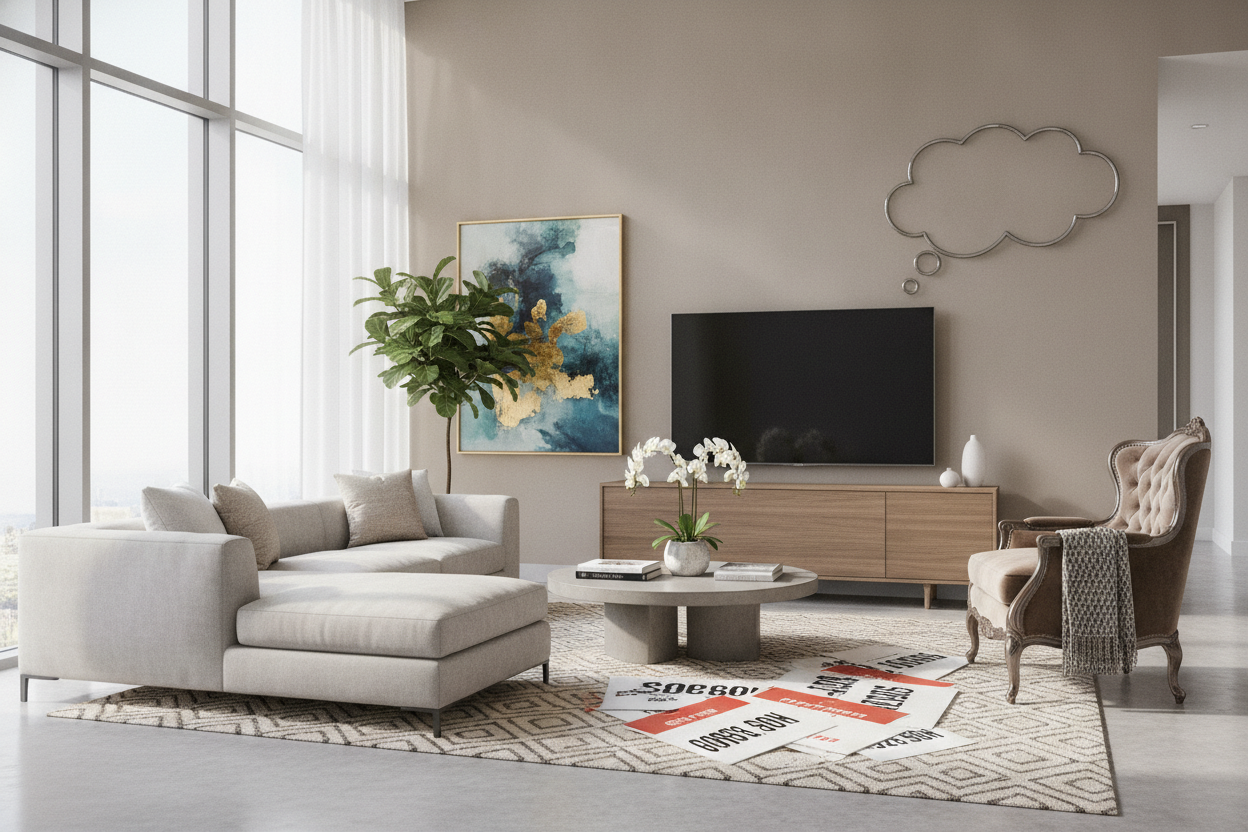
I remember standing in a high-end showroom three years ago, running my hand over a walnut-stained console priced at $1,200. I almost bought it until I realized the 'solid wood' felt suspiciously like plastic under the finish. Having spent years as a wholesale buyer, I knew that piece likely cost the retailer $250. If you are currently staring at a dozen browser tabs wondering how much is t v stand markup actually costing you, prepare to be annoyed.
Quick Takeaways
- Most big-box retailers use a 'Keystone' markup, doubling the price twice before it hits the floor.
- The $300 to $600 range is a 'dead zone' where you often pay for better marketing, not better materials.
- Genuine solid wood consoles rarely exist under the $600 mark.
- Buying locally to save on shipping often results in paying a premium for low-grade MDF.
The Big Furniture Store Markup Secret
When you walk into a traditional furniture store, you aren't just paying for wood and screws. You are paying for the massive air-conditioned showroom, the salesperson’s commission, and the 'free' cookies in the lobby. In the industry, we call it 'Keystone' pricing. A manufacturer sells a stand for $150, the retailer marks it to $300, and then they often bump it to $599 so they can 'discount' it back to $450 during a holiday sale.
I’ve seen units with a landed cost of $80 retailing for $350. That is a 430% markup on a piece of furniture that is essentially glued-together sawdust. The sticker price is almost never an indicator of how long the piece will last; it is an indicator of how much rent the store pays.
The $100 vs. $500 Trap (Spoiler: It's the Same Particle Board)
This is where most people get burned. You see a $120 stand on a budget site and a $480 stand at a mid-tier mall store. They look identical in photos. You assume the $480 one must be 'better.' Most of the time, it isn't. They both use 15mm MDF (Medium Density Fiberboard) or particle board cores.
The only difference is the 'paper.' The cheap one uses a thin, matte paper laminate that peels if you spill water. The mid-tier one uses a slightly thicker melamine or a paper-thin wood veneer. When shopping for TV stands in this price bracket, you are often paying for the brand name and the photography, not the structural integrity. If it isn't solid wood or high-grade plywood, don't spend over $300.
At What Price Are You Actually Getting Solid Wood?
If you want a piece that won't sag under the weight of a soundbar after six months, you have to look for the $600+ threshold. This is where you move away from cam-lock connectors and toward actual joinery. You want to see 'kiln-dried hardwood' or 'solid mango wood' in the specs, not 'wood solids' (which is just a fancy way of saying scraps glued together).
For example, a high-quality mid-century modern TV stand with slatted doors usually sits in the $700 to $900 range. At this price, you should expect soft-close hinges and cord management that isn't just a jagged hole cut into a cardboard backer. If you're paying $800 and the back panel is still a piece of flimsy 1/8-inch thick fiberboard held on by tiny nails, you're being ripped off.
Stop Searching for a '65 in TV Stand Nearby' Just to Save on Shipping
I get the impulse. You just bought a massive new screen and you want it off the floor today. You start googling a 65 tv stand nearby or a 65 in tv stand nearby hoping to find a local warehouse deal. The problem? Local 'liquidation' centers and big-box hubs specialize in high-volume, low-quality units that are heavy as lead but weak as cardboard.
Shipping a 100-pound box is expensive, so local stores often compensate by stocking the cheapest possible materials to keep the final price 'competitive.' These bulky units are often not sturdy enough for a 65-inch television, which can weigh 60+ pounds. I once saw a 'local deal' console literally buckle in the center because the span was too wide and the MDF couldn't handle the tension. Buying online from a specialist often gets you better materials for the same total price, even with shipping included.
The Real Budget You Need for a Console That Lasts
If you want something that survives a move and doesn't look like college furniture, the sweet spot is $400 to $700. In this range, you can find 'mixed media' pieces—metal frames with high-quality veneers or solid wood accents. Avoid the $200 'all-wood' claims (they are lying) and don't feel the need to spend $2,000 unless you are buying a handmade piece from a local carpenter.
My personal rule? If I can pick up the entire box by myself, it’s probably too flimsy for a large TV. If the hardware comes in a bag of 400 tiny silver screws, it’s going to wobble. Look for weight, look for real wood species names, and ignore the 'original price' tags that retailers use to make you feel like you're winning.
FAQ
Is a $200 TV stand ever worth it?
Only if you plan to never move it. Cheap MDF doesn't handle being disassembled and reassembled. It’s a 'one-and-done' purchase for a guest room or a rental you'll leave it in.
How can I tell if it's real wood?
Look at the edges. If you see a repeating grain pattern that wraps perfectly around a 90-degree corner, it’s a paper wrap. Real wood has end grain and slight imperfections in the texture.
Why are some stands so much heavier than others?
Weight usually comes from density. High-density fiberboard (HDF) is better than particle board, but solid wood is the gold standard. However, some cheap brands add heavy metal weights to the base just to make the unit feel 'premium' in the box.

Leave a comment
This site is protected by hCaptcha and the hCaptcha Privacy Policy and Terms of Service apply.