










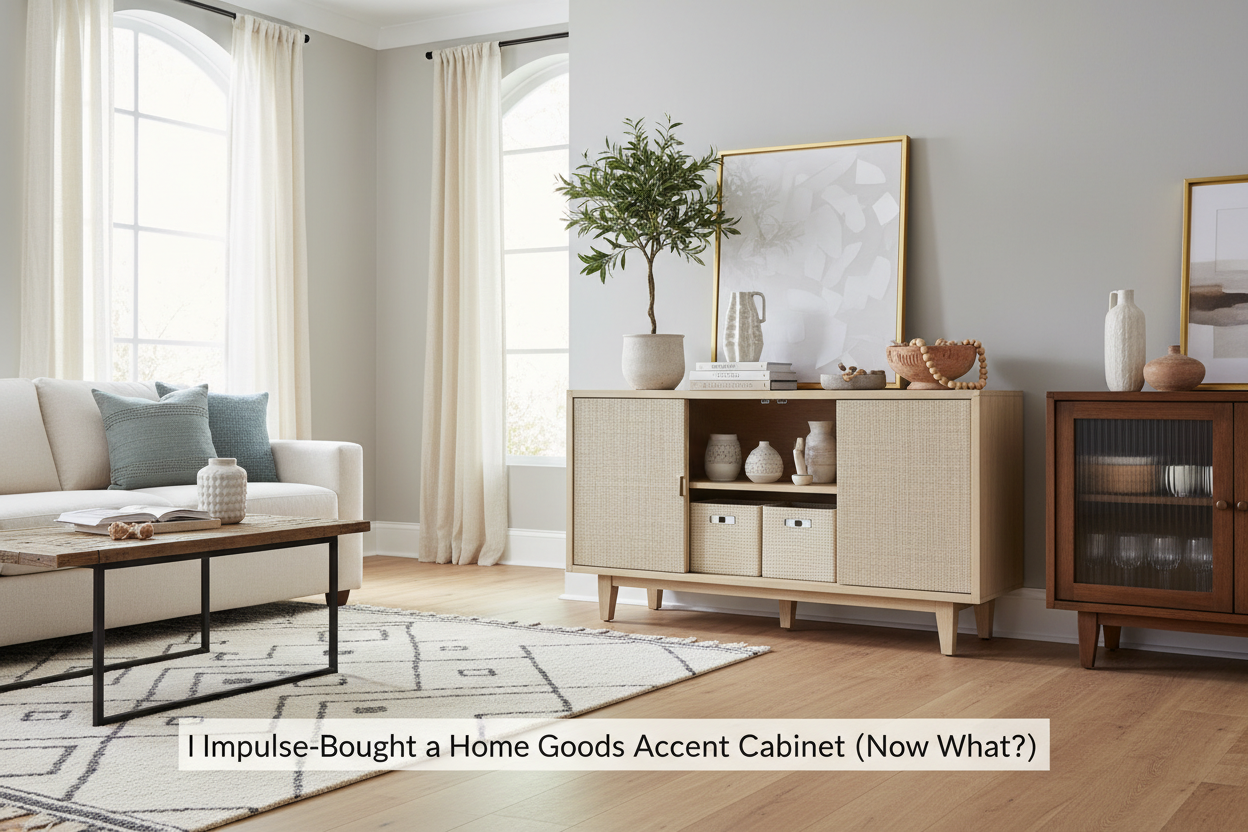
We have all been there. It is 7:15 PM on a Tuesday, you went in for 'just one thing,' and suddenly you are staring at a home goods accent cabinet with hand-carved doors and a price tag that feels like a steal. It looks incredible under those bright warehouse lights, surrounded by a sea of similar treasures. You buy it, wrestle it into your trunk, and haul it into your living room only to realize it looks like a total stranger moved in without asking.
The 'showroom goggles' effect is real. In the store, that quirky piece represents a vibe you want to have. At home, next to your actual sofa and your actual rug, it often looks like a beautiful mistake. I have spent years testing, returning, and eventually mastering the art of the 'odd piece' integration. Here is how to make that impulse buy look like a high-end design choice.
- Check the Scale: If it is under 30 inches tall, it is likely too short for most modern sofas.
- Mind the Undertones: Do not mix orange-y oaks with cool, grey walnuts unless you want a headache.
- Function First: A cabinet without a job is just a clutter magnet.
- Anchor with Contrast: Stop trying to match your existing wood; it will never look right.
The Danger of 'Showroom Goggles'
Shopping at HomeGoods is a sport. The inventory moves fast, the prices are low, and the dopamine hit of finding a 'one-of-a-kind' piece is addictive. This environment creates 'showroom goggles.' You see a piece in a vacuum, stripped of the context of your own home’s lighting, ceiling height, and existing color palette. You are not just buying a cabinet; you are buying the thrill of the hunt. I once bought a teal-distressed accent cabinet home goods find that I thought would be my 'pop of color.' In reality, it looked like a garage sale accident because my walls were already a warm beige. It clashed so hard I couldn't even look at it for a week.
The store's layout is designed to make everything feel accessible and exciting. When you are maximizing space with home goods finds, you often ignore the technical specs. You forget that your ceilings are ten feet high while the store's ceilings are thirty. That 34-inch cabinet looks substantial in an aisle, but it shrinks to the size of a nightstand once it hits your massive living room wall. Before you commit, pull out your phone and actually check the dimensions against your space. If you don't, you are just buying a very heavy paperweight.
Why Your New Piece Looks Like a UFO Landing
The most common reason an accent cabinets home goods purchase fails is a conflict of wood undertones. Most affordable furniture uses veneers or stained pine. If your floor is a cool-toned grey-wash oak and you bring in a warm, honey-toned cabinet, they are going to fight. They don't have to match perfectly—in fact, they shouldn't—but they need to be in the same temperature family. If one is 'yellow' and the other is 'blue,' the new piece will never feel grounded.
Then there is the issue of scale. I see this constantly: people buy a 'cute' cabinet and place it on a long, empty wall. It looks like a tiny island in a giant ocean. A standard sideboard should be between 30 and 36 inches tall. Many homegoods accent cabinet options are actually closer to 28 inches, which is fine for a bedside table but looks ridiculous next to an 84-inch sofa. If the piece is too small, it lacks the visual weight to anchor the room, making it look like a temporary placeholder rather than a permanent fixture.
How to Ground a Random Cabinet So It Belongs
If you have already brought the piece home and the 'Return' window feels too daunting, do not panic. You can fix this with intentional styling. The goal is to stop the cabinet from looking like a standalone object and start making it look like part of a 'moment.' This requires two things: visual contrast and a clear purpose.
Anchor It With Contrast
Stop trying to find a wood stain that matches your dining table. You will fail, and the 'almost-match' looks cheaper than a deliberate mismatch. Instead, lean into contrast. If you have a room full of light oak, go for a black cabinet with glass doors. The dark weight of the piece creates a focal point that feels intentional. It tells the eye, 'I am here on purpose,' rather than 'I am trying to blend in and failing.'
Contrast isn't just about color; it is about texture. If your room is full of soft fabrics and matte finishes, a cabinet with a high-gloss lacquer or metallic hardware provides the necessary 'bite' to wake up the space. Use the top of the cabinet to bridge the gap—place a lamp with a base that matches your other furniture to tie the two worlds together.
Give It a Highly Specific Job
A random cabinet in a hallway is just a place to drop mail. A cabinet styled as a dedicated beverage station is a lifestyle choice. If your impulse buy feels out of place, give it a strict job description. Turn it into a home coffee cabinet with wine shelf. By adding a tray of glassware, a coffee maker, or a stack of art books, you justify its existence.
When a piece has a function, the eye forgives a lot of design sins. Suddenly, it is not 'that weirdly small cabinet;' it is 'the bar.' I once took a low-slung cabinet that was too short for my entryway and moved it into the dining room to hold my record player. By adding a large piece of art above it to 'stretch' the vertical height, it became the coolest spot in the house. Specificity is the antidote to the 'random furniture' vibe.
When to Cut Your Losses
Sometimes, despite your best styling efforts, the piece just doesn't work. Maybe the quality is lower than you realized—if those hinges are wobbling and the 'wood' is actually thin MDF that sags under the weight of a lamp, it is time to move on. Furniture should solve problems, not create new ones. I have learned the hard way that keeping a piece you hate just because it was a 'good deal' is a waste of mental energy and floor space.
If you find yourself constantly moving the cabinet from room to room trying to find a spot where it doesn't look 'off,' that is your sign. Sell it on Marketplace or return it. Next time, go in with a plan. Focus on choosing the perfect cabinet and sideboard by measuring your space first and sticking to a color palette that actually exists in your home. The best 'treasure' is the one that actually fits.
FAQ
What if the cabinet is too short for my wall?
Hang a large vertical mirror or a piece of art about 6-8 inches above the cabinet. This draws the eye upward and creates the illusion that the furniture takes up more vertical space than it actually does.
Can I change the hardware on a Home Goods cabinet?
Absolutely. Swapping out cheap, generic knobs for heavy brass or matte black pulls is the fastest way to make a $200 cabinet look like a $1,000 designer piece. Just check the 'center-to-center' distance of the holes before buying new ones.
Are these cabinets sturdy enough for a heavy TV?
Usually, no. Most accent cabinets are rated for 30-50 lbs on top. A large modern TV can exceed that, and more importantly, these pieces are often top-heavy and lack the structural bracing needed for expensive electronics. Check the weight capacity sticker inside the drawer first.

Leave a comment
This site is protected by hCaptcha and the hCaptcha Privacy Policy and Terms of Service apply.