










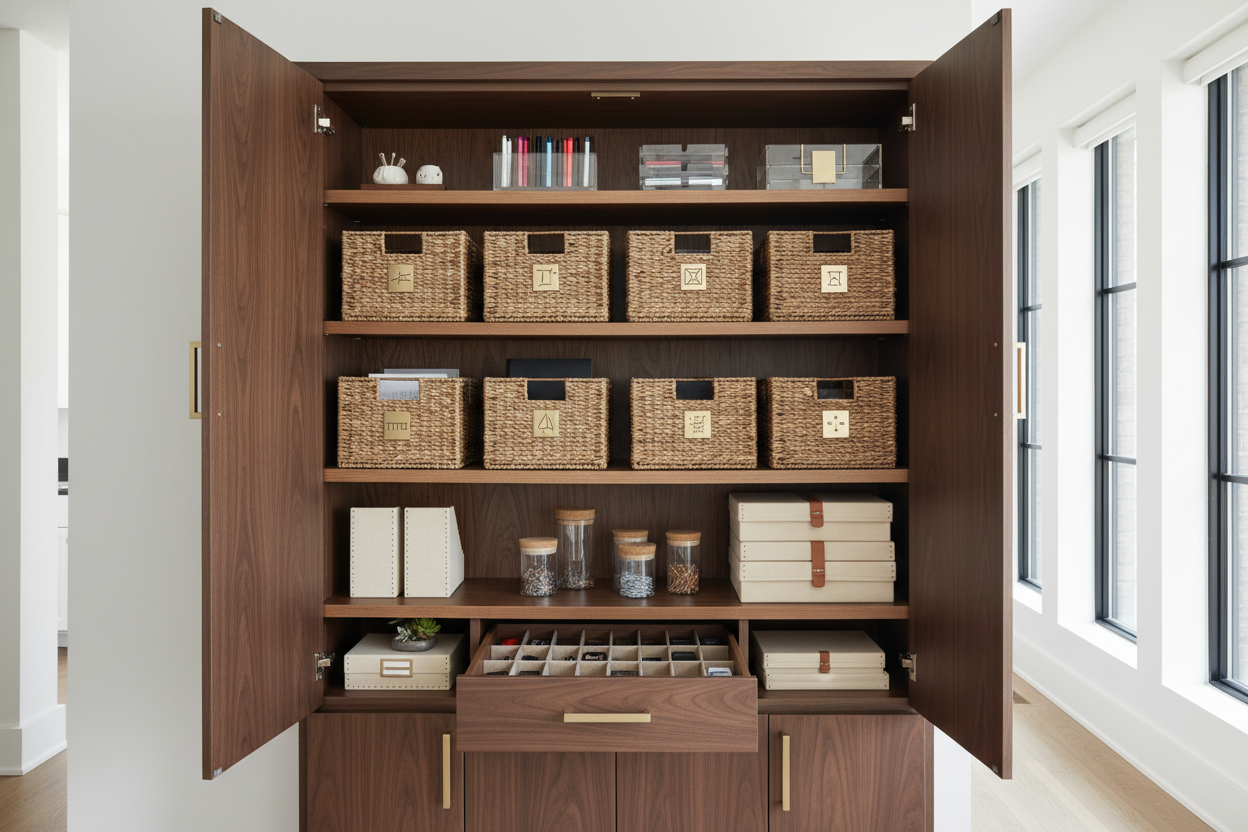
There is a distinct difference between a cabinet that is simply 'full' and one that is curated. As a designer, I often walk into stunning home offices where the visible surfaces are pristine, but opening a drawer reveals a chaotic avalanche of pens, cables, and paper. This disconnect breaks the visual calm necessary for high-level work. True office cabinet organization is not just about hiding the mess; it is about creating an infrastructure that supports your workflow while maintaining the sophisticated aesthetic of your room.
Key Principles for Storage Efficiency
- Zoning Hierarchy: Place daily essentials at waist-to-eye level; relegate archives to top or bottom shelves.
- Visual Weight: Use opaque bins for visual clutter (cables) and clear acrylics for beautiful stationery.
- Material Continuity: Match your organizers to the cabinet finish (e.g., bamboo inserts for walnut cabinets).
- Negative Space: Fill shelves only to 80% capacity to allow for retrieval ease and future accumulation.
Zoning Your Workflow: The "Prime Real Estate" Rule
When planning your layout, treat your cabinet space like a city plan. The most accessible areas—usually the top drawer of a desk cabinet organizer or the middle shelves of a tall unit—are your "downtown." This is where items you touch daily must live. If you have to crouch or stand on a stool to reach printer paper you use every day, the design has failed ergonomically.
For the deeper, less accessible recesses, utilize a work cabinet organizer system designed for long-term storage. This is where tax documents from three years ago belong, neatly labeled in uniform boxes that fit the cabinet depth perfectly.
Material Selection: Elevating "Cheap" to "Chic"
One of the most frequent questions I field is how to handle cheap office storage solutions without ruining the room's vibe. The secret lies in texture and uniformity. You can utilize budget-friendly plastic bins, but they must be uniform in color (preferably matte white or charcoal) to reduce visual noise.
However, for open shelving or glass-front cabinets, I always advise clients to invest in natural materials. A woven hyacinth basket or a leather-bound tray adds warmth and texture that plastic simply cannot replicate. If you are using an office supply cabinet organizer made of metal mesh, ensure the finish matches your cabinet hardware to create a cohesive, built-in look.
The Micro-Organization of Small Supplies
Broad categories are easy; it is the paperclips, staples, and USB drives that create the mess. Avoid the temptation to dump these into a single drawer. Instead, employ modular drawer dividers. A well-fitted office cabinet organizer should act like a bento box, giving every item a specific compartment. This prevents items from sliding to the back—the dreaded "drawer drift"—every time you close the cabinet.
Lessons from My Own Projects
I want to share a specific failure from a project I did about five years ago to save you the headache. I designed a gorgeous, high-gloss white office for a tech consultant. To maintain that sleek look, I specified clear, rigid acrylic bins for everything inside the drawers.
It looked incredible on installation day. However, three months later, the client called me. The issue wasn't the organization—it was the sound. Every time he threw a metal stapler or a heavy hard drive into those hard acrylic bins, it made a loud, cheap-sounding clack. Furthermore, the acrylic scratched almost immediately, looking cloudy and worn.
I learned a valuable lesson that day: acoustics and tactile feel matter just as much as looks. Now, I almost exclusively use felt-lined organizers or soft-touch silicone trays for clients who use their supplies heavily. It dampens the sound and protects both the organizer and the supplies. It’s a small detail, but it makes the furniture feel significantly more luxurious.
Conclusion
Organizing your office cabinets is an investment in your mental clarity. By selecting the right materials, respecting ergonomics, and paying attention to the tactile experience of using your storage, you transform a simple cupboard into a tool for productivity. Take a weekend to audit your space, purge what you don't need, and implement a system that looks as good as it functions.
Frequently Asked Questions
How do I organize a cabinet that is very deep?
Deep cabinets are notorious for becoming "black holes." The best solution is to use pull-out bins or install after-market sliding drawers. If that isn't an option, place rarely used items in the back and use a wide, shallow tray in the front that can be easily lifted out to access the rear.
Can I mix and match different organizer styles?
While you can mix materials, try to keep a consistent color palette. For example, mixing bamboo and white metal works well, but mixing bamboo, clear plastic, and black wire mesh creates visual chaos. Cohesion is key to a calm mind.
How do I maintain the organization long-term?
The "one-in, one-out" rule is essential for office supplies. Additionally, label your hidden storage. It might seem redundant, but a subtle label on a bin prevents you from shoving a charging cable into a box meant for envelopes simply because you were in a rush.

Leave a comment
This site is protected by hCaptcha and the hCaptcha Privacy Policy and Terms of Service apply.