










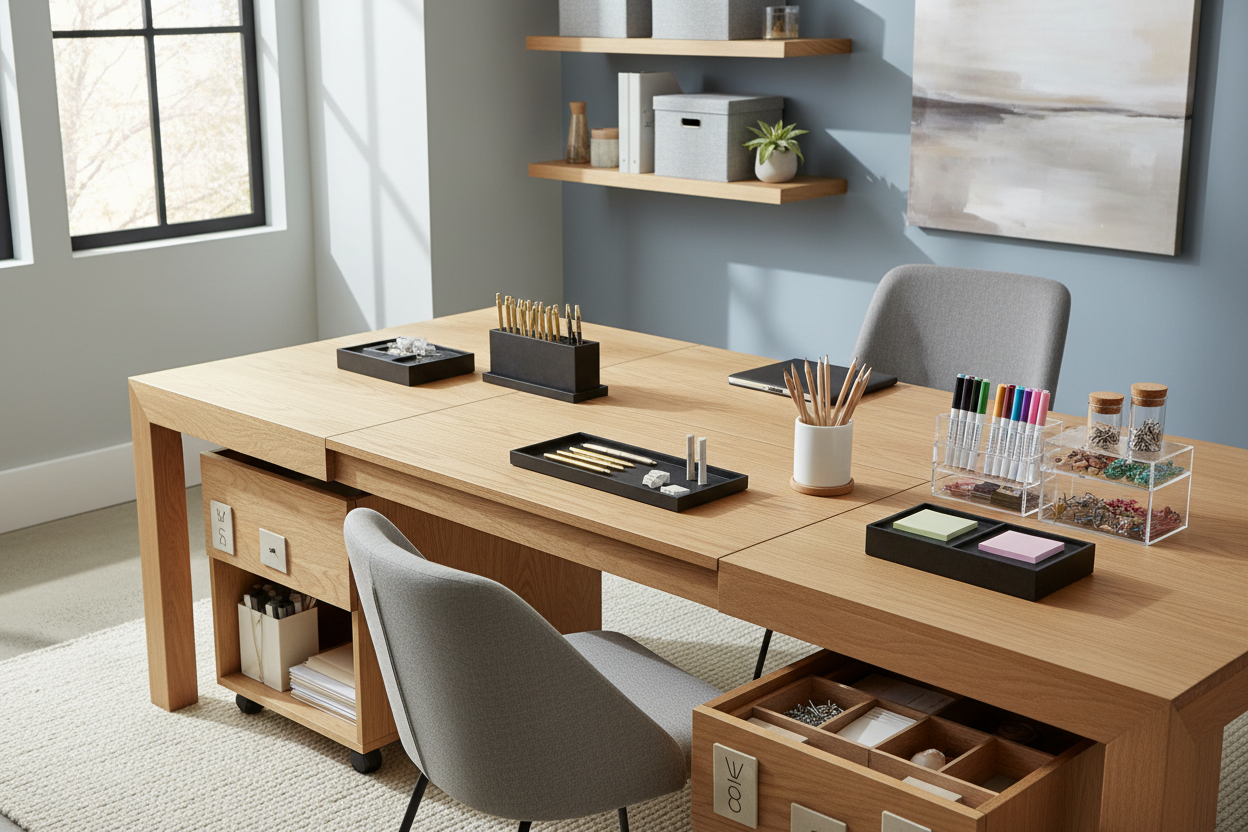
We have all seen it: a stunning, mid-century modern walnut desk completely overrun by a chaotic explosion of neon sticky notes, mismatched plastic pen cups, and tangled charging cables. A beautiful piece of furniture cannot save a room if the functional details are ignored. Mastering office supply organization is the critical bridge between a workspace that looks good in photos and one that actually supports your daily focus.
In my residential projects, the home office is often the room where design intent goes to die under a pile of paperwork. Today, we are going to walk through how to treat your desk accessories with the same level of design consideration as your primary furniture, ensuring your workspace feels both highly functional and intentionally styled.
Quick Decision Guide
- Apply the 80/20 rule: Conceal 80 percent of your supplies in drawers or opaque boxes, and leave only the 20 percent you use daily on the desktop.
- Measure internal drawer dimensions: Always account for the clearance height of your drawer before buying acrylic inserts to ensure they do not jam.
- Ditch the branded packaging: Decant items like paperclips, staples, and pushpins into cohesive, reusable containers to reduce visual noise.
- Utilize vertical negative space: Keep the primary work surface clear by utilizing wall-mounted rails or floating shelves for secondary items.
Space Planning the Desktop
The 'Zones of Reach' Rule
When mapping out your workspace, think about ergonomics and visual weight. The primary zone—the immediate arc your arms can sweep across without leaning—should be completely clear of clutter. Only your absolute essentials belong here. The secondary zone, which requires a slight lean or reach, is where your primary organizers should live. Pushing heavy visual elements, like a monitor or a dense filing tray, to the back third of the desk preserves the negative space you need to actually work comfortably.
Taming the Shallow Drawer
Most high-end desks feature shallow pencil drawers that become an absolute nightmare without structure. Effective organization for office supplies requires modular inserts. I always recommend using individual, configurable trays rather than a single molded piece. This allows you to lock them together like a puzzle, maximizing every square inch of the drawer and preventing items from sliding to the back when you open it.
Style, Materials, and Coordination
Curating Your Materials
The fastest way to cheapen a beautiful home office is with flimsy, translucent plastic organizers. If your desk is solid wood, complement it with organizers made of leather, powder-coated steel, or matte ceramic. If you are working with a minimalist glass or metal desk, warm it up with bamboo or walnut trays. The goal is to make your functional items feel like intentional decor choices rather than an afterthought.
Managing Visual Clutter
Color coordination matters just as much for your pens as it does for your throw pillows. If you prefer keeping items on the desktop, stick to a unified color palette. Hide the brightly colored, mismatched highlighters in a drawer, and display a set of uniform, sleek pens in a textured ceramic cup. It is a small change that drastically alters the silhouette of your workspace.
Designer's Honest Take
Early in my career, I was obsessed with open brass wire baskets. I specified them for a client's home office because they looked incredibly chic and airy in the showroom. It was a massive mistake. Once those wire baskets were actually filled with binder clips, random rubber bands, and half-used sticky notes, they did nothing but put the mess on display. They essentially framed the clutter.
I learned the hard way that open storage is only beautiful if the contents are beautiful. Now, I strictly use opaque, lidded boxes—like linen-wrapped or leather-bound containers—for the small, unattractive necessities. The wire baskets are strictly reserved for sorting clean, incoming mail.
Frequently Asked Questions
What are the best materials for desk organizers?
Opt for materials that add texture and weight. Leather, powder-coated metal, solid wood, and ceramic are excellent choices that age well and elevate the overall feel of the room. Reserve clear acrylic strictly for hidden drawer interiors.
How do I hide ugly cords and chargers?
Cable management is a crucial part of organizing your workspace. Mount a cable management tray under the back edge of the desk to hold power strips, and use adhesive clips to route charging cables down the back of the desk legs. Never leave cables pooling on the floor.
Is it better to have desk drawers or desktop organizers?
Drawers are always preferable for maintaining a clean aesthetic. If your desk lacks drawers, invest in a rolling filing cabinet that tucks underneath, or use beautiful, stackable lidded boxes on a nearby bookshelf to keep the desktop clear.

Leave a comment
This site is protected by hCaptcha and the hCaptcha Privacy Policy and Terms of Service apply.