










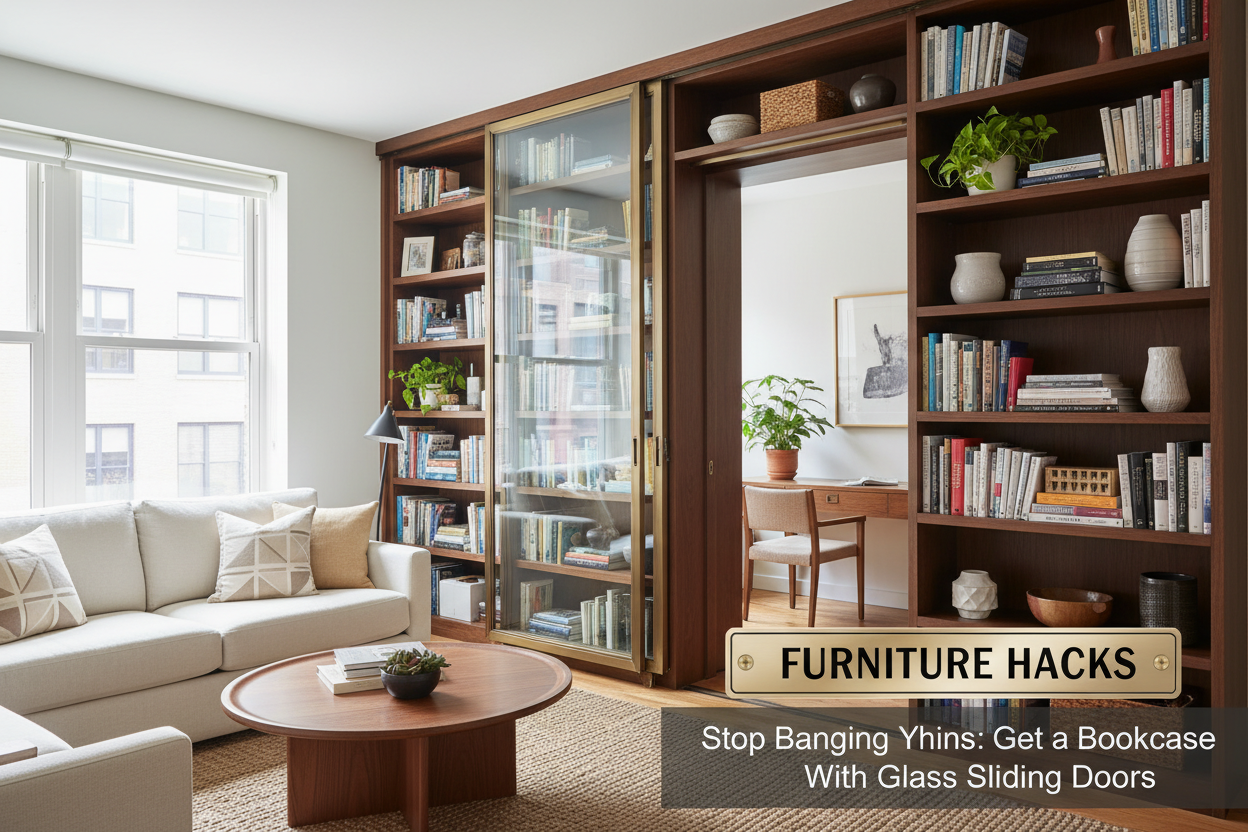
I once lived in a studio apartment so narrow I had to decide between owning a coffee table or being able to open my closet doors. I chose the table, and for two years, I did a weird sideways shimmy every time I needed a sweater. We often buy furniture based on how it looks in a 5,000-square-foot showroom, forgetting that in the real world, doors need room to breathe. If you are currently playing Tetris with your living room layout, a bookcase with glass sliding doors is the upgrade you didn't know you needed.
- Sliding tracks eliminate the 'door arc'—the dead space required for hinges to swing open.
- Glass panels keep your library dust-free while acting as a window that makes a room feel larger.
- Sliding mechanisms are generally more durable for heavy-use areas compared to cheap hinges that sag over time.
- Adjustable internal shelving is non-negotiable for a collected, non-retail look.
The Spatial Math of Swinging Doors (Why They Suck in Small Rooms)
Let’s talk about the 'door tax.' A standard 30-inch wide bookcase usually comes with two 15-inch swinging doors. To actually use that bookcase, you need at least 18 inches of clear floor space in front of it just to stand there and pull a door toward your face. In a tight home office or a hallway, that 18 inches is prime real estate. When you have swinging doors, you can’t put a chair nearby, you can't layer a rug properly, and you certainly can't walk past someone else while they are looking for a book.
Traditional bookshelves with doors are notorious for ruining traffic flow. I’ve seen beautiful rooms ruined by a 'clash zone' where the cabinet door hits the back of a desk chair or, worse, a door frame. It’s not just about the physical hit; it’s the visual clutter. A door stuck halfway open because it hit a sofa leg makes a room feel frantic. Sliding tracks solve this by keeping the entire operation within the footprint of the unit itself. You gain back every square inch of that clearance zone, allowing you to place furniture mere inches away without a single swear word involved.
Enter the Bookcase With Glass Sliding Doors
This is where the bookcase with glass sliding doors becomes the hero of the floor plan. By utilizing a bypass track system—where one pane of glass slides behind the other—you get a fully enclosed storage solution with zero external footprint. It’s the ultimate spatial hack. You can transform your space with stylish glass door shelving units by placing them in spots you previously thought were 'dead zones,' like right behind a dining table or in a narrow entryway.
A sliding bookcase door doesn't just save your shins; it protects your stuff. If you’ve ever owned open shelving, you know the pain of 'the gray film.' Dust loves paper. Within three months, the tops of your books look like they’ve been sitting in an attic for a decade. A sliding door bookcase gives you the visual lightness of open shelves—because you can see right through the glass—but provides a seal against the elements. It’s the best of both worlds: the airy feel of a display shelf and the low-maintenance reality of a closed cabinet.
Rolling Bookshelf Doors vs. Traditional Bottom Tracks
Not all sliding mechanisms are created equal. You generally have two choices: top-hung rolling hardware or bottom-track sliding bookcase doors. Top-hung systems (think miniature barn doors) look incredibly cool and industrial, but they require a very sturdy frame to handle the weight. The upside? They don't have a bottom track to collect dust, cat hair, and those mysterious crumbs that seem to materialize out of thin air. They glide like butter and usually stay on track better if the unit is slightly off-level.
Bottom-track systems are more common and often more affordable. They are great for a cleaner, more recessed look where the hardware is hidden. However, be honest with yourself about your cleaning habits. A sliding door for shelf units with a bottom track is basically a vacuum for floor debris. I recommend taking a Q-tip to those tracks once a month. If a sliding bookshelf starts to stick or 'jump,' 90% of the time it’s because a stray staple or a bit of grit is jammed in the groove. Keep it clean, and it’ll last a decade.
Styling a Sliding Unit Without Looking Like a Store Display
The danger of a sliding glass bookshelf is that it can end up looking like a trophy case in a high school hallway or a sterile retail display. To avoid this, you need to break the 'grid.' Don't just line up books by height from left to right. Lean some, stack some horizontally to act as pedestals for small objects, and leave some negative space. Use adjustable shelf storage to create uneven heights; a tall vase next to a short stack of paperbacks breaks the monotonous line that makes furniture look 'commercial.'
I like to mix textures behind the glass. Paper, wood, and ceramic all react differently to light. Because the glass adds a layer of reflection, objects with a matte finish tend to look better than high-gloss items, which can create a confusing double-glare. If you're using a sliding door with shelves for a collection of glassware or spirits, vary the bottle shapes. The goal is to make it feel like a curated library that happens to be protected, not a 'hands off' museum exhibit.
Don't Forget the Lighting (Because Glass Reflects)
Glass is a fickle beast. During the day, it looks great, but at night, a sliding glass door bookcase can turn into a giant dark mirror, reflecting your TV or your overhead ceiling light back at you. This is why integrated lighting is a must. It’s not just for show; it kills the external reflections by illuminating the interior of the unit. A lighted bookcase with glass doors creates depth and makes the unit feel like a custom built-in rather than a piece of flat-pack furniture.
If your unit didn't come with lights, stick-on LED strips are a decent DIY fix, but they rarely look as clean as factory-installed puck lights. When the light comes from within, the sliding glass door shelves glow, drawing the eye past the surface of the glass and into the display. It turns a piece of storage furniture into a focal point. Just remember to choose 'warm' LEDs (around 2700K to 3000K). Anything higher and your living room will start to feel like a jewelry store in a mall.
My Top Pick for Really Tight Floor Plans
If you are working with a truly narrow wall—say, in a home office that’s basically a converted closet—you need verticality. A tall bookcase with sliding doors is your best friend here. It draws the eye upward, making the ceiling feel higher while taking up a fraction of the floor space. I’m a huge fan of units that hit that 75-to-80-inch height mark. They feel substantial and expensive without being bulky.
For a reliable, middle-of-the-road option that fits almost any decor, a standard storage bookcase with glass door shelves is the baseline I recommend. It’s tall enough to hold a massive library but narrow enough to fit between a window and a corner. The sliding glass door shelf mechanism on these models is usually robust enough for daily use, and the footprint is mercifully small. It’s the kind of piece you buy for a small apartment but keep for the next ten years because it’s just so damn functional.
Is a sliding door bookcase harder to assemble than a regular one?
Slightly. You have to be precise with the track alignment. If the frame is even a quarter-inch out of square, the doors won't slide smoothly or might gap at the top. Use a level and don't rush the back panel—it's what keeps the whole thing square.
Do sliding glass doors rattle?
Cheap ones do. Look for units that include small felt bumpers or have a 'soft close' or tensioned track. If yours rattles, a tiny piece of clear adhesive foam in the track will usually silence it instantly.
Can I use these for heavy books?
Absolutely, but check the shelf material. The sliding door itself doesn't affect the weight capacity, but the shelves do. Look for thick, reinforced glass or solid wood/MDF shelves if you're planning to store a full set of encyclopedias or heavy art books.
What if my floor is uneven?
This is the kryptonite of sliding doors. If your floor slopes, the doors will want to slide open or closed on their own. Use furniture shims under the base to get it perfectly level before you put the doors on. It’s a five-minute fix that saves a lifetime of annoyance.


Leave a comment
This site is protected by hCaptcha and the hCaptcha Privacy Policy and Terms of Service apply.