










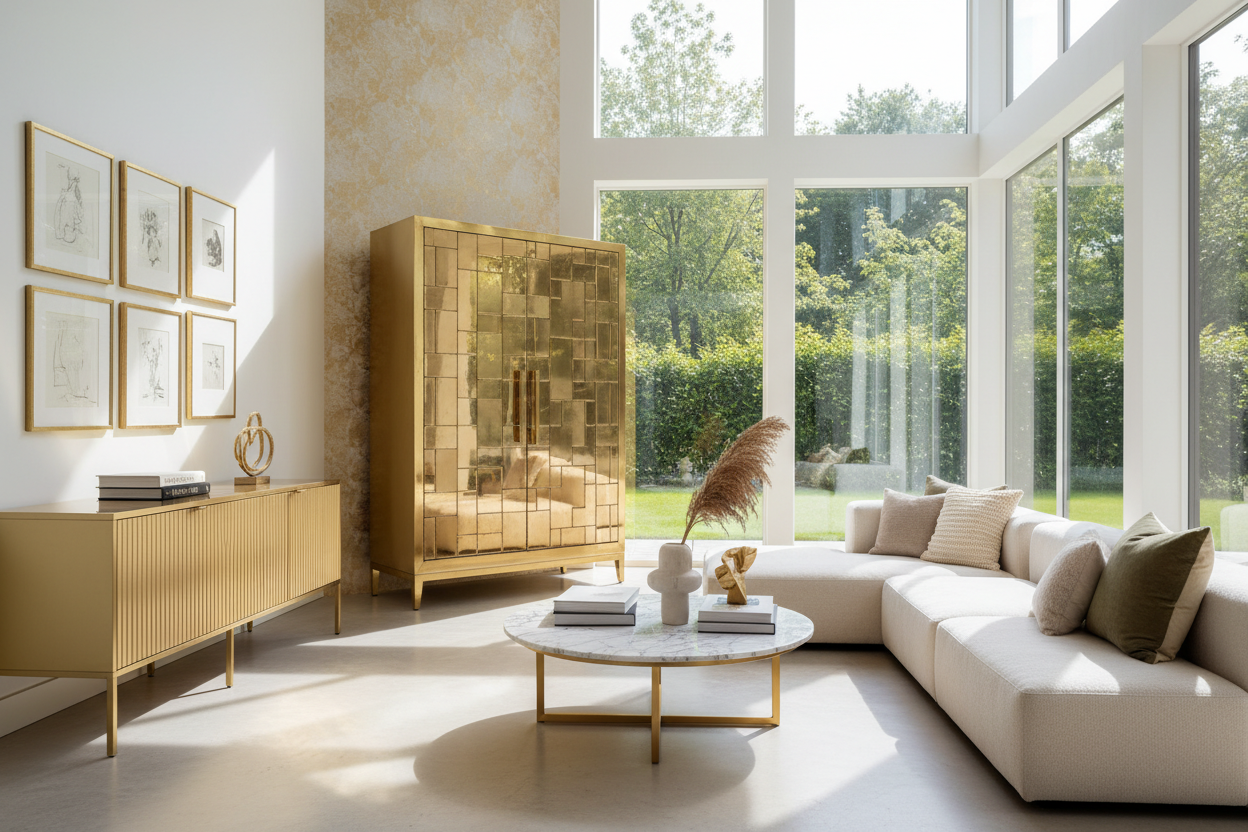
I spent three years living in a home that felt like a high-end doctor's waiting room. Everything was matte black, light oak, or some variation of 'oatmeal.' It was safe. It was cohesive. It was also incredibly boring. I realized my living room didn't need another neutral throw pillow or a 'pop of color' via a sad succulent. It needed a punch in the face. That's when I finally stopped overthinking and bought a gold cabinet.
- Tone is everything: Avoid high-shine chrome-gold; look for brushed, champagne, or antique brass finishes for a high-end look.
- Balance the flash: Pair metallic pieces with 'grounded' materials like wool, heavy linen, or dark wood to keep the room feeling sophisticated.
- Function first: A gold storage cabinet is a statement piece, but it still needs to hide your clutter. Opt for doors over open shelving.
- Scale matters: A small gold cabinet works as a side table, while a tall gold storage cabinet needs enough floor space to breathe.
Why I Finally Stopped Buying Matte Black Everything
For a long time, I was a devotee of the 'industrial modern' school of thought. If it wasn't matte black or raw steel, I didn't want it. I thought metallics were for people who wore too much perfume and owned mirrored furniture. I was wrong. The problem with a room full of flat, non-reflective surfaces is that there’s no visual tension. It feels heavy and static. I started noticing that the rooms I actually pinned to my boards — the ones that looked like a boutique hotel in Paris — all had one thing in common: a bit of metallic grit.
Adding gold accent cabinets isn't about turning your home into a palace; it's about breaking up the monotony. Gold acts as a warm neutral. It reflects light into dark corners and makes the surrounding wood tones look richer. When I finally swapped my black metal console for a gold accent chest, the whole room woke up. It provided a necessary friction against my grey velvet sofa. Don't be afraid of the 'glam' label. In small doses, gold is actually quite architectural.
I’ve assembled enough flat-pack furniture to know that cheap metal looks cheap. But when you find a piece with a heavy frame and a muted finish, it changes the entire energy of the space. It’s the difference between a room that looks like it was bought in one click and a room that was curated over time. My matte black phase was a safety blanket, but the gold was the spark that actually made the room feel finished.
The Rule of Tones: How to Pick a Gold That Doesn't Scream 'Vegas'
The biggest fear people have with gold is that it will look tacky. We’ve all seen that cheap, yellowy-orange chrome that looks like it belongs in a budget casino. To avoid this, you have to be obsessive about the finish. You want 'brushed,' 'satin,' or 'antique.' These finishes have a microscopic texture that diffuses light rather than bouncing it back like a mirror. If you’re looking at an elegant glass display cabinet, notice how the gold is often used as a frame. This subtle application keeps the piece looking expensive rather than flashy.
I personally look for 'champagne gold' or 'muted brass.' These tones have a bit of silver or brown mixed in, which makes them much more forgiving when paired with existing furniture. If you buy a gold accent cabinet with doors that is too shiny, every fingerprint and smudge will show up like a neon sign. A matte or brushed finish hides the reality of a lived-in home. I once bought a small gold cabinet that was so reflective I could see my own feet while I ate dinner. It went back to the store within 24 hours.
The weight of the material matters too. If the cabinet is made of thin, hollow aluminum tubes spray-painted gold, it’s going to rattle and feel flimsy. Look for solid steel or iron frames. A gold accent chest should have some heft to it. When you open the doors, you want a solid 'thud,' not a metallic 'ping.' This structural integrity is what separates a 'temporary' piece of furniture from something you’ll keep for a decade. High-end gold furniture doesn't scream for attention; it waits for you to notice it.
Where to Put a Gold Entryway Cabinet (Without Blinding Your Guests)
The entryway is the most dangerous and rewarding place for a gold entryway cabinet. It’s the first thing people see, but if you have a bright overhead light, that cabinet can turn into a literal flashlight. The trick is to ground it. I put my gold storage cabinet on top of a dark, moody wool runner. The contrast between the soft, heavy wool and the hard, reflective metal makes both look better. If you have white walls, a gold cabinet gold can almost disappear if the light hits it right, so I suggest hanging some dark, framed artwork above it to anchor the space.
Functionally, the entryway is where we dump all the things we hate looking at: mail, dog leashes, and those random keys to god-knows-where. This is why you need a cabinet with doors and drawers. A gold cabinet that is purely open shelving is a recipe for disaster in a foyer. You want the exterior to be the star, while the interior does the heavy lifting of hiding your life. I use a gold accent chest of drawers in my hallway, and it’s the only reason my house doesn't look like a post office exploded the moment you walk in.
Consider the height, too. A tall gold cabinet in a narrow hallway can feel claustrophobic. For entryways, I usually stick to something around 30 to 34 inches high. This allows you to use the top surface for a tray (maybe marble or wood to offset the gold) and a lamp. A lamp with a warm bulb on a gold cabinet creates a glow that makes the whole house feel inviting. It’s that 'boutique hotel' vibe I was talking about earlier.
Hiding Your Junk in a Gold Accent Cabinet With Doors
Let's be honest: most of us aren't minimalists. We have 'doom piles' of chargers, half-empty notebooks, and batteries. If you're going to buy a piece of furniture as loud as a gold accent cabinet with doors, the stuff inside has to be invisible. There is nothing that ruins the aesthetic of a metallic statement piece faster than seeing a stack of plastic takeout menus through a glass front. I learned this the hard way with a small accent cabinet with drawers that I thought I could keep organized. I couldn't.
Closed storage gives you permission to be messy. A gold small cabinet is the perfect place to tuck away the things you use every day but don't want to see. Think of it as a beautiful mask for your clutter. Because gold is such a strong visual element, your eye stops at the surface of the cabinet. It doesn't wonder what's inside. This makes the room feel instantly more organized, even if the drawers are a nightmare of tangled cords and old receipts. It’s the ultimate design hack for people who want a 'magazine look' without the lifestyle of a monk.
How to Balance a Tall Gold Cabinet with Boring Furniture
If you’re going big with a tall gold storage cabinet, you have to be careful not to make the rest of your furniture look like an afterthought. A 72-inch metallic tower is going to be the alpha in the room. To keep it from feeling like an alien spaceship landed in your living room, you need to 'bridge' the materials. This is where a wood and gold cabinet is a total lifesaver. By having wood grain (like walnut or oak) alongside the gold, the piece connects to your coffee table or flooring while still providing that metallic edge.
I recommend placing a tall gold cabinet against a wall that has some 'weight' to it — maybe a dark paint color like navy or forest green. If you put it against a plain white wall in a room full of light wood, it might feel too detached. You also want to repeat the gold elsewhere in the room in very small doses. A gold floor lamp or a picture frame on the opposite side of the room will 'pull' the gold through the space, making the tall cabinet feel intentional rather than accidental. Don't go overboard; two or three small touches are enough to create a cohesive flow.
One mistake I see often is people buying a tall gold cabinet and then leaving the top of it empty. Because it’s so tall, it draws the eye upward. Put something organic up there, like a trailing Pothos plant. The green leaves against the gold finish look incredible and it softens the hard lines of the metal. It’s about creating a balance between the 'man-made' shine of the gold and the 'natural' feel of the rest of your home.
The White and Gold Compromise for the Truly Nervous
If you're still staring at your screen thinking, 'I just can't do a solid gold cabinet,' then the white gold storage cabinet is your best friend. This is the gateway drug to metallic decor. It feels clean, bright, and familiar, but the gold accents give it that little bit of 'oomph' that a plain white IKEA dresser lacks. A white and gold accent chest fits into almost any decor style, from coastal to mid-century modern. It’s the safest way to experiment with the trend without feeling like you’ve committed to a theme park aesthetic.
I often suggest a white and gold corner curio cabinet for smaller apartments. Corner spaces are usually dead zones, and a bit of white and gold can brighten them up without overwhelming the limited square footage. The white keeps the piece feeling light and airy, while the gold adds a layer of sophistication. It’s a compromise that doesn't feel like a sacrifice. When I first started moving away from my all-black furniture, a white/gold accent cabinet was the first piece I bought. It was the 'proof of concept' I needed to realize that metallics aren't scary.
Frequently Asked Questions
Does gold furniture go out of style?
Trends in specific finishes change — like the shift from shiny brass in the 80s to brushed gold today — but metallic accents are a classic design element. As long as you choose a piece with clean lines and a high-quality finish, it will look good for decades. It’s more about the silhouette than the color.
How do I clean a gold cabinet?
Don't use harsh chemicals or Windex. Most gold finishes are a plating or a powder coat. A soft microfiber cloth with a tiny bit of warm water is all you need. If you use abrasive cleaners, you’ll strip the finish and end up with silver or grey patches showing through.
Can I mix gold and silver in the same room?
Yes, and you should. A room with only one metal finish can feel a bit 'showroom.' Mixing a gold cabinet with silver hardware or a chrome lamp makes the space feel more evolved and less 'matched.' Just try to keep the finishes (matte vs. shiny) somewhat consistent.

Leave a comment
This site is protected by hCaptcha and the hCaptcha Privacy Policy and Terms of Service apply.