










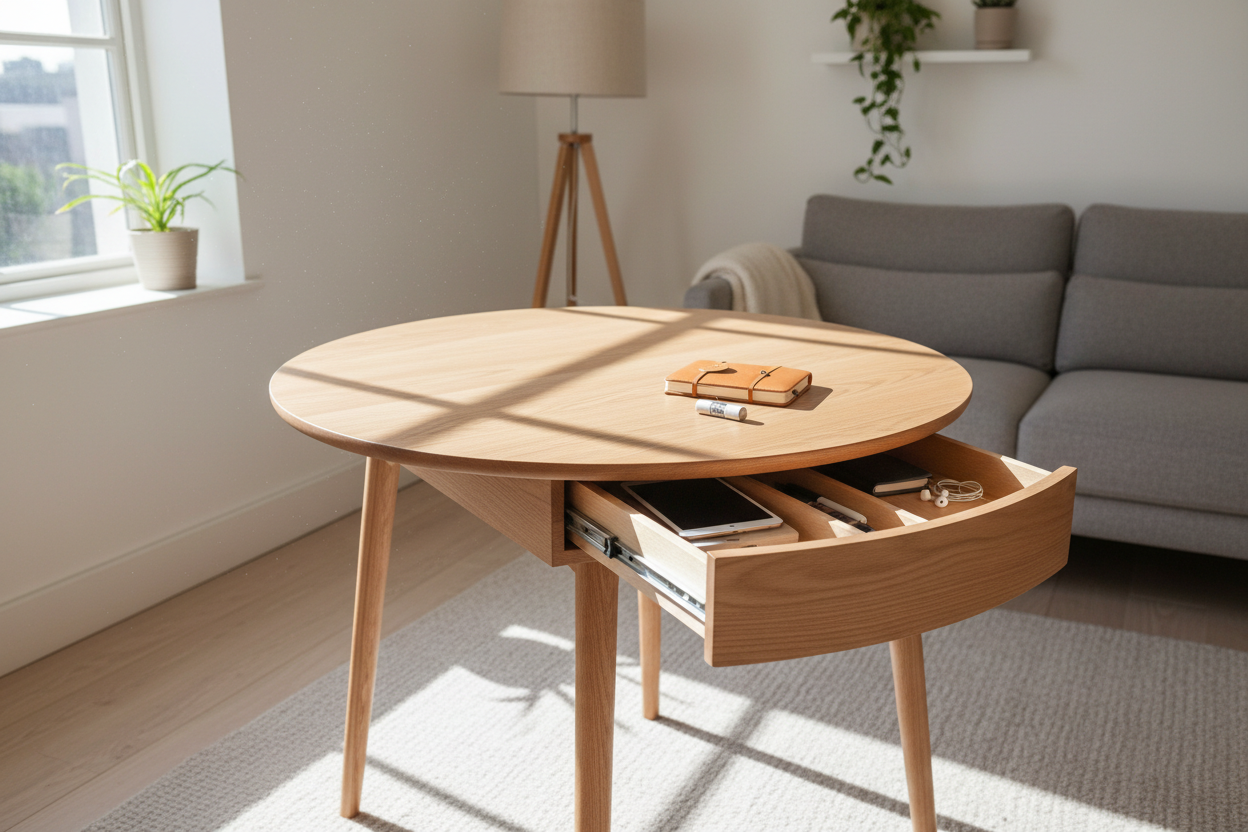
Most furniture shopping begins with a measurement tape and a specific gap to fill, but it often ends in a compromise between style and utility. You find a piece that looks beautiful but holds nothing, or a storage unit that looks like a filing cabinet. The round table with drawer bridges this gap. It offers the ergonomic benefits of a curved edge—crucial for high-traffic zones—while providing a designated hiding spot for the clutter that inevitably accumulates on flat surfaces. If you are trying to soften the hard lines of a boxy room while keeping your remotes and coasters out of sight, this specific piece of furniture is the most efficient solution.
Integrating circular furniture isn't just an aesthetic choice; it is a spatial strategy. Rectangular rooms filled with rectangular rugs, sofas, and media consoles can feel rigid. Introducing a circle side table with drawer functionality breaks up that grid. It allows for better flow, letting you walk around the furniture without catching your hip on a sharp corner. More importantly, that single drawer changes the table from a mere display surface into a functional tool for maintaining order.
The Real-World Struggle with Sharp Corners
I learned the value of curved furniture the hard way during my time living in a narrow railroad-style apartment. The living area was essentially a hallway with a sofa in it. I initially bought a square industrial side table because I liked the raw steel look. Within a week, I had bruised my shin twice trying to squeeze past it to get to the kitchen. It was a beautiful table, but it was hostile to the space.
I swapped it out for a small round table with drawer storage found at a flea market. The difference was immediate. Physically, the footprint was similar, but the absence of corners meant I could glide past it without maneuvering. The drawer, though shallow, became the permanent home for my spare keys and a charging cable—items that previously lived in a messy pile on top of the square table. That experience taught me that in tight quarters, geometry dictates comfort just as much as upholstery does.
Choosing the Right Dimensions for Your Space
Scale is the most common pitfall when selecting accent tables. A table that is too small looks like a toy, while one that is too large dominates the seating area. When looking for a round table with drawer, pay close attention to the diameter relative to your seating. Ideally, the table should sit within easy reach of the arm of your chair or sofa, but not extend so far out that it impedes foot traffic.
Height is equally critical. Standard advice suggests the table surface should be within two inches of the sofa arm height. However, if the table has a deep drawer, the under-structure might be thicker. Ensure that the bulk of the drawer casing doesn't make the table look top-heavy or block the visual flow of the floor. For bedside use, the height requirement shifts; you generally want the surface level with the top of the mattress to make reaching for a glass of water easy in the dark.
Analyzing Drawer Mechanics and Quality
Since the primary differentiator here is storage, the quality of that storage matters. Not all drawers are created equal. On a circle side table with drawer, the mechanism can be tricky because the curved front face must align perfectly with the frame. Cheaper models often use a wood-on-wood slide. While traditional, these can stick when humidity rises or if the wood swells, making the drawer frustrating to open.
Look for metal glides if you plan to use the drawer daily. If you prefer the aesthetic of an antique or a high-end reproduction that uses wood slides, check for wax application on the runners. A smooth pull is essential. A drawer that requires two hands to yank open usually results in spilling whatever is resting on the tabletop. Furthermore, check the drawer stop. There is nothing worse than pulling a drawer out slightly too far and having it crash onto your toes.
The Pedestal vs. Leg Debate
The base of your table affects both stability and visual weight. A pedestal base (a single central column) is fantastic for older homes with uneven floors because it is easier to shim a central point than four separate legs. It also offers a cleaner look if you have a busy rug pattern. However, a small round table with drawer on a pedestal base can sometimes be top-heavy. If you have pets or children who might lean on the edge, a three or four-legged design offers superior tip resistance.
Styling Without Sacrificing Function
Once you have the piece, the challenge becomes styling it without rendering the drawer inaccessible. I have seen countless beautifully styled tables where a heavy stack of coffee table books or a large lamp is placed right over the front edge, making it impossible to open the drawer without rearranging the decor.
Push your decorative items slightly back from the edge. Use the "triangle method" for arrangement: a lamp for height, a small plant for texture, and a coaster for utility, arranged in a loose triangle. This leaves the front arc of the table clear for access. Since these tables are often compact, verticality is your friend. A tall, slender lamp takes up less surface area than a short, stout one, leaving you more room for your morning coffee.
Material Selection for Longevity
The material you choose should reflect how you live. Solid wood walnut or oak offers durability and handles scratches gracefully—they often look better with age. However, water rings are a real threat. If you are the type of person who refuses to use coasters, consider a table with a stone or glass top, or a high-quality veneer with a polyurethane finish.
Painted finishes can add a necessary pop of color to a neutral room, but be wary of cheap lacquers on the drawer front. This is the area that will see the most contact with fingernails and oils from your hands. A distressed or matte finish is often more forgiving of daily wear than a high-gloss coat that shows every fingerprint.
Why This Piece Belongs in Your Home
Furniture should solve problems. A round table with drawer solves the problem of visual rigidity and the problem of small-item clutter simultaneously. It is a workhorse disguised as a decorative accent. Whether tucked beside a reading chair or standing guard as a nightstand, it provides a soft landing spot for your life's accessories while keeping the flow of your room open and inviting. By focusing on the mechanics of the drawer and the scale of the piece, you can find a table that doesn't just fill a space, but actually improves how you live in it.
Frequently Asked Questions
How do I match a round side table to my existing furniture?
You don't need to match the wood tone exactly. Instead, try to match the "visual weight" or the era of the furniture. If you have a chunky velvet sofa, a delicate spindle-leg table might look out of place; aim for something with a solid pedestal or thicker legs to balance the room.
Can a round table with a drawer work as a nightstand?
Absolutely, and they are often safer than square nightstands if you tend to stumble in the dark. Just ensure the surface area is large enough for a lamp and your phone, and that the drawer is easy to reach from the bed height.
What is the ideal diameter for a small side table?
For most living room setups, a diameter between 18 and 24 inches is the sweet spot. Anything smaller than 16 inches usually cannot hold much more than a cup of coffee, while anything over 26 inches begins to feel like a coffee table rather than a side accent.


Leave a comment
This site is protected by hCaptcha and the hCaptcha Privacy Policy and Terms of Service apply.