










There is a specific type of buyer's remorse reserved for interior design: the moment you unbox a desk that looked magnificent in a rendered image, only to realize the "solid wood" is actually hollow laminate and the scale completely overwhelms your room. As a designer, I see this happen constantly. While the convenience of clicking "buy now" is tempting, curating a workspace requires a tactile approach. Searching for nearby office furniture isn't just about supporting the local economy; it is a critical step in ensuring ergonomic precision and material integrity that a JPEG simply cannot convey.
Key Features to Test In-Person
- Mechanism Smoothness: Test the resistance on drawer glides and the silence of chair gas lifts.
- Fabric Tactility: Feel for double-rub counts (durability) and breathability, which you cannot judge through a screen.
- True Scale: Bring a tape measure to understand the piece's "visual weight" versus its physical dimensions.
- Joinery Quality: Look for dovetail joints or reinforced corners rather than staples and glue.
- Color Accuracy: View finishes under different lighting conditions, not just studio strobes.
The Value of the "Sit Test": Ergonomics First
When I walk a client through a showroom, the first thing I ask them to do is ignore the price tag and simply sit. An office furniture store nearby offers the singular advantage of physical verification. Ergonomics is not universal; a chair rated for eight hours of use might pinch your sciatic nerve or offer insufficient lumbar support for your specific height.
When testing a chair locally, adjust the tension knob. Does the recline support your weight effortlessly, or does it feel jerky? Check the seat pan depth—there should be a two-to-three-finger gap between the edge of the seat and the back of your knees. These are micro-adjustments that define your long-term health, and they are impossible to assess without physical interaction.
Assessing Material Integrity and Finish
Solid Wood vs. Veneers
In high-end design, we love the warmth of wood, but terminology can be deceptive. A local office furniture store allows you to inspect the grain. If the pattern repeats identically every few inches, it is likely a printed laminate. If you run your hand under the table edge and feel a rough transition, it’s a low-quality veneer. Real wood or high-grade architectural veneers will have a consistent, smooth hand-feel even in hidden areas.
Visual Weight and Room Flow
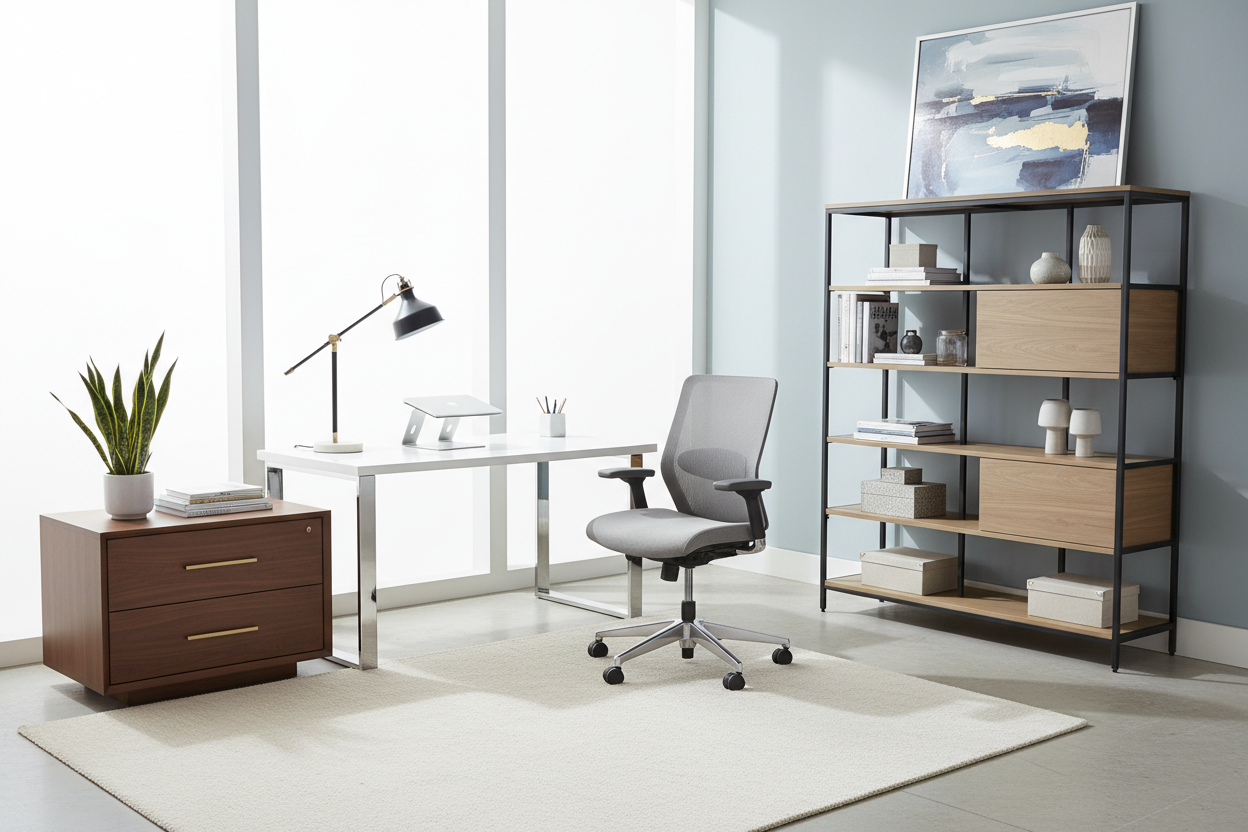
A common mistake is buying furniture that fits physically but fails visually. A heavy, dark mahogany desk might fit the measurements of a 10x10 room, but it will make the space feel claustrophobic. By visiting a showroom for local office furniture, you can gauge the silhouette of a piece. For smaller home offices, I often recommend pieces with exposed legs or glass elements to maintain an airy aesthetic, something that is much easier to visualize when standing directly in front of the object.
My Personal Take on Sourcing Locally
Let me be completely honest about a lesson I learned the hard way. Early in my career, I specified a stunning, imported executive chair for a client based solely on high-res photos and a spec sheet. It looked sculptural and divine. When it arrived six weeks later, the leather squeaked. Not a quiet rustle, but a loud, plastic-like friction noise every time the client shifted weight. It was humiliating.
Since then, I prioritize sourcing from a local office furniture store for anything that bears weight. Beyond the squeak test, there is the unpolished reality of delivery. I once bought a vintage-style credenza locally, and the in-house delivery team knew exactly how to angle it through a narrow pre-war hallway without scraping the walls. Drop-ship couriers from big online retailers will often leave a 200lb box on your curb and drive away. That level of service and the ability to inspect the "underbelly" of a table for stable welds is why I advocate for shopping in person.
Conclusion
Your workspace is an investment in your productivity and physical health. While online shopping offers infinite variety, the curated reliability of a showroom helps you avoid costly aesthetic and functional mistakes. Take the time to visit a showroom, touch the textures, and test the mechanisms. Your back—and your interior aesthetic—will thank you.
Frequently Asked Questions
Is buying from a local office furniture store more expensive than online?
Not necessarily. While the sticker price might appear higher, local stores often include assembly and white-glove delivery in the cost. When you factor in shipping fees and the potential cost of returning a bulky item bought online, local purchasing is often competitive.
Can I customize pieces at a store nearby?
Yes, this is a major benefit. Many local showrooms carry lines that offer "COM" (Customer's Own Material) or various finish options, allowing you to tailor the piece to your specific home decor palette, which is rarely an option with quick-ship online retailers.
How do I know if a desk will fit my space?
Measure your room, but also measure your "flow" space. You need at least 30 to 36 inches of clearance behind a desk for your chair to move freely. Bring a floor plan sketch to your local dealer; they can often help you visualize the layout better than an app.

Leave a comment
This site is protected by hCaptcha and the hCaptcha Privacy Policy and Terms of Service apply.