










I spent three years staring at a corner of my living room that looked like a Pinterest board gone wrong. I had the 'aesthetic' woven baskets, the open shelving, and the 'curated' stacks of books. In reality? Those baskets were just open-topped trash cans for mail I didn't want to open and charging cables that didn't work anymore. Every time I walked into the room, I felt the weight of that visual noise.
The breaking point came when I couldn't find my passport for three hours because it was buried under a pile of 'decorative' throw blankets. I realized I didn't need more baskets; I needed a large cabinet with drawers that could actually swallow my mess and keep it out of sight. I needed a system that didn't require me to be a minimalist, but rather one that accommodated my maximalist clutter habits behind closed doors.
- Baskets are clutter magnets; drawers are clutter killers because they force a physical boundary.
- Width beats height when you want a room to feel open but organized—think long and low.
- Categorization is the only way to prevent a large cabinet from becoming a black hole of junk.
- Solid drawer fronts provide a psychological 'reset' by hiding the visual chaos of everyday life.
The 'Aesthetic Basket' Illusion (And Why It Failed Me)
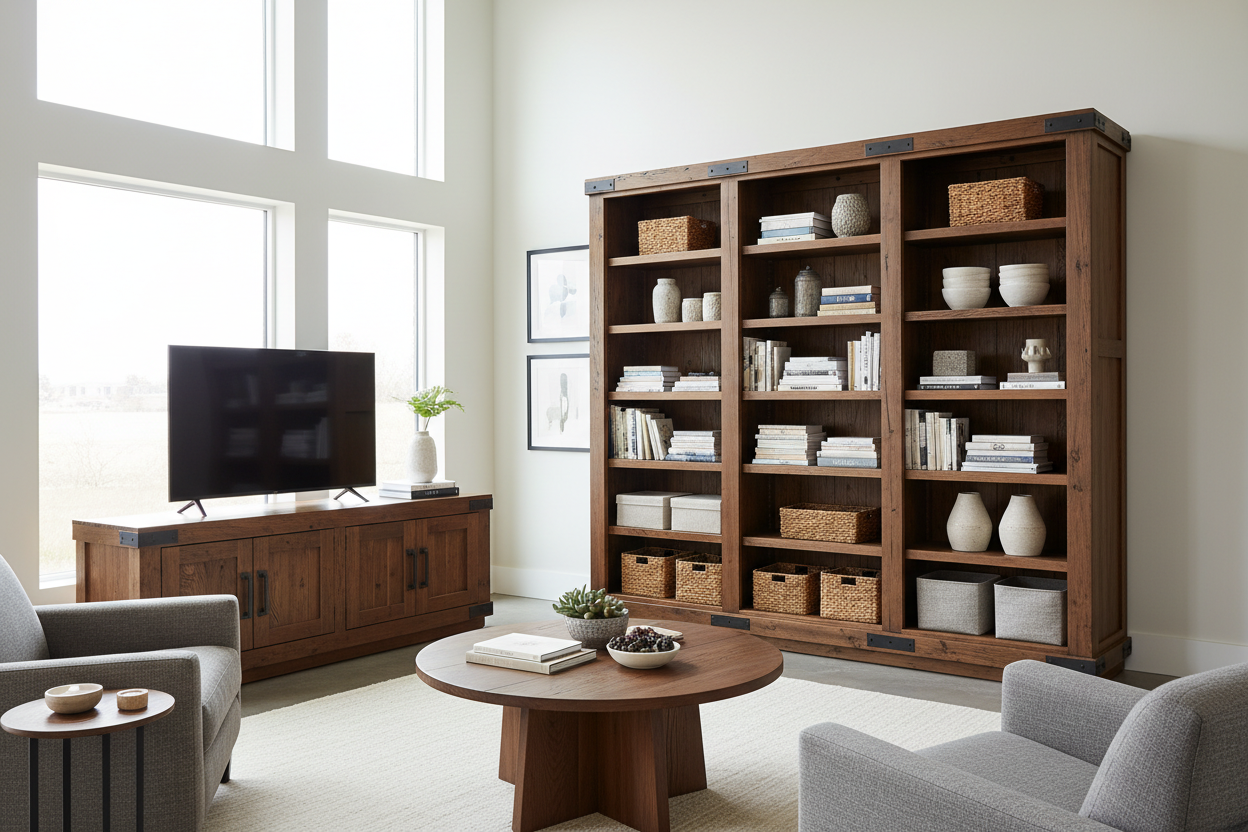
We’ve all been sold the lie that a few seagrass baskets can fix a disorganized life. I bought into it hard. I had a 12-unit cubby shelf filled with various bins, thinking it would make my living room look like a coastal retreat. Instead, it looked like a storage unit. The problem with open baskets is that they have no lids and no internal structure. You end up with 'top-heavy' junk bins where the thing you need is always at the very bottom, under a layer of dust and loose receipts.
I finally admitted that my brain doesn't work with open storage. If I can see the mess, I'm stressed. If the mess is in a basket on an open shelf, it's still mess. This realization sent me on a hunt for large drawer cabinets. I didn't want to see my stuff anymore. I wanted the clean lines of a solid piece of furniture that looked like it belonged in an adult's home, not a dorm room. I needed something with a footprint large enough to hold my printer, my board games, and my 'random electronics' graveyard without bulging at the seams.
Enter the Heavyweight Champion of Organization
After weeks of measuring my 12-foot living room wall, I stopped looking at small chests and started looking at substantial pieces. I eventually landed on a large sideboard buffet with drawers that had enough heft to anchor the entire wall. It wasn't just a piece of furniture; it was a structural intervention. This long cabinet with drawers offered something my previous setup couldn't: the ability to physically segregate my life into distinct, pull-out compartments.
The psychological relief of closing a solid drawer on a pile of unfiled paperwork is unmatched. There is a specific 'thud' that a well-made drawer makes—especially one with decent glides—that signals the end of the day. I spent about four hours assembling it (and yes, I put one drawer slide on backward initially), but once those 150 pounds of wood were in place, the room felt different. It felt anchored. I wasn't just looking at a long cabinet with drawers; I was looking at my new sanity-saver. Unlike the flimsy plywood units I'd owned in my twenties, this had the depth—about 16 inches—to actually hold a stack of dinner plates or a heavy laptop bag without the bottom bowing.
How I Categorize the Chaos (Without Losing My Mind)
The danger of large storage cabinets with drawers is the 'horizontal junk drawer' syndrome. If you have too much space, you just fill it with more garbage. To avoid this, I treated each drawer like a dedicated zone. I didn't just throw things in; I used small acrylic dividers to create sub-sections within the larger drawers. This is the secret to making large storage cabinets with drawers actually work for a busy household.
The Top Drawers: Keys, Mail, and Daily Regrets
The top three drawers of my cabinet are the shallowest, making them perfect for the 'drop zone' items. This is where the mail goes the second I walk through the door. One drawer is for 'Action Required' (bills), one is for 'To File,' and the third is for the daily carry—keys, sunglasses, and that one lip balm I can never find. By keeping these drawers shallow, I prevent the pile-up that usually happens on my kitchen island. If the drawer won't close, I know I've let too much junk accumulate.
The Bottom Drawers: Bulky Blankets and Board Games
The lower levels of a large storage cabinet with drawers are where the heavy lifting happens. My bottom drawers are nearly 10 inches deep. I’ve dedicated one entire side to those bulky, oversized throw blankets that usually end up in a heap on the floor. The other side holds my board game collection. Storing games in drawers rather than on open shelves keeps the boxes from getting dusty and prevents that 'cluttered toy room' vibe in what is supposed to be a sophisticated living area.
Why Width Matters More Than Height for My Layout
I used to think I needed a tall bookshelf to maximize storage in a small apartment. I was wrong. Tall furniture closes in the room and makes the ceilings feel lower. A long drawer cabinet does the opposite. It provides a massive amount of storage volume while keeping the sightlines open. Plus, the top surface of a wide cabinet is actually useful. It’s the perfect height for a 24-inch table lamp, a stack of art books, and a tray for my evening drink.
That’s exactly why I decided a wide storage cabinet with drawers was a better investment than a standard, flimsy TV stand. By choosing a piece that was 70 inches wide, I gained six extra drawers of storage that a traditional media console simply doesn't offer. It turned a single-use area of the room into a multi-functional storage powerhouse. I even have one drawer dedicated entirely to my 'work from home' kit—my mouse, headset, and notebook—so I can 'leave' the office by simply sliding a drawer shut at 5 PM.
The Glass Door Compromise: Showing Off Just a Little
If you're worried that a massive solid-wood piece will look like a monolithic block in your room, there is a middle ground. I love the look of hidden storage, but sometimes you want to see your 'good' stuff—the vintage glassware or the ceramics you actually like. If you aren't ready to go full 'solid wood block,' a display cabinet with glass doors and drawers offers the best of both worlds. You get the drawers at the bottom to hide the ugly stuff (cables, batteries, manuals) and glass shelving at the top for the items that deserve to be seen.
I ended up placing my heavy drawer unit in the main seating area and a smaller glass-front version in the dining nook. It balances the room. The drawers handle the chaos, while the glass doors handle the 'curation.' It’s the only way I’ve found to maintain a home that looks like a real person lives there without looking like that person is currently losing a battle with their own belongings.
FAQ
Are drawers better than shelves for deep storage?
Absolutely. With shelves, items at the back are essentially lost forever. Drawers bring the back of the cabinet to you, so you can see every single item without kneeling on the floor with a flashlight.
How do I prevent a large drawer from becoming a mess?
Use internal dividers or small bins. A large drawer is just a big empty box until you create boundaries. Group like-items together and never let a drawer be 'miscellaneous.'
What material should I look for in a large cabinet?
Look for a solid wood frame or high-density MDF with a quality veneer. Avoid the super-cheap particle board for large units; the weight of the drawers themselves can cause the frame to sag over time if the material is too thin.


Leave a comment
This site is protected by hCaptcha and the hCaptcha Privacy Policy and Terms of Service apply.