










I spent five years living with a 'temporary' media console that I hated from the second I assembled it. It was one of those $200 flat-pack deals that promised a mid-century vibe but delivered a sagging middle and a finish that peeled if you so much as looked at a coaster. Every time I rearranged the living room, I’d convince myself a new freestanding unit would be the fix. Instead, I just ended up with a graveyard of particle board and a cable management situation that looked like a plate of black spaghetti.
The breaking point came when I realized I’d spent nearly $1,500 over three years on three different 'affordable' stands. None of them actually fit the wall, and they all looked like afterthoughts. That’s when I finally looked into built in television wall units. I used to think they were only for million-dollar mansions or people who never planned on moving, but I was wrong. They are the only way to make a big black screen look like a design choice rather than a tech intrusion.
- Built-ins eliminate the visual 'clutter' of freestanding legs and gaps.
- Customizing for future tech prevents your cabinetry from becoming obsolete.
- Modular systems can achieve the high-end look without the $10k carpenter bill.
- Integrated lighting makes the entire room feel more expensive.
- Closing off the bottom storage hides the router, gaming consoles, and dust.
The Endless Cycle of Buying (and Hating) TV Consoles
We’ve all been there. You buy a 55-inch TV, so you buy a 60-inch stand. Then you realize that 60-inch stand looks tiny on a 12-foot wall. You try to flank it with floor plants or a basket of blankets, but it still looks like a lonely island of electronics. The inbuilt tv stand concept solves the scale problem. It’s not just a place to put the TV; it’s a way to reclaim the entire vertical surface of your room.
My biggest gripe with freestanding units was the 'cord creep.' No matter how many velcro ties I used, the wires for the soundbar, the Apple TV, and the lamp always found a way to peek out from the sides. It felt messy. More than that, the furniture never felt like it belonged to the house. It felt like it was just visiting. When you commit to a wall unit, you aren't just buying furniture; you're adding architecture to a room that probably lacked it.
I wasted so much time trying to find the 'perfect' console that didn't exist. I wanted something deep enough for an AV receiver but slim enough not to eat the floor space. I wanted it high enough for comfortable viewing but low enough to look modern. Standard retail pieces are built for the 'average' person, and my living room—like yours—isn't average. It has specific windows, specific light, and a specific flow that a box from a big-box store just can't respect.
Why I Finally Committed to the Built-In Look
The turning point was a Sunday afternoon spent trying to dust behind my old console. I found three dead AA batteries, a thick layer of grey lint, and a cat toy I thought was lost in 2019. I realized that freestanding furniture creates 'dead zones'—spaces that serve no purpose other than to collect grime. I wanted a wall that worked for me, from floor to ceiling. I wanted the room to feel anchored.
Choosing to go permanent was scary. I worried about what would happen if I wanted to move the TV to the other wall. But honestly? The TV was never going to move. The couch was already positioned for that wall, the cable outlet was there, and the window glare dictated the spot. Once I accepted that the layout was fixed, the decision became easy. Why I Ditched My TV Stand for a Built In Cabinet Wall explains the mental shift I went through, moving from 'renter mindset' furniture to 'homeowner mindset' design.
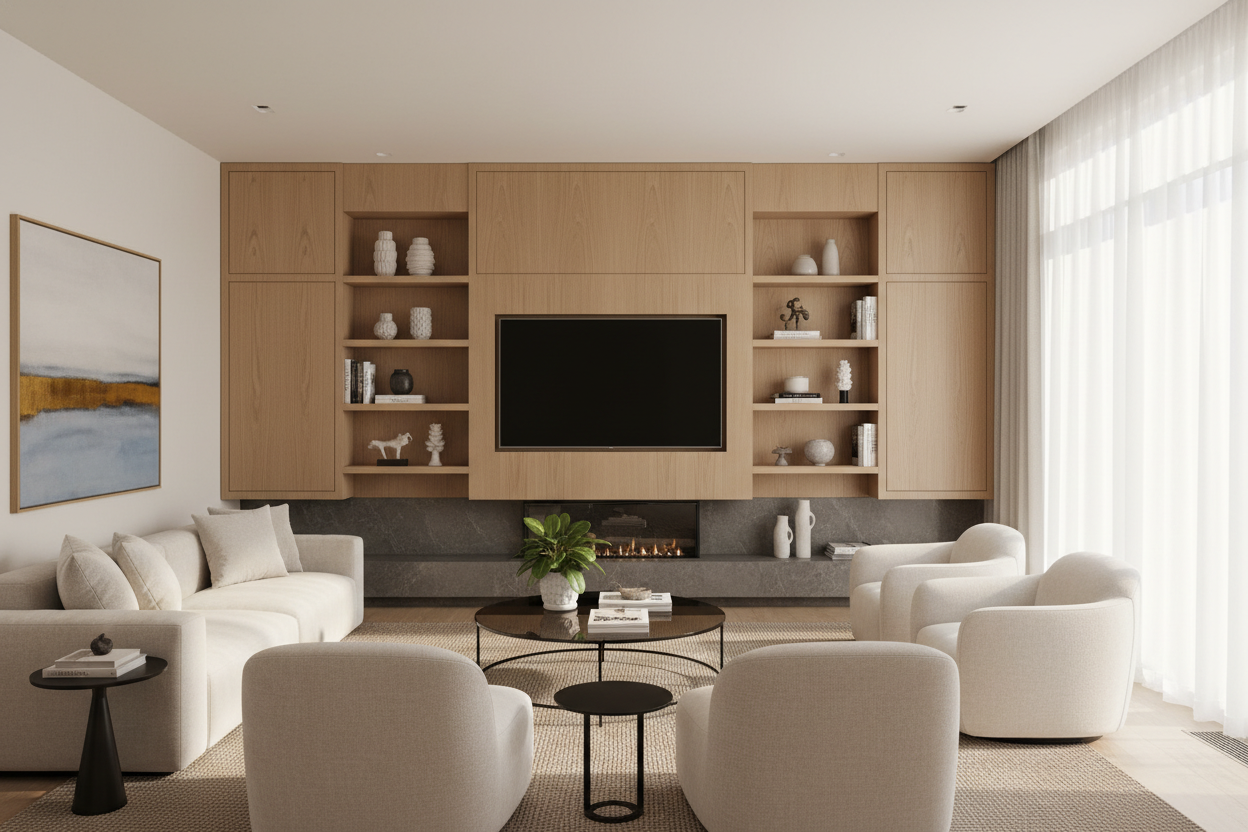
A built-in doesn't just hold the TV; it frames it. By surrounding the screen with cabinetry or shelving, the TV stops being a giant black hole in the room and starts being part of a larger composition. I opted for a mix of closed cabinetry on the bottom (to hide the ugly stuff) and open shelving on top (to show off the pretty stuff). It grounded the room in a way a flimsy stand never could. The weight of the cabinetry draws the eye up, making my 8-foot ceilings feel significantly taller than they actually are.
Planning the Layout: What I Wish I Knew First
If you’re going to do this, do it right. The biggest mistake people make with a built in wall tv unit is building it too tight. I’ve seen beautiful custom woodwork that was built specifically for a 50-inch TV in 2015, and now the owners are stuck because a modern 75-inch screen won't fit the hole. You have to think five to ten years ahead.
Airflow is the second thing most people forget. Your Xbox, your PlayStation, and your router all generate heat. If you shove them into a closed cabinet without ventilation, you’re basically putting them in a slow cooker. I learned this the hard way when my router started cutting out every time we watched a 4K movie. I had to go back in with a hole saw and add decorative brass grilles to the cabinet doors to let the air circulate. It looks intentional now, but it was a stressful weekend fix.
Think about your 'zones.' I divided my unit into three: the Tech Zone (bottom cabinets with wire pass-throughs), the Display Zone (the open shelves for books and ceramics), and the Focal Zone (the TV area). For the built in wall tv unit, I also made sure to include a 'chase'—a hollow channel behind the back panel where I can run new cables later if I need to. Technology changes, and you don't want to be tearing out drywall just to upgrade to a new HDMI standard.
Always Measure for the 'Next' TV
Never, ever build your unit to fit your current screen like a glove. Screens are getting larger and thinner every year. If you have a 55-inch today, design the opening for at least a 75-inch. You can always fill the extra space with a larger soundbar or a bit of dark-painted backing to make the gap look intentional. I left 6 inches of clearance on all sides of my current screen, and I’m already eyeing an upgrade. Because I planned for it, the swap will take ten minutes instead of a full renovation.
Custom Carpentry vs. High-End Modular Systems
When I started pricing this out, local carpenters were quoting me $8,000 to $12,000. That’s a lot of money to commit to a single wall. I started looking at alternatives that didn't involve a month of sawdust in my house. You can actually get 90% of the look for 40% of the price by using high-end modular built in wall units for tv. These are systems that look like custom work but arrive in finished sections.
I've seen people have great success by combining several high-quality Tv Stands and wrapping them with crown molding and a unified baseboard. It’s the 'hack' that professional designers use to save clients money while still delivering that architectural feel. If you want something even sleeker, starting with a Floating Tv Stand Wall Mounted Media Console Entertainment Center as your base gives you that modern, airy look. You can then build shelving around it to create the 'built-in' effect.
The key is the finishing touches. If you use modular pieces, the secret is in the trim. Adding a single piece of continuous molding across the top of three separate cabinets makes them look like one custom unit. I spent $200 on extra trim and paint that perfectly matched my cabinets, and nobody who walks into my house believes I didn't hire a master carpenter. It’s about the details—using high-quality hardware and ensuring the joints are caulked and seamless.
Was the Investment Actually Worth It?
Looking back, my only regret is that I spent years 'saving money' on cheap consoles that ended up in a landfill. The built-in unit changed the way the room functions. It’s cleaner, it’s more organized, and it feels like a 'grown-up' space. The room actually feels larger now because the furniture isn't jutting out into the walking paths; it’s part of the perimeter.
Is it a permanent commitment? Yes. But so is a bathtub or a kitchen island. We shouldn't be afraid of making our homes work for us right now. If you’re tired of the cord nests and the wobbly legs, stop looking for the next 'perfect' stand and start looking at your wall as a blank canvas. It’s an investment in your daily sanity. Every time I sit down to watch a movie and don't see a single dangling wire, I know I made the right choice.
FAQ
Will a built-in unit hurt my home's resale value?
Generally, no. High-quality built-ins are considered an upgrade. Just keep the design relatively neutral. Avoid super-specific colors or weirdly shaped TV openings that won't fit standard screens. Most buyers love the extra storage and the 'finished' look it gives a living room.
How do I manage heat for my electronics?
Don't seal them in a tomb. Use slatted cabinet doors, mesh inserts, or drill 2-inch vent holes in the back and bottom of the cabinets. You can even buy quiet USB-powered fans that trigger when the temperature rises if you're keeping a high-powered gaming PC inside.
Can I do this in a rental?
Probably not a full custom build, but the modular approach works. You can use 'wall-leaning' units or large modular systems that are secured with just a few anti-tip anchors. When you move, you take them with you, but while you're there, they provide that floor-to-ceiling architectural look.


Leave a comment
This site is protected by hCaptcha and the hCaptcha Privacy Policy and Terms of Service apply.