










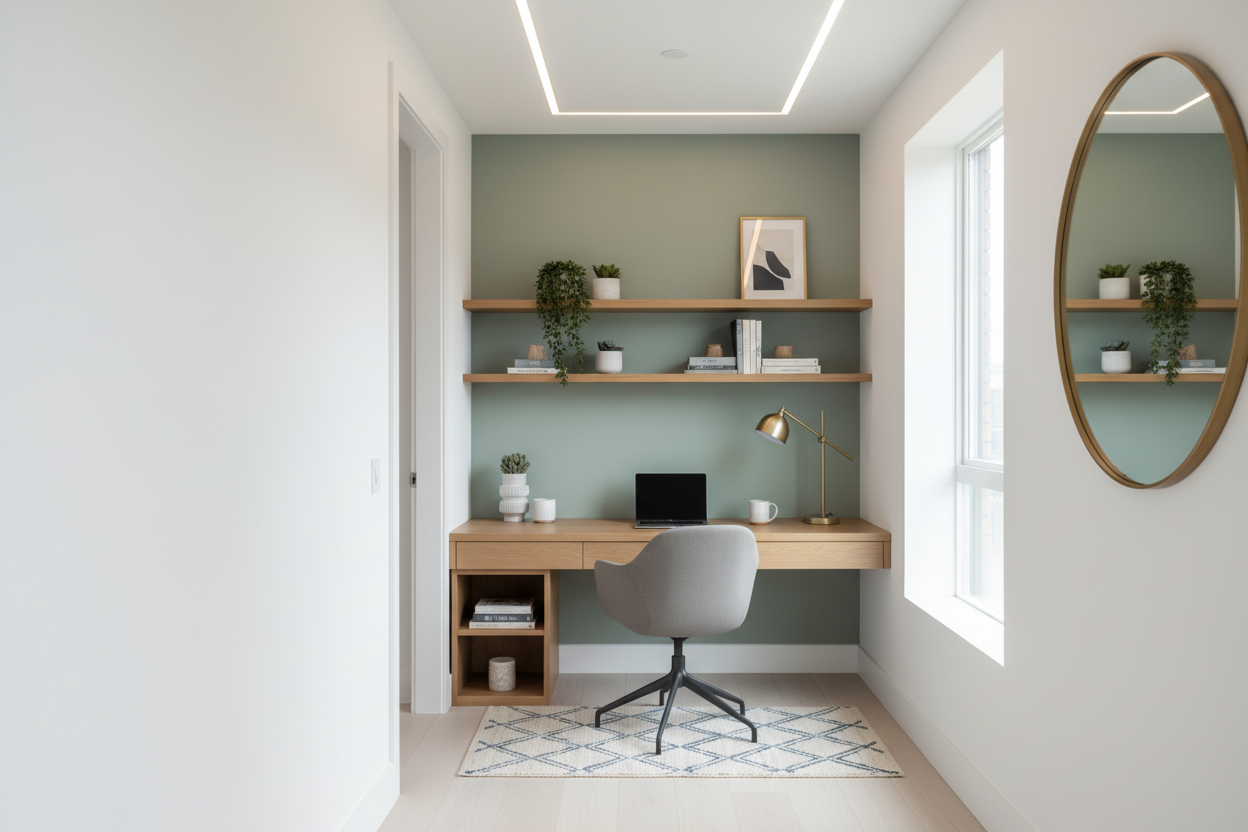
Corridors are often treated as mere arteries of a home—transitional spaces that get you from point A to point B. However, in contemporary interior design, neglecting this square footage is a missed opportunity. Whether you are looking to carve out a functional workspace in a compact urban apartment or simply want to elevate the aesthetics of a corporate corridor, the office hallway represents a unique intersection of utility and style. The challenge lies in balancing the visual weight of furniture with the necessary traffic flow, ensuring the space feels intentional rather than cluttered.
Key Features to Look For
- Traffic Clearance: Ensure a minimum of 36 inches of walkway remains clear behind the chair to maintain flow.
- Visual Weight: Opt for floating desks or legs with open silhouettes to keep the modern office hallway feeling airy.
- Lighting Strategy: Prioritize wall sconces or articulating arms over floor lamps to save precious floor space.
- Material Durability: Select high-rub count finishes and hardwood edges, as hallway furniture endures more accidental bumps than standard office pieces.
Mastering the Layout: The Desk in Hallway Dilemma
Integrating an office in hallway settings requires precise spatial planning. Unlike a dedicated room, a hallway demands that your furniture be unobtrusive. When selecting an office desk in hallway layouts, depth is your most critical dimension. Standard desks are often 24 to 30 inches deep, which can choke a narrow corridor.
I always advise clients to look for console-style desks or custom millwork that sits between 16 and 20 inches deep. This creates a functional office hall design without impeding movement. If you are building a permanent station, consider a floating desktop anchored to the wall. This absence of legs tricks the eye into seeing more floor space, making the hallway appear wider than it actually is.
Material Selection and Aesthetics
Because this workspace is in a high-traffic zone, office hallway design ideas must prioritize materials that can withstand wear. Veneers might peel if brushed against frequently by passersby; therefore, solid wood or high-pressure laminates are superior choices for the desktop edge.
Cohesion with Adjacent Rooms
Your hallway office ideas should not exist in a vacuum. The design should act as a bridge between the rooms the hallway connects. If your living room features walnut accents, carry that timber into the hallway desk. For a seamless office hallway design, consider painting the shelving or cabinetry the same color as the walls (color-drenching). This monochromatic approach allows the workspace to visually recede when not in use, reducing visual clutter.
Lighting and Office Hallway Decor
Lighting a windowless corridor is notoriously difficult. For a modern office hallway, rely on layered lighting. Ambient overhead lighting is rarely enough for focused work. Install articulating wall sconces that can be pulled out for tasks and pushed back flush against the wall when finished.
regarding office hallway decorating ideas, avoid bulky accessories. Use the vertical plane for storage and decor. Floating shelves above the desk can house books and plants, drawing the eye upward. A large mirror positioned on the wall opposite the desk can bounce light and double the perceived width of the space, a classic trick for any narrow office hallway.
My Personal Take on Office Hallway Projects
In my years of designing, the biggest friction point I've encountered with hallway desk ideas isn't the desk itself—it's the chair. I once designed a stunning custom floating walnut slab for a client's upstairs landing. It looked architectural and sleek. However, we initially paired it with a standard ergonomic rolling chair.
It was a disaster. The wheelbase was too wide, constantly tripping family members walking by, and the visual bulk ruined the sleek lines we worked so hard to achieve. I learned then that for a hallway workstation, you must sacrifice a bit of traditional "office" utility for form. We swapped it for a low-profile, armless upholstered dining chair that could tuck fully under the floating top. The lesson? Always measure the chair's footprint when tucked in, not just when it's in use. If the chair back protrudes into the walkway, the design has failed.
Frequently Asked Questions
What is the minimum width a hallway needs to accommodate a desk?
Ideally, your hallway should be at least 60 inches wide to comfortably fit a narrow desk (approx. 18-20 inches deep) while leaving the standard 36-40 inches of clearance required for comfortable walking traffic.
How do I hide cables in an open hallway office?
Cable management is vital in open spaces. Use a desk with a built-in grommet and cable tray underneath. Alternatively, run paintable cord covers along the baseboard or invest in a hollow-leg desk where wires can be routed internally to the floor outlet.
Can a hallway office really be ergonomic?
It is challenging but possible. Since deep monitors are hard to fit, use a monitor arm to pull the screen closer when working and push it flush against the wall when done. Pair this with a compact chair that offers lumbar support without a massive footprint.

Leave a comment
This site is protected by hCaptcha and the hCaptcha Privacy Policy and Terms of Service apply.