










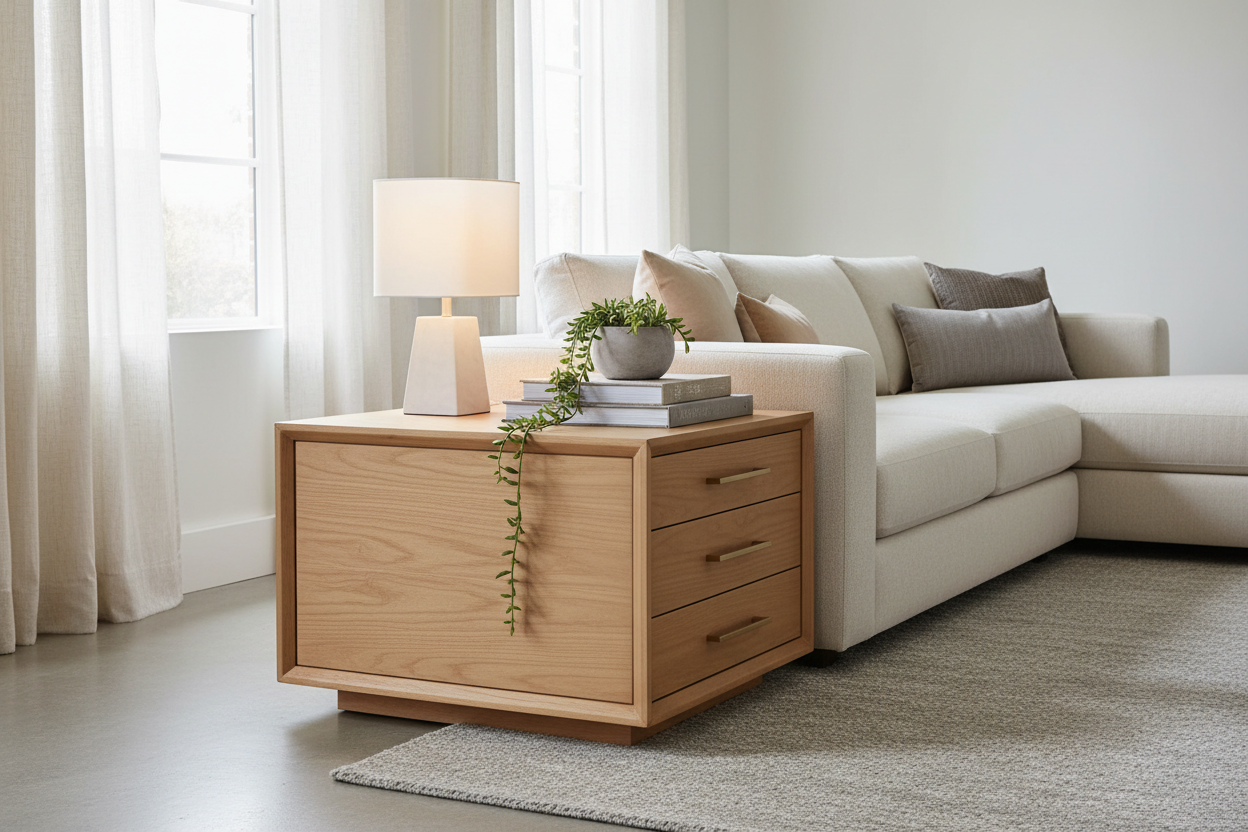
Clutter has a way of accumulating on flat surfaces. You set down a remote, then a magazine, then a pair of reading glasses, and suddenly your carefully designed living space looks chaotic. The solution isn't necessarily to get rid of your things, but to change where they live. An accent table with drawers is the most efficient piece of furniture for solving this specific problem. It provides a dedicated surface for decor—like a lamp or a coaster—while the storage compartment below swallows the necessary mess of daily life.
Choosing the right piece goes beyond just picking a color that matches your sofa. You have to consider the height relative to your seating, the smooth operation of the storage mechanism, and the visual weight of the piece. If you choose correctly, this small item can completely change the flow of a room.
My battle with the wobbly side table
A few years ago, I fell in love with a delicate, mid-century modern side table online. It had spindly legs and a sleek profile that looked perfect for my tight apartment living room. When it arrived, it looked exactly like the picture, but I hadn't accounted for the physics of daily use. The moment I pulled the handle to stash my chargers, the entire table tipped forward.
The piece was too top-heavy, and the drawer lacked a smooth glide, meaning I had to yank it to get it open. It became a source of frustration rather than a helpful tool. I eventually moved it to a corner where it holds a plant and is never touched. That experience taught me that stability and hardware quality are non-negotiable. You need a piece with enough heft to stay grounded when you interact with it, especially if you plan to use the storage daily.
Finding the right fit for tight spaces
Space planning is often where people get stuck. If you are working with a cramped layout, a small accent table with drawer functionality is usually the best replacement for a bulky end table. The key here is checking the footprint. You want a piece that offers vertical storage rather than horizontal spread. A narrow silhouette allows you to slide the table between a recliner and a wall, or tuck it next to a sofa arm without blocking the walkway.
Pay close attention to the height. The ideal surface should sit at or just below the arm of your sofa or chair. If it is too high, you will knock your elbow against it; too low, and it becomes awkward to reach your drink. For a standard sofa, look for tables between 22 and 24 inches high. If you are using it as a nightstand substitute in a small bedroom, measure your mattress height first. The goal is seamless interaction where you don't have to strain to reach the surface or the handle.
Assessing build quality and hardware
The difference between a piece that lasts a year and one that becomes an heirloom often lies in the mechanics. When you are shopping, look closely at how the accent table drawers are constructed. In lower-end furniture, the storage box often sits on a simple wood or plastic rail. While this saves money, humidity can cause the wood to swell, making the compartment stick or jam. Over time, this friction creates wood dust and frustration.
Metal glides are generally superior for ease of use. Ball-bearing slides allow for a full extension, meaning you can reach the items all the way at the back without fishing around blindly. If you prefer the look of an antique or a rustic farmhouse piece that utilizes wood-on-wood runners, ensure there is a stop mechanism. There is nothing worse than pulling a drawer out a little too enthusiastically and having the entire box—and its contents—fall onto your toes. Dovetail joinery is another visual cue of quality; if you see interlocking teeth where the drawer front meets the side, you are likely looking at a sturdy piece.
Styling the surface and the interior
Once you have the furniture in place, the challenge shifts to styling. Because an accent table with drawers offers hidden storage, you don't need to clutter the top with practical items. You can reserve the surface for aesthetics. A good rule of thumb is the rule of three: a light source (lamp), a height object (vase or sculpture), and a low object (tray or book). This creates visual interest without overcrowding the small surface area.
Don't neglect the interior organization. A junk drawer becomes useless if you can't find what you need. Use small organizers or dividers inside the compartment. This is the perfect spot for items that are ugly but necessary: remote controls, lip balm, charging cables, and coasters. By giving these items a home, you keep the visual noise of the room down. If the table is in an entryway, the drawer becomes the drop zone for keys and mail, keeping the foyer looking curated rather than chaotic.
Material mixing and visual weight
Your table doesn't need to match your other furniture perfectly. In fact, it looks better if it doesn't. If you have a heavy, upholstered fabric sofa, consider a table made of wood or metal to provide a textural contrast. A glass-topped table can make a small room feel larger because it takes up less visual space, but keep in mind that you lose the ability to hide things unless the storage component is opaque.
Solid wood adds warmth and sturdiness, anchoring a floating seating arrangement. Painted finishes can introduce a pop of color to a neutral room. If your room feels too boxy or angular, try a round table to break up the straight lines. The juxtaposition of shapes and materials is what makes a room feel designed rather than just furnished.
The versatility factor
The beauty of these pieces lies in their mobility. A small accent table with drawer storage is lightweight enough to move around as your needs change. It can start its life as a side table in the living room, move to the bedroom as a nightstand, and eventually end up in a hallway holding a plant and spare keys. Unlike a massive coffee table or a media console, this is a low-commitment piece of furniture that offers high functionality.
Investing in a quality accent table is an investment in your daily peace of mind. It solves the practical issue of where to put your coffee and where to hide the clutter, all while adding a layer of style to your home. Focus on the mechanism, watch the height, and choose a material that makes you happy every time you walk into the room.
Frequently Asked Questions
How tall should an accent table be relative to a sofa?
The general guideline is that the table surface should be within two inches of the sofa's arm height. Ideally, it should be level with or slightly lower than the armrest to make reaching for items comfortable and to prevent knocking things over with your elbows.
Can I use an accent table with drawers as a nightstand?
Absolutely. As long as the height aligns with your mattress (usually 24-28 inches), these tables work perfectly as nightstands. They are often a better choice for small bedrooms because they tend to have a smaller footprint than traditional bedside chests.
How do I stop the drawers from smelling musty over time?
If you are buying vintage or using the table for long-term storage, moisture can be an issue. Lining the bottom with scented drawer paper or tossing in a small cedar block or silica gel packet can help absorb moisture and keep the interior smelling fresh.

Leave a comment
This site is protected by hCaptcha and the hCaptcha Privacy Policy and Terms of Service apply.