










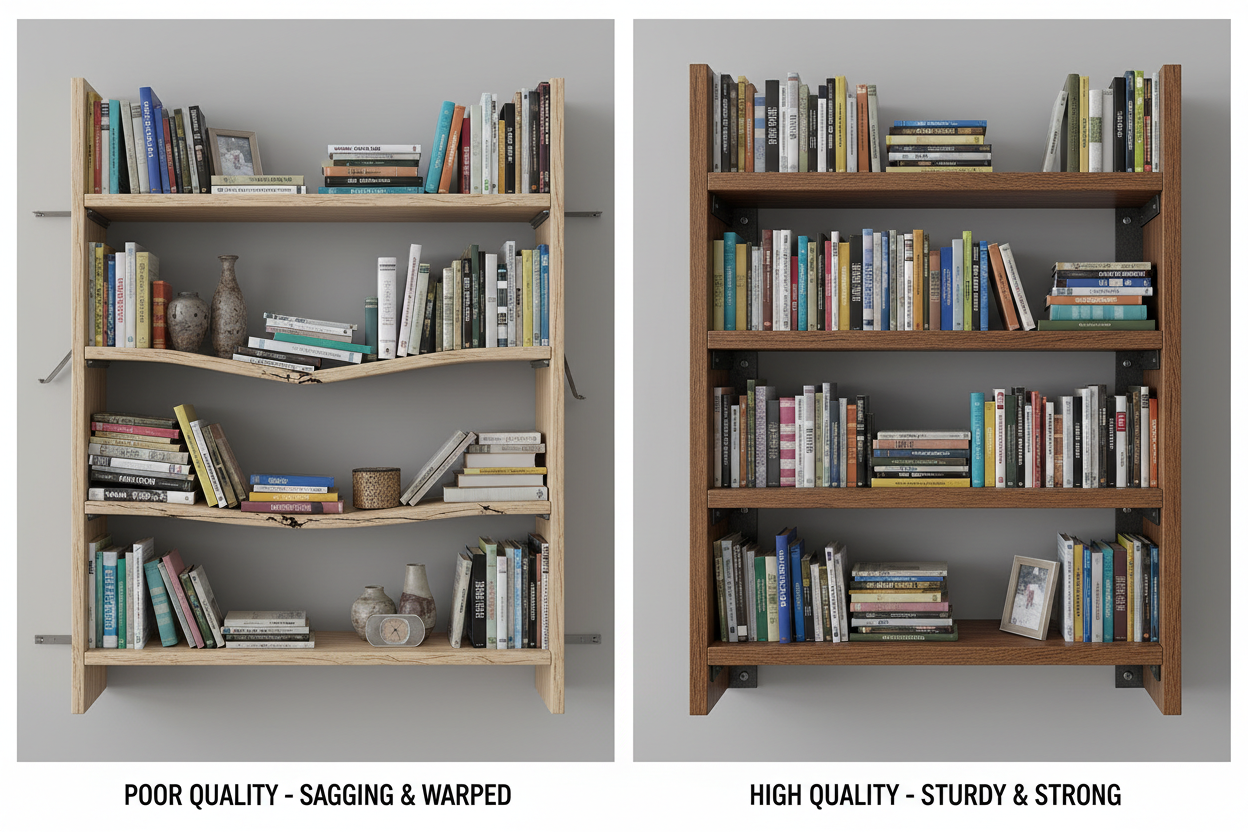
True furniture quality comes down to three specific factors: material density, joinery technique, and structural reinforcement. If you are tired of replacing bowing laminate units every few years, the secret to identifying a quality bookcase lies in looking past the finish and examining the bones of the piece. A unit built to last generations will invariably use solid wood or high-grade plywood rather than particle board, feature a structural back panel rather than a flimsy tack-on sheet, and utilize shelves that are at least three-quarters of an inch thick to prevent deflection under heavy loads.
I learned this lesson the hard way during my college years. I bought what I thought was a decent storage unit from a big-box store, attracted by the sleek cherry finish. It looked great for about three months. However, as soon as I loaded the middle shelves with my heavy art history textbooks and vinyl records, the particle board core surrendered. The shelves bowed into a permanent smile, and eventually, the cam-lock fasteners ripped right out of the side panels, sending my collection tumbling to the floor. That disaster taught me that a high quality bookshelf requires more than just a pretty veneer; it demands engineering capable of fighting gravity.
The Core Materials Matter Most
The primary indicator of longevity is what lies beneath the surface. Most budget-friendly options are constructed from particle board or MDF (Medium Density Fiberboard). While MDF has its place in painted cabinetry, it lacks the tensile strength necessary for wide spans. Over time, moisture and weight cause these materials to disintegrate and sag.
High-quality bookcases rely on two superior options: solid hardwood or furniture-grade plywood. Hardwoods like oak, maple, and walnut offer incredible rigidity. However, solid wood expands and contracts with humidity changes, which requires specialized construction to prevent cracking. This is why many expert cabinetmakers actually prefer high-grade plywood with a hardwood veneer. Plywood is dimensionally stable and, pound for pound, often stronger than solid pine. When you are shopping, lift the shelf. If it feels suspiciously light, it is likely a honeycomb cardboard core or low-density fiberboard. A quality bookcase should have significant heft.
The Geometry of Sagging: Shelf Span and Thickness
Even the best wood will bow if the physics aren't right. There is a direct relationship between the thickness of the shelf and how wide it can span before gravity takes over. In the woodworking world, we often refer to the "Sagulator," a calculation used to determine how much weight a shelf can hold.
For a standard 36-inch wide unit, you need quality book shelves that are at least 3/4-inch thick. If the design calls for a wider span, say 48 inches, that thickness needs to increase to an inch or more, or the shelf requires a reinforced front lip (nosing) to add stiffness. If you see a bookshelf that spans three feet but is only half an inch thick, walk away. It is mathematically guaranteed to fail if you plan on storing anything heavier than paperbacks.
Joinery and The Back Panel
How the pieces connect is just as vital as the wood they are made from. Mass-produced furniture often uses cam-locks and dowels. While convenient for shipping, these joints loosen over time. A high quality bookshelf utilizes permanent joinery techniques like dadoes (where the shelf fits into a groove in the side panel), dovetails, or pocket screws reinforced with glue.
Pay close attention to the back of the unit. On cheap models, the back is a folded piece of cardboard nailed on simply to keep dust out. On a structural level, the back panel is crucial for preventing "racking"—the side-to-side wobble that eventually collapses the piece. A premium unit will feature a plywood or solid wood back that is screwed or inset into the frame, providing the shear strength needed to keep the case square and rigid.
Adjustability and Hardware
If the shelves are adjustable, look at the hardware. Plastic pins are a failure point; they become brittle and snap. Metal pins or threaded sleeves are the standard for quality book shelves. Furthermore, a well-made shelf will have a mechanism to lock the shelf in place so it doesn't tip forward when you pull a heavy book off the edge. This might be a small notch in the shelf bottom that sits over the pin, or a locking clip.
Finish and Tactile Feel
The final check is tactile. Run your hand along the edges and underneath the shelves. High-quality bookcases are finished on all sides, even the ones you don't see immediately. The underside of a shelf should be smooth, not rough or raw. If the unit is painted, the finish should be hard and cured, resistant to chipping. If it is stained, the grain should be visible and not muddied by cheap toners used to hide imperfections in the wood.
Investing in better furniture prevents the cycle of buying and discarding. By focusing on material density, proper span calculations, and solid joinery, you ensure your library has a safe, permanent home. A quality bookshelf is not just storage; it is a piece of architecture for your living room.
Frequently Asked Questions
How can I fix a bookshelf that is already sagging?
You can temporarily reinforce a sagging shelf by gluing and screwing a strip of solid wood (a cleat) along the back edge or the front lip of the shelf. Flipping the shelf over can also help gravity correct the bow over time, though this is only a temporary fix if the material is weak.
Is solid wood always better than plywood for bookcases?
Not necessarily. While solid wood is beautiful, high-quality furniture plywood is actually more stable and less prone to warping from humidity changes. Plywood is often the superior choice for the case structure, while solid wood is best for the face frames, trim, and shelf edging.
What is the standard weight capacity for a quality shelf?
A well-made shelf spanning 30 to 36 inches should be able to support 20 to 40 pounds per linear foot without visible deflection. This translates to roughly 50 to 100 pounds for a standard shelf, which is sufficient for a full row of heavy hardcovers or encyclopedias.


Leave a comment
This site is protected by hCaptcha and the hCaptcha Privacy Policy and Terms of Service apply.