










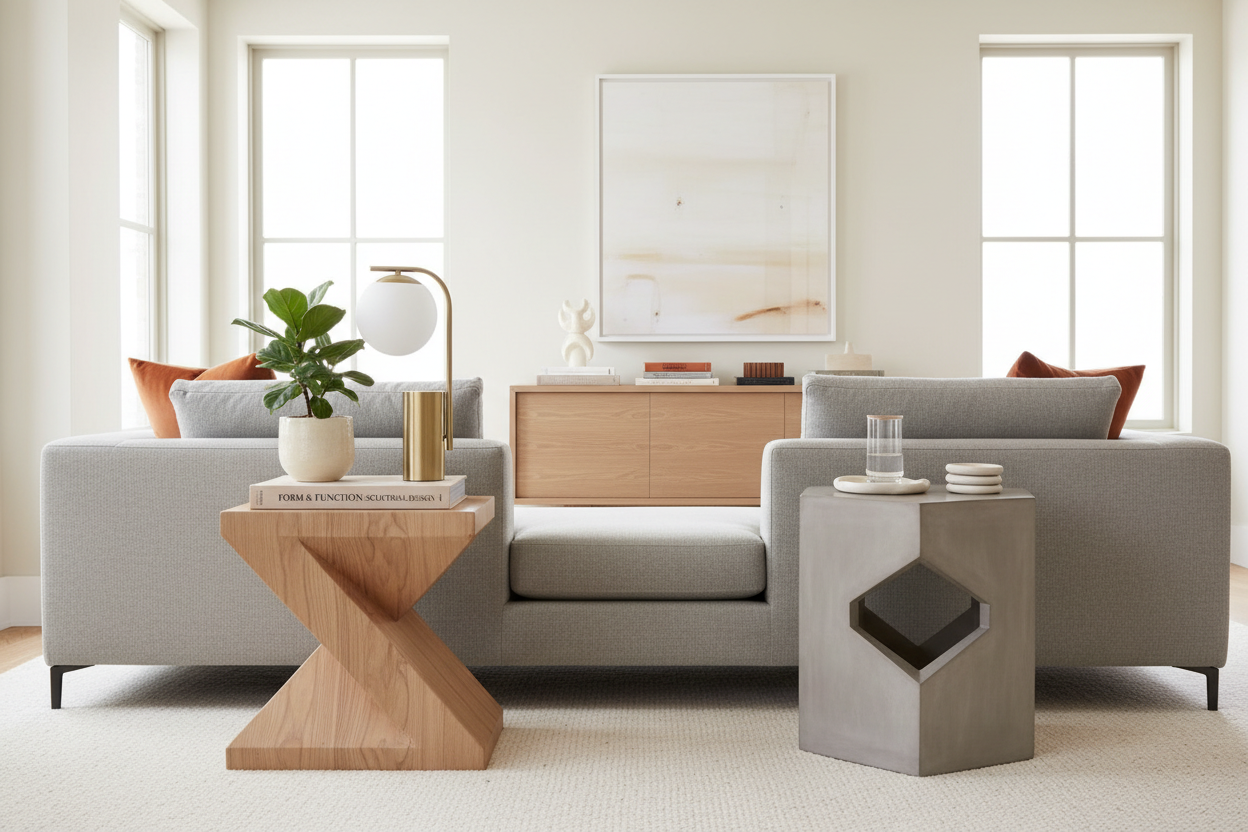
Most of us default to the expected when furnishing a living room: a rectangular rug, a long sofa, and square end tables. While this grid-like approach is safe, it often leaves a space feeling rigid and predictable. A shaped side table is the antidote to this boxy monotony. These pieces, ranging from organic kidney shapes to geometric hexagons and cylindrical drums, do more than just hold your coffee cup. They act as functional sculpture, disrupting straight lines and introducing rhythm to your interior design.
If you are wondering if a non-traditional table is right for you, the answer lies in flow. Unlike sharp-cornered furniture that dictates a strict path, curved or distinctively shaped accent tables guide the eye and allow for smoother movement through a room. They soften the edges of a space dominated by upholstery and cabinetry, offering a deliberate contrast that elevates the entire aesthetic.
Breaking the Grid: My Experience with Organic Forms
I learned the power of shape the hard way during a renovation of my own reading nook. I had a fantastic, overstuffed velvet armchair that was incredibly comfortable but visually heavy. I initially paired it with a standard cubic wooden side table. The result felt clunky; the corner looked crowded rather than cozy. It wasn't until I swapped the square block for a teardrop-shaped mid-century table that the vignette finally clicked. The tapered edge of the table nestled perfectly against the angle of the chair, freeing up floor space and making the heavy chair look lighter by comparison. That small switch taught me that geometry isn't just about dimensions; it's about visual breathing room.
The Functional Art of C-Tables and Pedestals
Not all shaped tables are purely decorative. Some of the most distinct silhouettes are born from necessity. The C-shaped side table is a prime example of engineering meeting aesthetics. Designed to cantilever over the arm of a sofa or the seat of a chair, these tables bring the surface to you. They are indispensable in tight urban apartments where floor space is a luxury. Because they lack a fourth leg and often feature a floating top, they reduce visual clutter while providing a sturdy surface for a laptop or a drink.
Pedestal tables, often featuring round or oval tops supported by a single central column, offer a different kind of utility. Without legs at the corners, they eliminate the "knee-knocking" hazard common in tight seating arrangements. A fluted drum table or an hourglass silhouette adds mass and grounding to a room without the visual noise of four spindly legs. These solid forms work exceptionally well as anchors between two lighter armchairs.
Materiality and Mood
The impact of a shaped side table depends heavily on what it is made of. The curve of the furniture piece interacts with light differently depending on the surface texture.
- Ceramic and Stone: Glazed ceramic stools or marble plinths bring a cool, architectural feel. They are heavy and permanent, ideal for grounding a floaty, bohemian space.
- Bentwood and Rattan: If you want warmth, curved wood or woven fibers are the way to go. These materials emphasize the organic nature of the shape, making the room feel more approachable and lived-in.
- Metal and Glass: For a modern edge, geometric metal frames with hexagonal or octagonal tops create sharp shadows and add a touch of industrial chic. Glass tops keep the look airy, allowing the rug or floor underneath to remain visible.
Styling Geometric and Abstract Shapes
Integrating a geometric accent piece requires a bit of strategy. You don't want the table to look like it landed from outer space; it needs to converse with the rest of your furniture. If you choose a table with sharp, hexagonal angles, try to echo that sharpness elsewhere, perhaps in the pattern of a throw pillow or a picture frame. Conversely, if you opt for a kidney-shaped or amorphous table, it pairs beautifully with other soft forms, like a curved sofa or a round mirror.
Nesting tables offer a fantastic opportunity to play with shape on a larger scale. A set of two or three triangular or pebble-shaped tables can be spread out to serve guests or clustered together to form a multi-tiered coffee table alternative. This flexibility creates a dynamic landscape in the center of the room that static, rectangular tables simply cannot match.
Small Spaces and Visual Weight
In smaller homes, every square inch matters. A shaped side table often has a smaller footprint than its square counterparts. A round or oval table creates a sense of spaciousness because there are no corners jutting out into the walkway. This improves traffic flow, preventing those painful shin collisions.
Furthermore, many sculptural tables utilize negative space. An open-frame geometric base allows light to pass through, tricking the eye into thinking the room is larger than it is. Even solid distinct shapes, like a slender martini table, provide function without dominating the visual field. They act as punctuation marks rather than paragraphs in the story of your room.
Choosing the Right Height and Scale
While the shape is the headline, the dimensions are the fine print you must read. The most common mistake is buying a table that is too tall or too low for the seating it accompanies. A good rule of thumb is that the table surface should be within two inches of the sofa arm height. If the table is too low, it looks like a footstool; too high, and it feels imposing.
Scale also dictates placement. A massive, solid wood block table will overwhelm a delicate slipper chair. Similarly, a spindly wire-frame table will get lost next to a grand, overstuffed sectional. Match the visual weight of the table to the furniture it serves. A shaped table should complement your primary furniture, not compete with it for dominance.
Frequently Asked Questions
Can I mix different table shapes in one room?
Absolutely. In fact, mixing shapes creates a more professionally designed look than matching everything perfectly. Try pairing a rectangular coffee table with round or geometric side tables to balance structure with softness.
Are shaped side tables suitable for heavy use?
It depends on the base. Pedestal and drum tables are generally very stable and can hold heavy lamps or stacks of books. However, three-legged or C-shaped tables are better suited for lighter items like drinks, phones, or a single vase.
Do odd-shaped tables work in traditional homes?
Yes, classic design often incorporates curves. Look for traditional materials like mahogany, brass, or marble in shapes like scalloped edges or turned pedestals to bridge the gap between classic elegance and modern silhouettes.

Leave a comment
This site is protected by hCaptcha and the hCaptcha Privacy Policy and Terms of Service apply.