










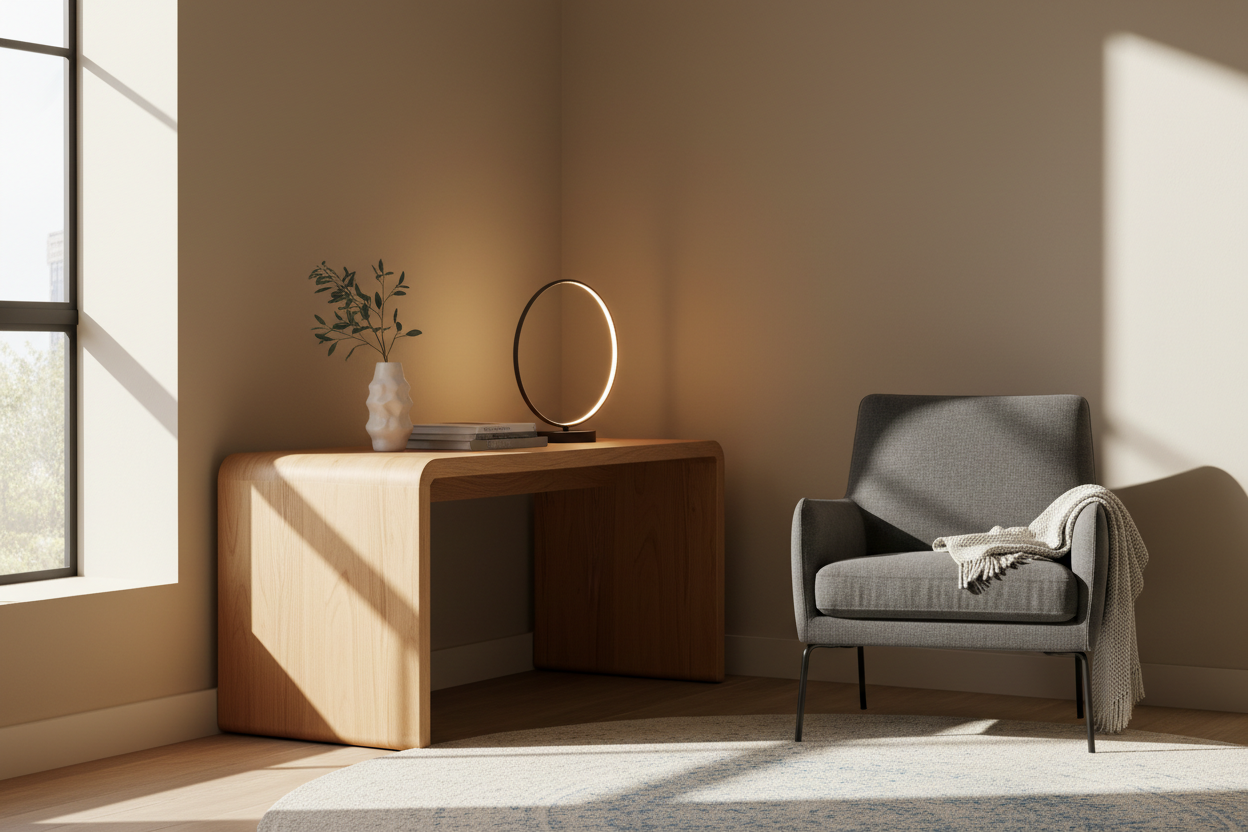
Most of us default to squares and rectangles when furnishing a room. It makes sense logically; rugs are rectangular, rooms have 90-degree corners, and books are flat. But when you are working with limited square footage or awkward transition areas, sharp corners become enemies. They interrupt traffic flow, catch hips and knees, and visually clutter a space. The solution often lies in softening those edges with curved furniture. Specifically, the demilune (half-moon) or wedge-shaped table is an underutilized design tool that maximizes surface area while minimizing the physical footprint.
Integrating curved furniture isn't just about safety or saving a few inches of walking room, though those are major benefits. It is about disrupting the grid of a room. When everything is linear, a curve acts as a visual relief, drawing the eye and making the room feel more curated and less like a showroom setup. Whether you are trying to fill a dead corner or need a landing strip for keys in a narrow hallway, choosing the right curved table requires understanding the subtle differences in shape and proportion.
The Geometry of Space Saving
Not all curved tables serve the same purpose. The distinction between an oval cut in half and a true semi-circle might seem pedantic, but it dictates where the piece fits best. A half oval side table, for instance, typically has a shallower depth than a perfect half-circle. These are elongated, resembling a racetrack shape cut down the center. This specific geometry makes them superior for high-traffic hallways or narrow spots beside a sofa arm. You get the width necessary to display a lamp or a vase, but the table doesn't protrude far enough into the room to become an obstacle.
Contrast this with the standard half round corner table, often referred to as a demilune. These are perfect semi-circles. Because they are deeper, they command more presence and work beautifully as focal points on small walls, such as between two windows or at the end of a corridor. They offer enough surface area to actually function as a workspace or a substantial display area, rather than just a perch for a coaster.
Conquering the 90-Degree Angle
The most difficult space in any living room is the dead zone where two walls meet, or where a sofa and loveseat converge. Placing a square table here often leaves an awkward gap behind the furniture or creates a sharp point that is hard to reach. A quarter circle end table is the geometric answer to this problem. Shaped like a slice of pie, the 90-degree back fits snugly into the corner, while the curved front faces the room. This shape bridges the gap between seating pieces smoothly, allowing for a lamp to be placed deep in the corner while keeping drinks accessible on the curved edge.
A Lesson Learned in a Tiny Walk-Up
My appreciation for curved furniture was born out of necessity rather than design preference. Years ago, I lived in a third-floor walk-up with an entryway that was barely wider than my shoulders. I desperately needed a place to drop my mail and keys, so I bought a sleek, rectangular console table. It looked great in the store.
In practice, it was a disaster. Every time I came in with grocery bags, I snagged a handle on the sharp corner. If I walked too quickly in the dark, my hip found the edge with painful precision. The hallway felt choked. Eventually, I swapped it for a small half circle end table I found at a flea market. The difference was immediate. The curved front guided me into the apartment rather than blocking my path. Even though the surface area was roughly the same, the removal of those two front corners physically and psychologically opened up the space. It taught me that in tight quarters, flow is more important than symmetry.
Material Matters: Visual Weight and Balance
Once you have determined the shape—whether it is a wedge or a half-oval—the material you choose dictates how big the piece feels. In a cramped room, visual weight is just as important as physical dimensions. A solid oak cabinet with a curved front will feel heavy and grounded. This is excellent if you need to hide clutter or anchor a floaty room, but it can shrink a small space.
For airier vibes, look for open bases. A metal frame with a glass top or a slender wood design with long, tapered legs allows the eye to travel through the piece to the wall behind it. This trick of the eye makes the room appear larger. If you are using a half oval side table next to a bulky upholstered armchair, a lighter, leggy table provides a necessary contrast to the heavy fabric of the chair.
Styling Your Curves
Styling a curved table requires a slightly different approach than a rectangular one. On a square table, you might balance items in a grid. On a curved surface, think in triangles. Place your tallest item (usually a lamp) toward the back, widest part of the table. Cluster smaller items, like a stack of coasters or a small succulent, in a triangular formation towards the front curve.
If you are utilizing a quarter circle end table in a dark corner, lighting is non-negotiable. Because these tables sit deep in the corner, they are prone to shadows. A tall, slender lamp adds height and brightens the recess, effectively pushing the walls back out visually. For entryways using a half-round table, a mirror hung directly above is a classic move for a reason: the curve of the table combined with the reflection in the mirror creates a complete circle effect, adding a sense of wholeness and harmony to the entry.
When to Choose the Wedge
Don't reserve the wedge shape solely for corners. These pie-shaped tables can be surprisingly effective when placed beside a recliner that is angled into a room. The flat sides can align with the angled chair, while the curve softens the look from the rest of the room. It creates a custom, built-in look that square tables simply cannot achieve in an angled arrangement.
Ultimately, the goal is to stop fighting your room's architecture. If a walkway is tight, don't force a square peg into a round hole. Let the furniture guide the movement through the room. By shaving off the corners, you gain flow, save your shins, and add a layer of sophisticated softness to your home.
Frequently Asked Questions
Does a round or curved table take up more space than a square one?
Generally, no. While the widest point of a curved table might match a square table, the missing corners significantly reduce the total footprint. This creates more negative space around the piece, making the room feel less crowded and facilitating easier movement around the furniture.
Can I use a half-round table if I have wainscoting or chair rails?
Yes, but you need to measure the height of the obstruction. If the table legs hit the wainscoting or baseboard, the table won't sit flush against the wall, which can cause items to fall behind it. Look for tables with an overhang at the back or legs that are inset slightly to accommodate baseboards.
How do I style a table that sits flush against a wall?
Treat the wall as part of the vignette. Lean a piece of art against the wall or hang a mirror above the table to anchor it. Ensure you don't clutter the front curved edge; keep the functional space clear and push decorative items toward the back, flat edge where the table meets the wall.


Leave a comment
This site is protected by hCaptcha and the hCaptcha Privacy Policy and Terms of Service apply.