










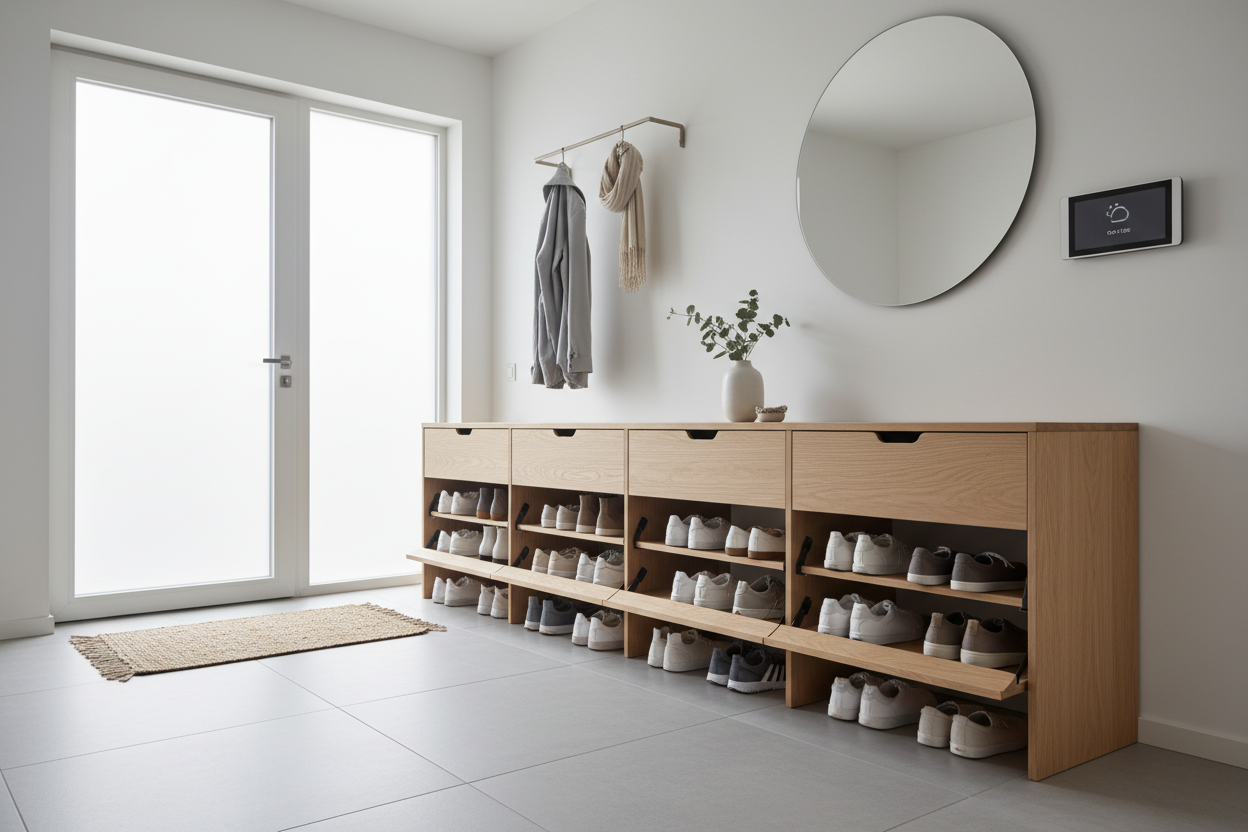
The hallway is the most traversed yet most neglected thoroughfare in a home. It sets the tone for the rest of your house, yet for many, it serves as little more than an obstacle course of discarded sneakers, piles of unopened mail, and coats draped over banisters. If you find yourself holding your breath or stepping gingerly every time you walk through the front door, your entry space isn't working for you.
The most effective approach to fixing this isn't just buying bins; it is about creating distinct zones within a narrow footprint. You need to exploit vertical wall space, utilize slim-profile furniture, and be ruthless about what is allowed to stay in the corridor versus what belongs in a closet. By shifting your focus from floor storage to wall utility, you can transform a cramped passage into a functional, welcoming entrance.
Defining Your Drop Zone
Every hallway needs a designated spot for the items you shed the moment you walk inside. Without a specific place for keys, wallets, and sunglasses, these items inevitably migrate to the kitchen counter or get lost in sofa cushions. The challenge with hall organization ideas usually lies in the lack of square footage. You likely don't have room for a massive dresser, but you don't need one.
Look for a narrow console table. Even a shelf that is only six inches deep can serve as a perfect landing strip. I once lived in a townhouse where the entry was so tight that opening the front door nearly hit the opposite wall. My solution was a floating shelf mounted at waist height with a small ceramic bowl glued to it. It wasn't furniture in the traditional sense, but it stopped me from throwing my keys on the floor. Pairing a slim surface with a mirror above it also helps reflect light, making the tight area feel significantly larger.
Conquering the Shoe Mountain
Shoes are the primary culprit of hallway chaos. They are bulky, dirty, and tend to multiply. If you have a "shoes off" policy in your home, the pile at the door can become a safety hazard quickly. Traditional shoe racks often stick out too far, eating into your walking path. This is where tip-out shoe cabinets shine. These units are incredibly slender—often less than 10 inches deep—because they store shoes vertically rather than horizontally. They hide the visual clutter completely and offer a surface on top for decor or mail.
For families with active kids, open baskets tucked under a bench might work better than cabinets. Children are rarely patient enough to open a drawer and place shoes inside nicely. A designated "toss basket" for each family member keeps the floor clear without requiring unrealistic discipline. When looking for hallway organisation ideas, always factor in the behavior of the people living there. If the system is too complex, nobody will use it.
Going Vertical with Coats and Bags
Coat stands are classic, but they are also space hogs. In a narrow hall, a coat stand loaded with winter jackets looks like a hulking monster in the corner. Wall-mounted solutions are far superior for maintaining a streamlined look. A shaker-style peg rail running the length of the hallway is a brilliant architectural feature that doubles as storage. It allows you to hang items anywhere along the wall, not just in one clustered spot.
The High-Low Hook System
One specific technique that works wonders is staggering your hook heights. Install a row of heavy-duty hooks at standard height for adult coats and heavy bags. Then, install a secondary row of fun, decorative knobs about three feet off the ground. This lower tier is strictly for the kids. It empowers them to hang up their own backpacks and jackets because the hooks are within reach. It clears the higher hooks for your longer coats and prevents that top-heavy, overloaded look that happens when you try to hang three layers of gear on a single peg.
Managing the Paper Trail
Mail and school permission slips are silent clutter. They accumulate in flat piles that slide around and eventually get stepped on. To combat this, get the paper off the horizontal surfaces immediately. A wall-mounted file organizer or a series of shallow floating pockets can act as a triage center. Label them: "Outgoing," "Bills," and "Action Required."
This prevents the console table from becoming a graveyard for junk mail. Keep a small recycling bin nearby—perhaps hidden inside a cabinet or disguised as a nice wicker basket—so you can discard flyers before they ever make it deeper into your home. The goal is to filter the intake right at the threshold.
Lighting and Visual Tricks
Organization isn't just about storage; it is about perception. A dimly lit hallway feels smaller and more cluttered than a bright one. If you lack natural light, upgrade your overhead fixture to something that casts a wide, diffused glow. Avoid spotlights that create harsh shadows in the corners.
Runner rugs are another tool in your arsenal. A long runner with a linear pattern draws the eye forward, creating an illusion of length. It also protects your floor from the heavy traffic and wet shoes. Just ensure you use a high-quality rug pad underneath; a sliding rug in a high-traffic zone is a recipe for disaster.
The Sunday Reset Routine
Even the best hall organization ideas will fail without maintenance. Hallways are transient spaces; things land there that don't belong there. A library book that needs returning, a box for donation, a tool borrowed from the garage. These items have a habit of becoming permanent fixtures.
Implement a "Sunday Reset" rule. Once a week, clear the hallway completely. Jackets that aren't in season go back to the main closet. Shoes that weren't worn this week go to the bedroom. The random screwdriver goes back to the toolbox. This weekly purge prevents the slow creep of clutter that eventually overwhelms the space. It turns the hallway back into a breezeway rather than a storage unit.
Frequently Asked Questions
How do I organize a hallway with no closet?
Focus entirely on wall-mounted solutions. Use a combination of high-mounted shelving for seasonal items (like hats in baskets) and sturdy wall hooks for daily coats. A slim tip-out shoe cabinet can replace the floor storage a closet usually provides without blocking the walkway.
What is the best way to make a narrow hallway look wider?
Mirrors are the best solution; a large mirror on one wall reflects light and tricks the eye into seeing double the space. Additionally, keep the floor visible by choosing furniture with legs or floating wall-mounted units, as seeing the floorboards extend to the wall makes the footprint feel larger.
How do I protect my hallway walls from scuff marks?
High-traffic hallways often suffer from bag and shoe scuffs. Installing wainscoting or beadboard on the lower half of the wall provides a durable shield that is easier to clean than drywall. Alternatively, using a semi-gloss or satin paint finish allows you to wipe away marks that would stain flat paint.



Leave a comment
This site is protected by hCaptcha and the hCaptcha Privacy Policy and Terms of Service apply.